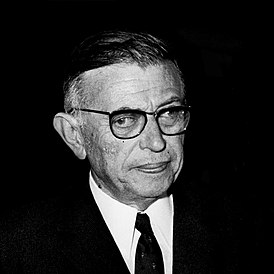
A little boy in an Alsatian house, surrounded by books, called them "his birds." Books would become his air and his destiny; but before he became the loudest writer of his century, Jean-Paul Sartre lived through a strange discovery — that man has no ready-made soul left only to be unfolded. Born in Paris in 1905 and losing his father early, he passed through the best philosophical schooling in France, and then went off to Berlin — to where German thought taught men to peer into consciousness itself. From there he returned with an instrument with which he would cut into the whole European tradition.
This instrument he inherited from Edmund Husserl and Martin Heidegger — phenomenology, the art of describing things as they appear to consciousness, without intermediaries or theories. But Sartre made of it something his own. His first novel, "Nausea" (1938), is not a case history but a philosophical experiment in its pure form. The hero suddenly sees the world without the veil of meaning: the root of a tree, things "viscous and solidly inert," bare, superfluous, unjustified matter. Nausea is the vertigo of a man who has met being for the first time, being stripped of all human projections. The world simply is, and it owes us nothing.
Out of this experience grows the formula that became the banner of an epoch: existence precedes essence. A knife has a design before the knife exists — the maker knew what he was forging it for. Man has no design. First he is, thrown into the world, and only afterward, by his own acts, does he shape what he will become. There is no nature that would excuse cowardice or explain nobility: the coward makes himself a coward by every cowardly choice. "For man there is no alibi" — in this short phrase lies all the ruthlessness of Sartre's ethics.
Hence, too, his hardest thesis: man is condemned to be free. Freedom for Sartre is not a gift and not a right but a sentence one cannot refuse. Even the refusal to choose is a choice. In his major work, "Being and Nothingness" (1943), he distinguishes two forms of existence: being-in-itself — the dense, dormant being of things, and being-for-itself — consciousness, whose nature is nothingness. Man is that crack in the dense world through which negation, distance, the possibility of being otherwise, enters into being. We never fully coincide with ourselves, and in this non-coincidence lie both our freedom and our anguish.
Freedom, however, is hard to bear, and man invents ways to flee from it. This self-deception Sartre called bad faith (mauvaise foi). The waiter who plays at being a waiter so zealously that he might be a waiter-thing; the man who says "I cannot" where it would be more honest to say "I do not want to" — all of them hide their freedom, pretending to be objects with a given essence. Bad faith is a flight into the soothing lie that I could not have acted otherwise. In this Sartre was an heir of Søren Kierkegaard: authenticity is won only by the one who dares to look at his own freedom without deception.
But freedom never hangs in a void. Man, Sartre insisted, exists "in a situation" — within history, the body, the gazes of others. "Hell is other people": the other's gaze turns me into an object, a frozen thing in his world, and I forever resist this petrification. Out of this tension was born the idea of engagement: the writer and the philosopher have no right to sit it out; the word is an act, capable of "infecting society with a bad conscience." Later Sartre would try to graft existentialism onto the thought of Karl Marx, granting that man is also shaped by material conditions — but to the end he would insist that individuality is not reducible to impersonal structures.
In 1964 he refused the Nobel Prize, unwilling to be "numbered among the bourgeois elite" — a gesture in which all of Sartre is contained. And when he was buried in 1980, more than fifty thousand people spontaneously joined the procession: the philosopher had touched the heart of a whole people. His legacy lies not in ready answers but in the relentless question he returned to each of us. If you have no given essence, no justification, and no alibi — then everything you are, you have made yourself. This is both a frightening and a liberating message: meaning is not found, it is created, and one must create it here, among others, under their gaze, with one's single irreparable life.