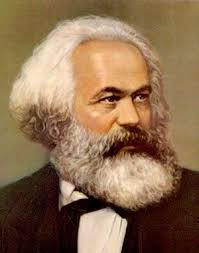
Karl Marx was born in 1818 into the family of a lawyer. The Prussian laws of those years barred his father, a man of a certain background, from legal practice, and he changed his religious confession in order to keep his profession. This early episode left its mark: the future philosopher was persuaded early on of the relativity of religion and of the cold power of external institutions. He studied in Bonn and Berlin, took philosophy from one of the Left Hegelians, and from the very start absorbed the central question of the age — what to do with the legacy of Hegel in a world where, before the eyes of a single generation, the whole old order was collapsing.
Marx expressed his position in a famous image: he "set Hegel back on his feet." He did not deny his debt to his teacher, but he turned Hegel's dialectic upside down. In the Critique of Hegel's Philosophy of Right he pointed to two errors: it is not the constitution that creates the people, but the people that create the constitution; and the people are not a projection of the spirit, but the reverse. In Hegel, real, living human beings became the predicates of a universal substance, the spirit — Marx restored their primacy. Here he also inherits from Ludwig Feuerbach, who had already reduced theology to anthropology; but where Feuerbach located alienation in religion, Marx transferred it into the very structure of society and labour.
Out of this grew his materialist view of history. The formula "being determines consciousness" meant this: history is moved not by people's thoughts and theories but by the development of production itself. There is a stratum of life common to all living things — eating, drinking, bearing children; but the way in which a human being produces changes from age to age, and it is precisely this that is purely human. One must therefore fix one's attention not on the constant but on the changing — on technology and the economy. The development of the productive forces (materials, machines, labour) sooner or later ceases to fit within the old relations of production; these become fetters — and a social revolution follows.
Hence, too, his image of society as base and superstructure. Legal, political and religious institutions, so weighty on the surface, are merely a superstructure over the base of the means and conditions of production. Philosophy and ideology, which justify the order of each age, are for Marx a "smokescreen" concealing the interests of the ruling class. The history of all societies that have existed appears as the history of class struggle, and its deepest mainspring always turns out to be material forces.
The concept of alienation Marx also takes from Hegel — in particular Hegel's dialectic of master and slave, in which the slave actually produces the thing, while the master, who produces nothing, falls into dependence on him, so that the enslaved man enslaves his master. Private property, according to Marx, makes labour compulsory. A paradox arises: in his animal side — in eating and drinking — a person seems free, while in what is properly human, in labour, he is unfree, for he sells his hands and the fruits go to another. Money, meanwhile, becomes "the alienated essence of human labour and life," the false sovereign of all things.
Marx viewed religion by the same logic: the struggle against religion is a struggle against the society that gives rise to it. Hence the formula about religion as "the opium of the people" — and, alongside it, his unexpectedly sympathetic words about it as "the sigh of the oppressed creature, the soul of a heartless world." He called his own teaching "scientific socialism," setting it against the "utopians," and in the Manifesto and Capital he built a theory of surplus value, of revolution, and of the alliance of philosophers with the proletariat: "the philosophers have only interpreted the world; the point is to change it."
Marx's significance in the history of thought is twofold. Time has disputed much in his constructions, and his economic theories met serious criticism. But the very idea that economic relations play an enormous role in the life of society has entered philosophy firmly. From Feuerbach he took the anthropological turn; from Hegel he took dialectic and alienation; and for forty years his closest ally was Friedrich Engels, without whom his chief work would never have been completed.