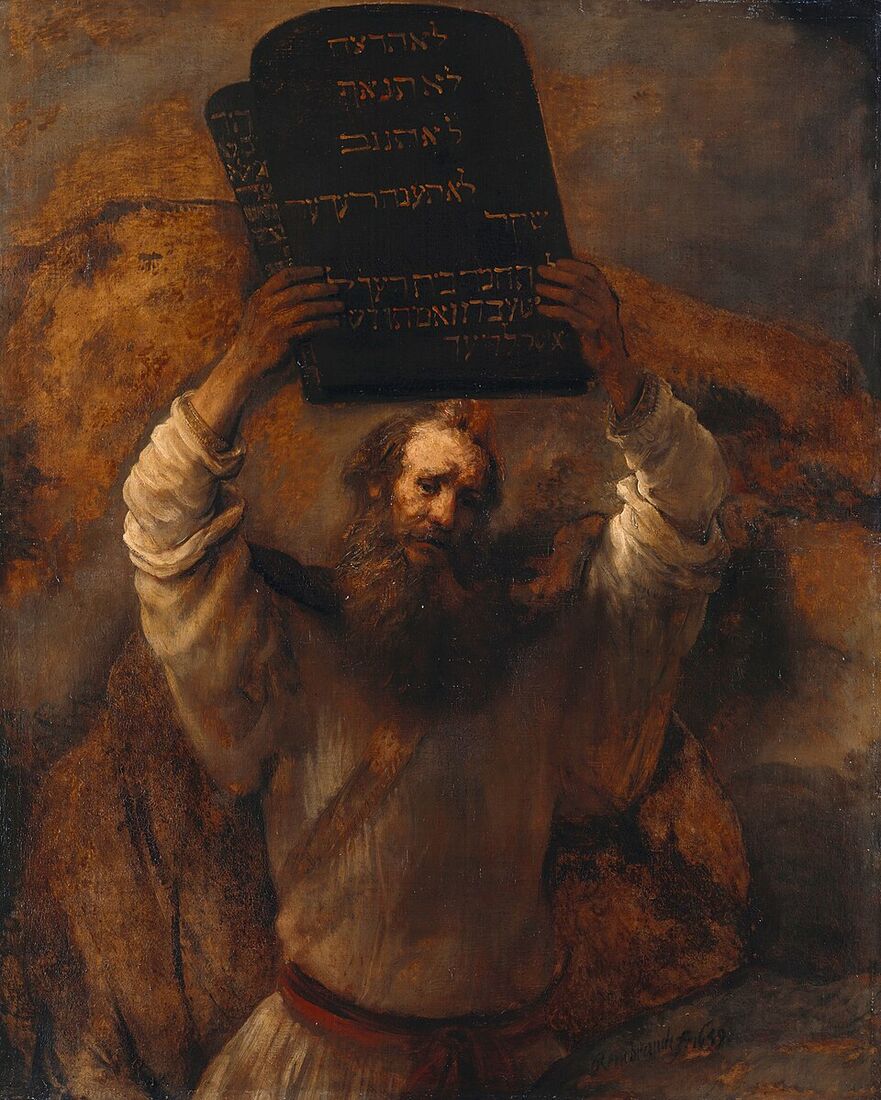
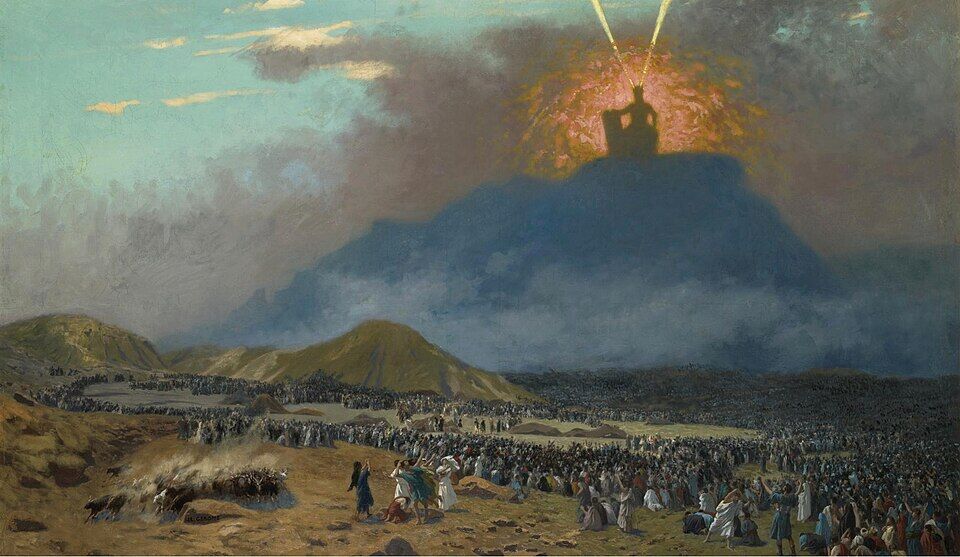
At the foot of Sinai — thunder, lightning, smoke: the mountain burns, and the people stand at a distance in terror. Here, in fire, the covenant is concluded, and the ten commandments are given. This is not a code of prohibitions; it is the spiritual core of the covenant, the conditions of life with God: after the first man preferred his own will to God's, the commandments restore the very possibility of following Him.
They are arranged with an almost geometric clarity: four concerning man's relation to God, six concerning his relation to his fellow man. And these six are no riddle but simple, universally human things: do not lie, do not steal, do not kill, do not covet what belongs to another. For we ourselves have no wish to be lied to or robbed — yet somehow we demand this only on our own behalf. The whole law folds into one sentence: do not do to another what you do not wish for yourself. This is not a cage but a path back — out of an embittered world where each man is for himself, back toward paradise.
But here is what happens while Moses is on the mountain for forty days. The people are afraid before a God who cannot be seen, who speaks from the cloud — they want control, a god familiar and comprehensible, one that can be managed. And the whole people, in a common deed, takes off its gold and melts it down — casts a golden calf, a bull such as was worshipped in Egypt. The sin is not in the metal, but in this: that free people, to whom God Himself spoke face to face, choose an idol they can hold in their hands over the Living One, before Whom one must stand in trust.
And yet the covenant is not annulled. God condescends: He gives a detailed Law, the Torah, spelled out to the smallest particular — not as an abolition of freedom, but as an instruction in holiness for spiritual infants, a barrier at the edge of the abyss. But even this is not kept under duress: for a long time Israel will have no king to compel it, for its King is God Himself, and the law is fulfilled freely — or not fulfilled at all.
So on Sinai there arises, for the first time, the question that torments man always: from where does morality derive its authority, if there is no overseer above you — and why does a free man bind himself with a rule? Of this — the next station.
The spine of it all — the arc. The same law through the four voices: philosophy · literature · painting · music.
all 21 stations · Russian version