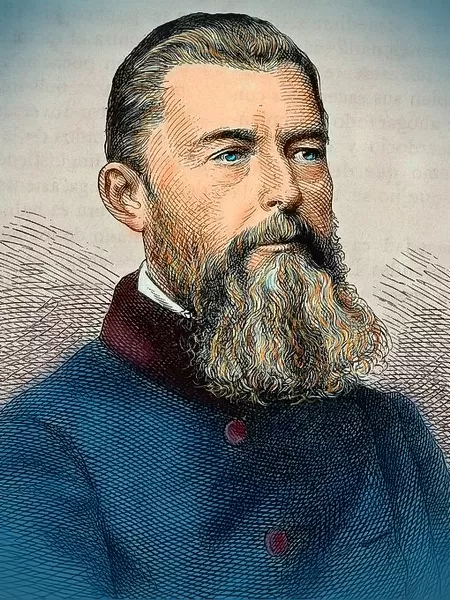
When Hegel died, his followers split into two camps — the right and the left. The right completed their master in the direction of the state and the church; the left, or "Young Hegelians," turned his dialectic against itself. The most brilliant figure of this left wing became Ludwig Feuerbach (1804–1872). He began as a theologian, studying divinity at Heidelberg, but on hearing Hegel's lectures he was so shaken that he wrote to his father: in four weeks he had learned more than in the two previous years of study. From this shock began a movement that in the end carried him beyond his teacher — to a complete rethinking of what religion is.
Already at twenty-six Feuerbach published the work Thoughts on Death and Immortality, which cost him his academic career. In it he voiced an idea that would later prove very influential: the individual man is mortal, but humanity is immortal. Each person is a cell contributing to the whole; in that whole he finds his immortal continuation. So arises the idea of social immortality: both the one who writes books or paints and the simple labourer who bears and raises children continue themselves in the species. Not personal salvation, but the species, humanity as a whole, becomes the bearer of the eternal.
Feuerbach described his own intellectual evolution in three words: "the first thought was God, the second reason, the third and last man." Hegel put absolute spirit in place of God — that is, he replaced living reality with an abstraction. But the true object of thought, Feuerbach held, is neither God, who does not exist, nor spirit, which is an abstraction, but the concrete human being: nature, body, sensuousness, needs. Hence his materialist conclusion, which overturned theology: it is not God who creates man, but man who creates God. The unity of the finite and the infinite is realized not in absolute spirit but in man himself — in his natural sociality, for the individual man is finite while humanity is infinite.
His chief book, The Essence of Christianity (1841), Feuerbach built upon a single formula: theology is anthropology. To understand God, one must study man. The consciousness of God is the consciousness of the species: the human race carries within itself an idea of the beautiful, the ought, the perfect, the absolute — and this idea, according to Feuerbach, it alienates from itself, casts outward and calls God. Here he uses Hegel's concept of alienation: people create an image of boundless mind, will and love, and then worship this sublimated perfection of their own as something alien and higher than themselves.
In this light he reinterpreted prayer as well. It seems to a person that he is addressing God — in fact he is addressing the depth of his own heart, mobilizing his own will, and the fulfilled desire he calls a miracle that has come from without. "There is only you" — such is the conclusion. The old saying homo homini lupus est ("man is a wolf to man") Feuerbach reworked into homo homini deus est — "man is a god to man." And of religion itself he said with a bitter tenderness: "God is a tear of love, fallen into the most secret depth of the human soul, where mystery and helplessness dwell." Where there was love in the name of the Lord, there must come love in the name of man; his ideal is not half-angels but human beings in the fullness of flesh and blood.
Feuerbach himself died forgotten and in poverty, invited only once to deliver lectures "On the Essence of Religion" in his native town. But his line of thought proved a decisive link in the history of the nineteenth century. It was precisely from his anthropological critique of religion that the young Karl Marx pushed off, transferring the concept of alienation from the sphere of faith to the sphere of labour and property. And it is precisely this dissolution of man into the species that another line of post-Hegelian thought opposes — Søren Kierkegaard, with his defence of the single, unrepeatable "I" before the face of God. So the figure of Feuerbach stands at a crossroads: from him roads lead both to materialism and to a new dispute about man.