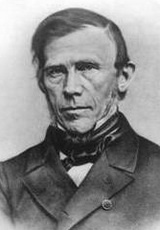
Søren Kierkegaard was born in Copenhagen on 5 May 1813, the last, seventh child in a family where the father was more than twelve years older than the mother and where five of the elder children had died. A secret hung over the house, which the father once let slip: as a ten-year-old shepherd boy, driven to despair by poverty, he had cursed God; and later he had seduced a servant — the philosopher's future mother. These two "crimes" lay, in the son's words, like a cross upon the grave of all his desires. He wrote of himself that a day would come when not so much his writings as his life would be described in the fullest detail — and he left a diary of twenty volumes, spanning his whole short life until his death at forty-three.
Personal drama completed this sense of doom. At twenty-seven he became engaged to eighteen-year-old Regine Olsen, but three years later returned the ring, saying he could not make the girl happy. "Regine did not become my wife because God got there first," he wrote; she married another and outlived her would-be bridegroom by half a century. An ascetic by vocation, he held that the saint and the genius are born not from possessing a woman but from renunciation.
His chief adversary was the system — above all the philosophy of Hegel, whom he called a charlatan. The philosopher, he said, had erected a pompous fortress and then settled next door, in a hovel: no one lives inside his own monolithic constructions. Out of "Hegel's beak," which explained the necessity of the whole world, had dropped any understanding of the single individual. Kierkegaard overturned the familiar law: in the animal world the individual ranks below the species, but man is created in the image of God and therefore stands above any collective — nation, state, or humanity. For himself he dreamed of the epitaph "that individual."
The path to God he pictured as an ordinary Danish house. In the cellar lives the aesthetic man — an anonymous part of the crowd, seeking pleasure and tasting the world with his eyes alone: art, comfort, "The Diary of a Seducer" with its game of the sexes. Dissatisfied with himself, he climbs to the first floor — the ethical: work, marriage, a sense of duty; but his own strength is not enough, and again and again he slips back down into the cellar. Higher up is the religious floor, where men live no longer by duty but by love of God. The passage there is a leap of faith, the risk of casting aside both duty and pleasure: "without risk there is no faith."
The image of this faith is Abraham, whom God commands to sacrifice his son. The book "Fear and Trembling" (1843) grows out of the question: how can a good God demand a killing, a breach of every moral law? And yet the knight of faith casts aside his fatherly feeling and stands before God as though nothing else existed. In "Either/Or" (1841) he set against Hegel's reconciliation of opposites the hard ethical choice between truth and falsehood. Truth, for him, is subjective: the right to bear witness to it belongs not to the well-settled man but to the one who is poor, humiliated, and torn apart, for the man who is at ease will not find himself in a ready-made world.
The bottom of man he named outright: despair — the guilt before oneself, the unwillingness to accept one's own existence and to give oneself into God's hands; one can break through it only by trust in Him. And fear gives rise to the desire to be like everyone else, if only to avoid standing face to face with God. "A mass of apes gives the impression of mighty force, but it creates no force" — strength lies in the single man shot through with God. In the age of positivism he kept repeating: the fact that the Earth revolves around the Sun changes nothing in our moral foundations, and science is not given to know the spiritual essence of man.
Toward the end he broke with the official Church, declaring that there was no more Christianity in Denmark — only a "playing at Christianity," where faith had been replaced by culture and comfort. Unlike Schopenhauer with his Buddhist exit — to extinguish the will, to cease desiring — he pointed to a Christian way out: union with God. Long remaining on the periphery, after the great war he became the center of a new mode of thinking; he was prized by Heidegger and Jaspers, and he is rightly called the father of European existentialism, of the very word "existential." In his hymn to the single individual before God, an ancient line of the heart came alive again, the line traced by Blaise Pascal — and the mystery of human existence this Dane laid bare in full.