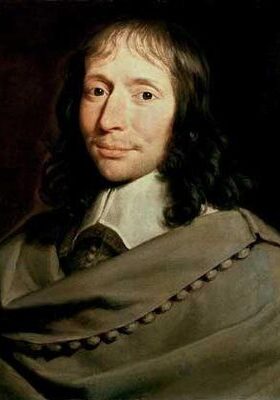
Blaise Pascal was born in 1623 in provincial Clermont, into a family where education was laid out like a precise blueprint: his father had planned in advance when his son would take up mathematics. But the boy outran the schedule. Even as a child, once his textbooks had been taken from him, he chalked circles on the floor, calling them "rounds," and worked his own way to Euclid's theorems. At sixteen he wrote a treatise on conic sections and entered the circle of Parisian mathematicians, where he met René Descartes; at nineteen he invented a calculating machine built of dozens of gears, to help his father with tax computations. Then came the barometer and the experiments with a vacuum that refuted the ancient claim that "nature abhors a vacuum." In a world that seemed as though everything could be calculated, he was unquestionably a genius.
And this mind made an unexpected turn. Pascal was a sickly man, tormented by headaches and ailments that in his lifetime had no name. Two events overturned his life. First came the sudden healing of his niece, whose facial bone was disintegrating, after she touched a thorn from the Crown of Thorns: the scholar saw it with his own eyes. Then came the night of illumination of November 23, 1654, which he recorded on a scrap of parchment and sewed into his clothing: "Fire. God of Abraham, God of Isaac, and God of Jacob, not of the philosophers and the scholars... Joy, tears of joy." After this he all but abandoned science, regarding it as pride.
From this experience his central thought was born. Man, says Pascal, is the weakest thing in nature, a "thinking reed": a drop of water, a breath of wind is enough to crush him. But even if the universe were to kill him, he would still be higher than it, for he knows that he is dying, while the universe knows nothing of its victory. Here lies the knot of his thought: greatness and wretchedness meet at a single point. Man is great not when he amounts to something, but when he grasps how small he is.
From this comes the famous saying: man is neither angel nor animal, and he who wishes to become an angel turns into an animal. By its own strength the reed cannot reach heaven; it can become something only through the grace of God. Reason is precious not because it produces logical proofs of the existence of God — Pascal found these fruitless — but because through it man is able to know his own nothingness and to prepare within himself a place for grace, like an empty vessel.
Therefore faith, for Pascal, lives not in the reason but in the heart: "the heart has its reasons, which reason does not know." "I do not know, but I believe" — such is its formula. He warned against two extremes — "excluding reason and admitting only reason." The mind cannot be disdained, for only through it do we know our own weakness; but neither can it be made the sole measure, for faith says what the senses cannot say. This logic of the heart set Pascal against the rationalism of Descartes: faith, he repeated, cannot be born of arguments.
Theologically Pascal allied himself with Jansenism, a movement that grew out of the three-volume work of Bishop Cornelius Jansen on the blessed Augustine. Following Augustine, who had once disputed with the monk Pelagius, the Jansenists taught that human nature is deeply corrupted by sin, that man of himself is powerless even to choose between good and evil, and is saved only by predestination and grace. The popes condemned five propositions of this teaching; the Jesuits, with their casuistry, which sought in each act the point at which free will operates, took up arms against the Jansenists. Defending his own, Pascal wrote the brilliant "Provincial Letters," and from his scattered notes, written near the end of his life, the "Pensées" were assembled.
Pascal's significance outlasts his own age. By lifting from man the responsibility for his deeds and leaving it to reason alone, he, strangely enough, individualized faith: each person, in the union of mind and grace, builds his own measure of good and evil — and therefore no one has the right to judge another's choice. This was a step toward human freedom, and the line runs on further — to the rebellious question of Nietzsche ("why did You make me thus?") and to the existential limit of Kierkegaard. A reed from which God Himself weaves a basket — such was how one of the greatest minds of Europe saw himself, asking in his final written note for one thing only: "that You would make me an instrument in Your hands."