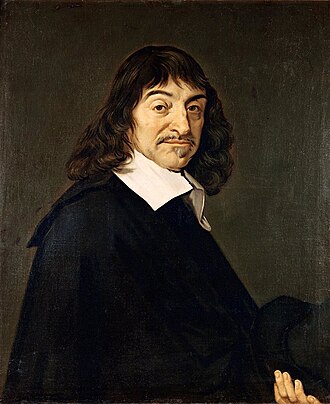
With Descartes a new, modern philosophy begins. Where the Middle Ages sought support in authority and faith, Descartes resolved to rebuild everything from scratch — on a foundation that could not be doubted. His method is audacious: to doubt absolutely everything, until something utterly indubitable is left.
And he doubts radically. The senses deceive — so the world around us cannot be trusted. What if I am asleep and all of this is a dream? What if even mathematics is planted in me by some "evil demon," a deceiver, and two plus two only seems to be four? Everything can be called into question. Everything — except one thing.
As long as I doubt, I am thinking; and as long as I think, I undoubtedly exist. Even if the demon deceives me in everything, there must be someone he is deceiving. "I think, therefore I am" (cogito ergo sum) — this is the unshakable point from which Descartes rebuilds all knowledge anew. For the first time the support is found not in God and not in the world, but in the thinking "I" itself.
From there he restores the world: since there is within me an idea of a perfect God, and an imperfect being could not have generated such an idea on its own, it follows that God exists. And a good God would not deceive me totally — and so the world, when known clearly and distinctly, can be trusted. Thus for Descartes God is the guarantor of the certainty of knowledge.
His chief legacy (and his chief problem) is dualism. There are two entirely distinct substances: the thinking (spirit, soul, the "I") and the extended (matter, bodies). The body is a machine, a mechanism working by the laws of physics; the soul is something else, immaterial. This split will free the hands of science (the body-mechanism can be studied like a clock), but it leaves an unsolvable question: how does an immaterial soul govern the body? All who came after would struggle over this.
Descartes split the world in two — and by this set the agenda for the whole modern age. Spinoza will try to fuse spirit and matter back into a single substance; Leibniz will shatter the world into monads; and Kant, a century and a half later, will overturn the question itself — asking not about the world, but about the limits of the reason that knows it.