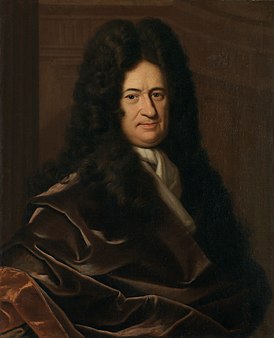
Gottfried Wilhelm Leibniz was born in 1646 in Leipzig, into a family in which both his father and grandfather were professors of philosophy — from childhood he grew up in a sphere of lofty metaphysics. Having completed a course in theology while still a boy, he studied law and at the age of twenty defended his doctoral dissertation, but a professorial chair struck him as dull: he dreamed of uniting science, culture, and politics into a single whole. Legal counselor, diplomat, librarian, privy councilor to the sovereigns of Prussia, Vienna, and Russia — he traveled the length and breadth of Europe. And yet he died in solitude in 1716: behind the coffin of the greatest of men walked a single secretary.
His life passed under the sign of two passions. The first was the dream of reconciling a divided Christendom and creating a European federation to put an end to the bloody wars of religion. The second was mathematics: almost simultaneously with Newton, but independently of him, he discovered differential and integral calculus — the dispute over priority stretched into a feud between academies. His acquaintance with Leeuwenhoek's microscope became a foundation of his philosophy: the discovery, in a single drop of water, of an entire invisible world.
His chief achievement was synthesis. Whereas René Descartes and Benedict Spinoza discarded ancient thought for the sake of pure mechanics, Leibniz restored two forgotten categories. The first was the final cause, the purpose for the sake of which a thing exists: blood moves not for the sake of motion, but to give life to the body; the body exists for the sake of the soul, the soul for the fulfillment of God's will. Without purpose, science loses its meaning. The second was substantial form, entelechy, that essence which makes a thing itself. Unashamed of being taken for a scholastic, he acknowledged more truth in Aristotle than in the newest philosophers.
Out of this his system grows. Beyond extension and motion lies a metaphysical force, whose bearers are monads, indivisible spiritual centers. They "have no windows": none acts upon another, yet each, like a living mirror, reflects the whole universe in its own way. Monads differ in the clarity of their perception: a stone perceives dimly, animals possess memory, man possesses consciousness — apperception — and only God sees all things clearly. There are no two identical monads — otherwise they would merge into one; hence the inestimable worth of every creature, unrepeatable as a leaf or a fingerprint. And space itself, for him, is merely the order of the coexistence of bodies, not an absolute receptacle, as it was for Newton.
The connection among monads is secured by pre-established harmony. Like two pendulums tuned to swing in unison, the whole world has been wound up by God so that everything coincides without any intervention from without. From this follows the famous thesis: God, absolutely good, chooses from among countless possibilities the best of all possible worlds. Allied to this is the principle of sufficient reason: nothing happens without a cause. But here the system develops a crack. Refusing to recognize free will, Leibniz is compelled to justify the unjustifiable: Judas betrayed freely, and yet was created just so for the sake of the world's harmony. This theodicy was later mocked by Voltaire, who brought forth Doctor Pangloss with his "all is for the best in this best of all possible worlds."
In the dispute over the origin of knowledge, Leibniz stood between the two poles. John Locke taught that the soul is a blank slate, tabula rasa, and that there is nothing in the intellect that was not first in the senses; Descartes insisted on innate ideas. Leibniz found a formula of his own: there is nothing in the intellect that was not first in the senses — except the intellect itself. The soul is like not plain white marble but veined marble, out of which the sculptor carves a figure following the veins already laid down in the stone. With this qualification he was paving the way toward Immanuel Kant.
Leibniz's significance is immense: his universal encyclopedism and his great synthesis of ancient and modern thought laid the foundation for the science of the centuries that followed. But above all, he gave philosophical grounding to the inestimable worth of every creature in an age when religious wars reduced man to nothing. And yet, having failed to encompass the mystery of evil and freedom, he remained a captive of his century: the conviction that everything actual is rational and necessary determined the course of European thought for a long time to come. It would be Blaise Pascal who would attempt to turn that course.