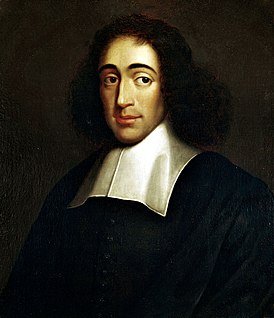
His family, Jews who were persecuted on the Iberian Peninsula even after accepting baptism, settled in Holland — the freest country in Europe at the time. Here, in the Amsterdam community, was born the man whom, at twenty-four, they wanted to call as rabbi, and who refused. The defiance was so great that one fanatic tried to kill him, and for the rest of his life he kept the cloak slashed by the dagger. In 1656 he was excommunicated from the synagogue — and he remained neither Jew nor Christian, outside every community. He earned his living grinding lenses; glass dust brought him to the grave through consumption. He refused a chair at Heidelberg, and the money of patrons. When he died, only books were found in his room. He lived his life exactly as he taught.
And what he taught, above all, was ethics — the truth that gives man happiness. Wealth, pleasures, honors grant a moment's delight, like divine grace, but they are inevitably followed by dejection, confusion, and numbness; only love of the unchanging gives rise to joy that does not diminish. He built his conclusions in an unusual way — by the geometric method: his "Ethics" is demonstrated like Euclid's geometry, with axioms and theorems. He rejected at once scholastic abstraction, the rhetoric of the Renaissance, and the verbosity of commentary. Not to laugh, not to weep, but to understand — such was his principle. In this he inherited the revolution of René Descartes, and he read Thomas Hobbes with interest.
Here he takes his decisive step. Descartes had two substances — thinking and extended — and struggled with how to join them. Spinoza says it more simply: substance is one, and it is God, causa sui, cause of itself. Thought and extension are merely two of His attributes, two out of an infinite number, unknowable to us; individual things are modes, states of substance. Thus is born the famous Deus sive Natura, "God or Nature": everything that exists, exists in God, and without God no single thing could either exist or be conceived.
Here God is immanent in the world — He is in everything, not outside creation. Spinoza introduces the distinction between natura naturans and natura naturata: nature that begets and nature that is begotten. The world was not created by will or by love — these are merely poetic expressions, since will and love are themselves modes. The world flows from the essence of God with the same necessity with which a theorem follows from a triangle. Therefore Spinoza's God is not a person, but an impersonal absolute necessity, a source of peace and repose. This is the direct opposite of the biblical Creator, who stands above the world — and it was for this that he was excommunicated.
Knowledge proceeds by three stages. The lowest is empirical: a vague perception of external appearances, prone to error. The second is rational, scientific: clear ideas of number, form, motion, chains of causes — geometry and physics. The highest is intuitive knowledge, a direct illumination from God: anyone who looks at the numbers 1, 2, 3 will at once name the fourth, without calculating — for all knowledge is already in God, and the human soul is part of the divine intellect.
From this follows the denial of free will: the soul is determined to desire one thing by a cause, that cause by another, and so on to infinity. The only "freedom" is the right to error, a lapse into inadequate ideas. True freedom is necessity understood: "make your thoughts clear, and you will cease to be a slave of passion." And the summit of it all is amor Dei intellectualis, the intellectual love of God: when a man loves God, this is itself the infinite love of God for Himself. To love one's fate — what much later Friedrich Nietzsche would call love of fate. All religions, he observed, are in essence alike, and he honored Christ as the mouth of God Himself, and spoke of man's deification.
In politics he demanded freedom as the goal of the state: power should not turn rational beings into automatons, but free them from fear. Unappreciated in his lifetime, he became in the 20th century one of Europe's greatest philosophers: his face was struck on the largest Dutch banknote, and a prize for freedom of thought bears his name. To arrive at union with God, this mind abandoned every ready-made tradition — and proved what human reason is capable of, even when it has fallen out of every familiar shell. Close by, in that same Dutch freedom, Gottfried Leibniz was building his universe of monads — but that was already a different road to the same eternal end.