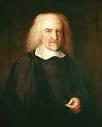
He was born in the spring of 1588, prematurely — out of fear: the Spanish Armada was approaching the shores of England, and his mother's terror hurried his birth. Already an old man, he would write that his twin, born together with him, was fear. That phrase is the key to everything. The son of a village priest, he graduated from Oxford and spent most of his life on the continent, where he met Galileo and sent his objections to the writings of René Descartes. A contemporary of Francis Bacon, he was a child of the terrible age of the wars of religion, when Europe was losing a quarter of its population, and in his homeland the civil war between king and parliament was ablaze. This experience settled on his heart once and for all: he was convinced that man is by nature evil.
He made natural science the foundation of the new thought. If Galileo had proved that a new physics was possible on simple, measurable first principles, then a new political science was also possible, built as strictly as the geometry of Euclid — from axioms that cannot be proved yet are accepted by all. Philosophy, in his conviction, is a science only of bodies and motion; everything spiritual is excluded from it. Hence his mechanistic materialism and his nominalism: a word is merely a conventional sign on which men have agreed. To think is to reckon, to add and subtract concepts; there are no innate truths, only convention.
From this follows the harshest conclusion. If will, love and hatred are only varieties of motion, then there is no freedom. Man is like the newly invented clock: the little wheels turn as if reasonably, but everything is predetermined by the first push. A stone falls from a mountain not because it wanted to — and so we too merely imagine that we choose for ourselves. Here he parts ways with Descartes, for whom the thinking "I" is free. And since there is no will, there is no objective good and evil either: the good is only what a man deems good for himself. One value is beyond doubt — life itself, the highest good, and one unconditional evil — death.
On this axiom he builds everything. In the state of nature — without a state and without a covenant — everyone has a natural right to all things: to preserve his life by any means. But if all are greedy and each sees a rival in the other, the right to everything turns into a war of all against all. The famous formula is man is a wolf to man. Man, for him, is an egoistic monad, and here he deliberately disputes with Aristotle, who called man a social animal like the bee: bees live in concord, whereas men envy one another and are at odds. The proof is caustically simple: even in your own house, among your kin, you bolt the door. And war makes the good of life itself impossible: where it rages there are neither crafts nor arts — only savagery and ruin.
Salvation lies in reason. The natural law commands us to seek peace, and from it dozens of rules are derived: keep covenants, be grateful, be yielding, forgive the repentant, judge impartially. But "covenants without the sword are but words." Therefore men conclude a social contract — and, most importantly, they conclude it not with the power but with one another: all at once renounce part of their rights in favor of a single person or assembly, which alone will keep the sword. This person he called the Leviathan — after the biblical monster from the Book of Job, mightiest of earthly creatures. The state, for him, is a "mortal god": all-powerful, yet mortal. And where it exists, the reverse formula holds — man is a god to man.
The Leviathan's power must be absolute and indivisible, standing above the covenant and above the law: laws bind the subjects, not the sovereign, otherwise he would become an interested party and cease to be the punishing sword. And yet this is not naked despotism. Heavy duties are laid upon the ruler: the security and welfare of his subjects and, without fail, their enlightenment — the people must understand why power is one. The subjects retain inalienable rights: they are free in all that the law does not forbid, and no one can be compelled to kill himself — even a condemned man has the right to defend his life, for it is dearer than the state.
Thus from fear and from a sober, almost cynical view of man there was born a hardy system that in many ways laid the foundation of Western political consciousness: the covenant that must be kept, an independent court, the ruler's responsibility for the good of the people. But in the very depths of this machinery, where both the little wheels are bad and the clockmaker is no better, another idea ripened — of the good man, who creates the state not at all in order to halt the war of all against all. It fell to John Locke to unfold it, who would contest the very meaning of the covenant and the absolute power embedded in it — and from that dispute the further European thought of freedom would proceed.