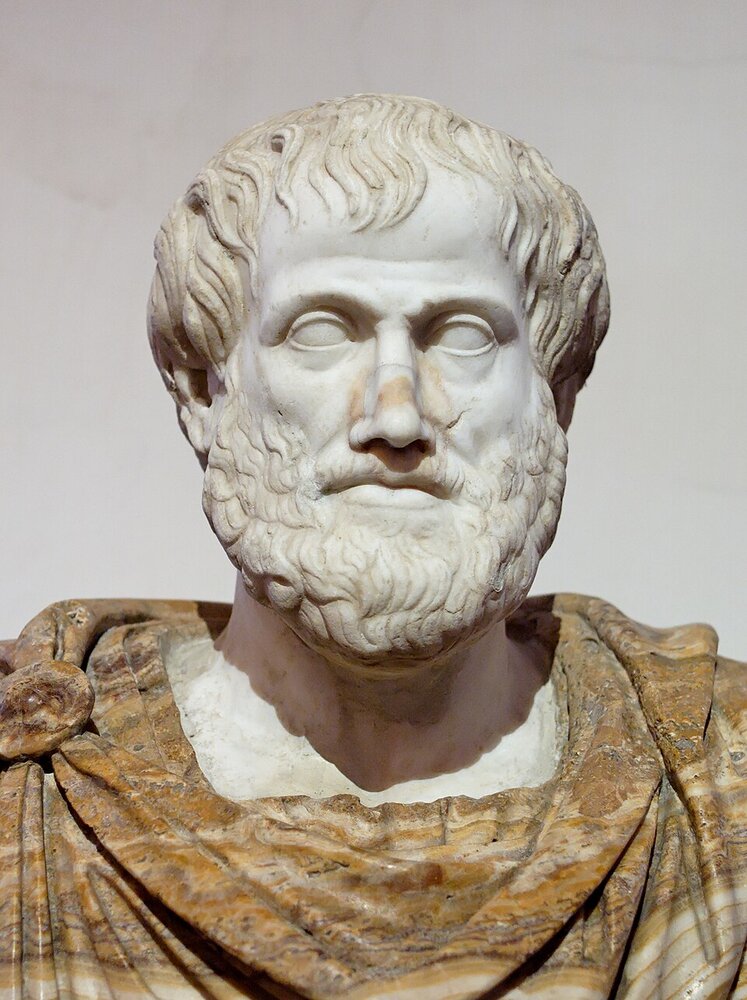
Aristotle's teacher, Plato, placed true being in the heavens: what is truly real are the eternal Forms, and the things around us are merely their pale shadows. Aristotle, his most beloved and gifted pupil, carried out a quiet revolution: he brought reality back down from the heavens to the earth. What truly exists is not "the idea of a chair" floating somewhere beyond the sky, but this particular chair. The Forms do not hover apart — they are within things.
Hence his famous pairing of form and matter. In any given thing there is matter (what it is made of) and form (what it is). Bronze is matter, the contour of a statue is form; and the two do not exist apart, but only together, in the statue itself. Everything in the world is matter given form, and everything strives to realize its form: an acorn strives to become an oak. Aristotle called this "realization," this movement toward one's own end, entelechy.
To explain any given thing, he asks about its four causes: the material cause (what is it made of?), the formal cause (what is it?), the efficient cause (who made it?), and the final cause (for what purpose?). The last is the key one — for Aristotle the world is not a mechanism but a whole pervaded by purposes; everything is directed toward something. This view — that every thing has a purpose — would shape European thought for two thousand years.
But if every thing is moved by a striving toward its own end, there must also be that for the sake of which everything moves. This is how Aristotle arrives at the Prime Mover — the source of all motion, which is itself unmoved. It is the one thing in the universe that is pure form without any matter: the ultimate end toward which all being is drawn, while itself needing nothing. Aristotle's God moves the world not by a push, but the way the beloved moves the lover — by attraction.
He applies the same reasoning to man: the soul is the form of the body. It is not a prisoner of the flesh, as it is for Plato, but the flesh's realization — that which makes a living body alive. Soul and body are inseparable, as form and matter are inseparable in a statue. And the highest thing in man is reason; happiness (eudaimonia) lies not in pleasure and not in honors, but in a life of activity in accordance with reason and virtue.
Aristotle was the first to turn philosophy into a system of sciences — logic, physics, ethics, politics, poetics. In politics he is sober: the best forms of government degenerate (monarchy into tyranny, democracy into mob rule), and the most stable is "polity" — mixed rule resting on the middle class. Everywhere he seeks not an ideal in the heavens, but a reasonable measure here on earth.