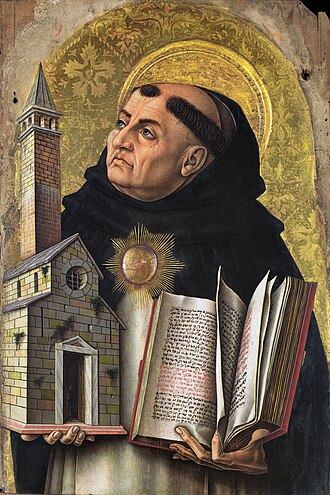
For most of us the word scholasticism smells of dust and empty verbiage, but this is a deep injustice. Scholasticism is simply schooling, the doctrinal body of the medieval school and university, that very system of knowledge preserved at the courts of kings and bishops and later spilling out into the free corporations of students and masters at Bologna and Paris. Here men were taught not faith instead of reason, but faith clarified by reason. This long ascent had its summit — the golden age of scholasticism, the thirteenth century. And upon that summit stands Thomas Aquinas, the man in whom the thousand-year dispute between faith and reason found at last a coherent, almost architectural resolution.
To grasp the scale of his achievement, one must recall the wanderings of a single book. Aristotle had all but vanished from the Latin world: after the fall of Rome the West read him only through commentaries, and knew the living, whole Aristotle not at all for centuries. But the East preserved and developed him — the Syrian schools, expelled from Byzantium, settled in Baghdad, and from there the teaching passed to Muslim thinkers. A remarkable pattern: if Platonism proved closer to the Christian East, then Aristotle proved closer to Islam. And it was precisely through the Arab world, through Spain, that Aristotle returned a second time to Europe. Thomas's achievement lies just in this: this returning, "pagan" philosopher of nature he fearlessly brought into the very heart of Christian theology, showing their deep harmony rather than their enmity.
The Arab teachers brought with them not only texts but a subtle conceptual apparatus. Avicenna taught that one essence may be clothed in many forms — in man there are three, the vegetative, the animal, and the rational, set one within another, and only the highest, rational form is immortal. He also struggled with how the essence of a thing is bound to its existence, how the essence of God, once grasped, turns into form within man himself. This knot — essence and existence — Thomas untangles in his own way: only in God do essence and being coincide; every created thing receives its existence from without, as a gift.
At the centre of mature scholasticism stands the question of the proof of God's existence. Before Thomas, Anselm proposed a famous move of pure thought: if we so much as conceive of something than which nothing greater can be conceived, it cannot exist in the mind alone — otherwise we could conceive of something greater, existing in reality as well. Thomas rejected this elegant argument. He chose a different path — not from concept to God, but from the experience of the world to its Cause: the five ways, proceeding from motion, from the order of things, from their striving toward the good. Here the Aristotelian proof through motion comes alive — from the First Mover who gave the world its impulse. Thus natural reason, without leaving the earth, ascends to the threshold of God: the world itself bears witness to its Creator.
But reason, for Thomas, is not sovereign. Above it stands revelation, that which the understanding cannot reach on its own. Here scholasticism inherits the legacy of Augustine and the minted formula of Anselm: I believe in order to understand. Faith does not oppose thought — it is the key to it; without it the very meaning of being slips away, the essence of man, his freedom and his calling. Thomas draws the boundary with rare clarity: there are truths accessible to natural reason, and there are truths disclosed by faith alone — and they do not war, for their source is one. The liberal arts remain secular; theology crowns them from above without supplanting them. This is the mature synthesis of faith and reason: not the subjection of one to the other, but the concord of two roads to a single Truth.
The significance of Thomas lies in his having completed the work of many generations — gathering the scattered threads, pagan philosophy and Christian faith, the Eastern Aristotle and Latin theology, into a single edifice. The dispute he waged did not die with the Middle Ages. His refusal of a purely logical proof of God's existence divided thinkers for centuries: against Anselm's move, together with Thomas, would later stand Kant, and in its favour Descartes and Leibniz. And in this the living destiny of scholasticism is visible: it was no dead end but a school that taught Europe to think, and from its summit run straight threads to the very core of the new philosophy.