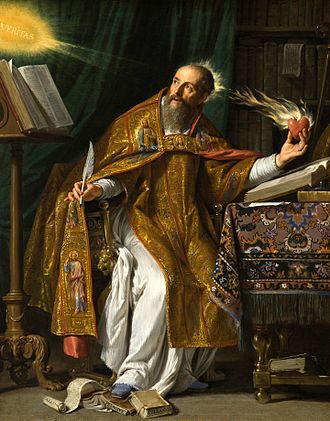
Augustine is a bridge between two worlds: ancient philosophy and Christianity. Through him Plato enters the Church. But before becoming the West's chief theologian, he himself walked a long road of wandering — and described it in the Confessions, the first book in history in which a human being gazes so intently into his own soul.
From his youth he was tormented by one question: whence does evil come? At first he accepted the answer of the Manichaeans: the world is a battlefield of two equal forces, light and darkness, good and evil. But later, through the Neoplatonists, he came to see it differently and gave an answer that would become classic: evil is neither a thing nor a force. Evil is a privation of the good, as darkness is the absence of light, and sickness the corruption of health. God did not create evil; evil enters the world through the misuse of free will. The Creator bears no blame — the fault lies with the corrupted will of the creature.
He experienced his conversion as a blow: in a garden in Milan, in tears, he heard a child's voice say "take up and read" — he opened the Apostle Paul at random and was struck to the heart. From this comes his famous line: "You have made us for Yourself, and our heart is restless until it rests in You." Human restlessness is no accident, but the Creator's trace within us.
From this experience grew his doctrine of grace. Augustine understood it from his own experience: by his own strength man does not tear himself free from sin — what saves is not an effort of will but a gift from above. In his dispute with Pelagius, who taught that man saves himself, Augustine insisted: the will is corrupted by sin, and without grace it cannot rise. This would determine the whole of Western theology — and a thousand years later it would echo in Luther.
And he thought through time as no one before him had. What is time? The past no longer exists, the future does not yet exist, the present has no duration. And Augustine draws the conclusion: time is "a distension of the soul itself," we measure it within ourselves, through memory and expectation. God, however, abides in eternity, where there is no "before" and "after" — He sees all things at once.
At the end, when the barbarians were sacking Rome and the pagans blamed it on the abandonment of the old gods, Augustine wrote The City of God. The two cities, he says, are not two empires but two loves: the earthly city is built on love of self even to the contempt of God, the City of God on love of God even to the forgetting of self. They are intermingled throughout history and will be separated only at the end. Thus was born the first Christian philosophy of history.