Is love stronger than death?
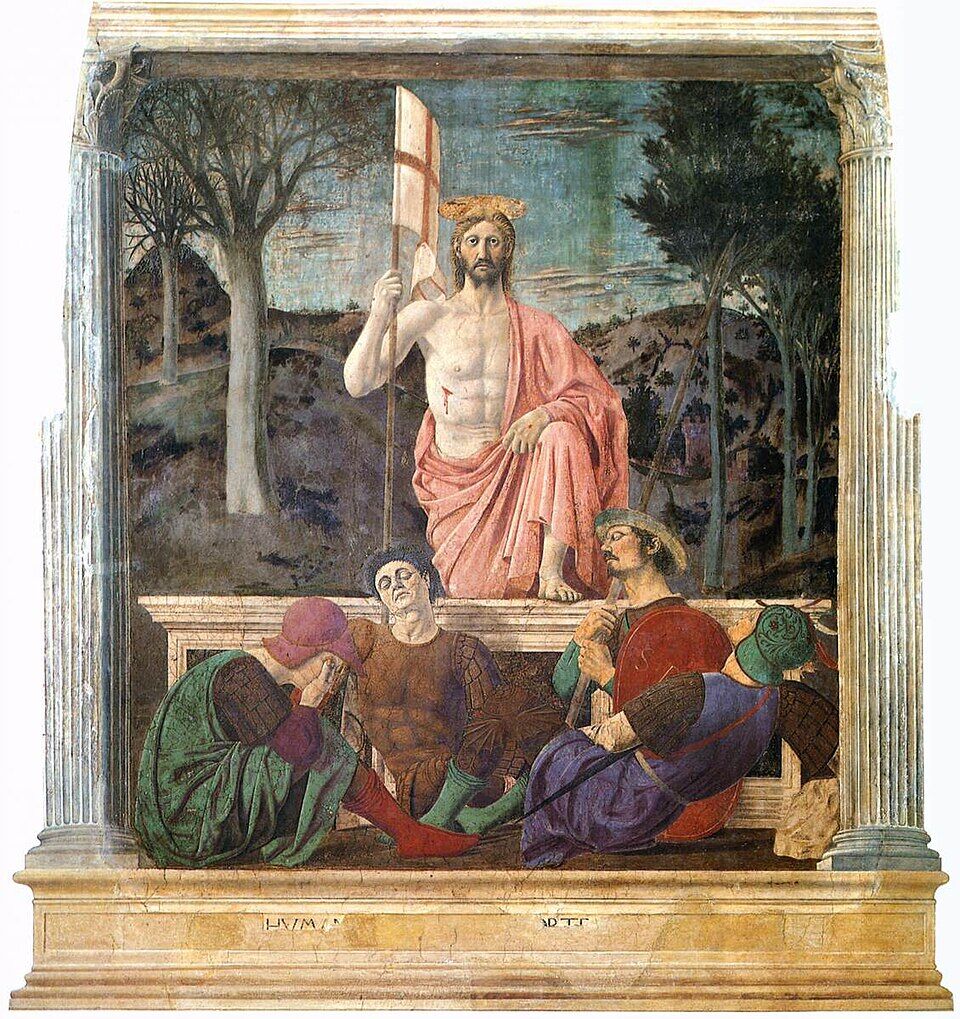
Piero painted the Risen One frontally, head-on. One foot is already lifted onto the edge of the sarcophagus, in His hand a banner with the cross, on His body the wound is visible, and His eyes—wide open, motionless, terrible—look straight at you and do not let you go. At the foot of the tomb four soldiers sleep; in one of them tradition sees a self-portrait of Piero himself—a man who slept through the turning point of history. And the landscape is split in two: on the left, bare winter trees; on the right, green, living ones. Death and life are divided by the rising Body.
And here the voice changes. Until now the whole drama could be read as an archetype—and read honestly. An unbeliever, even an atheist, has the right to see in it the deepest myth of the human soul: you are the exiled Adam; you are the prodigal son trudging home; you are the one sleeping in Gethsemane; you are the one crucified by his own and forgiving them. Jung would say that the image of Christ is a constellation of the Self, and he would be right in his own way: "this is you yourself." Up to the tomb the drama is a mirror, and every soul recognizes itself in it.
But at the empty tomb the mirror cracks. The Resurrection cannot be tamed as an archetype without quietly emptying it out. It does not say: "you will feel renewal, as the trees turn green on the right." It says: He is risen—bodily, in history, as an event. This cannot be made a symbol of one's own psyche without changing the subject of the conversation. Here the archetype ends and confession begins. The voice changes from "this is you yourself" to "this is what I believe"—not "this is what you are," but "this is what I stake my life on."
And here, at the very wall, Camus stands beside us—and we honor him. In The Myth of Sisyphus he refuses the leap of faith, the "philosophical suicide," that is, the resolution of the absurd by a leap into consolation. He stands before the same blank wall—the silence of the universe, the thirst for meaning, a world that does not answer—and he refuses to lie, refuses to leap. His honest man is Sisyphus, consciously rolling his stone: "One must imagine Sisyphus happy." Camus does not cross the wall; he keeps faith with the absurd. The believer at the same wall crosses over—not by proof, for there is no proof here, but by confession: this is what I believe. Both stand at the same wall, both refuse the easy lie. One says the wall is final; the other, that one day at dawn a door opened in it, and a weeping woman mistook the Gardener for a corpse, and He turned out to be alive.
Honesty demands that one not pretend the wall is not there. The drama up to the wall belongs to everyone—it is a common human mirror. Beyond the wall it belongs to faith—or to its honest refusal. In this lies the whole boundary: "this is you yourself" is an archetype, true for each; "this is what I believe" is a confession that a particular tomb on a particular morning was found empty.
Let us draw the thread together. Berdyaev called the malady of history objectification—a deadening in which the person becomes an object, a means, a cog. The whole New Testament drama is its consistent defeat, played out in the body. In the Incarnation God becomes an object—a body, an infant—in order to ransom subjects from the fate of things. In the Ministry He restores faces to the depersonalized and refuses to lord it over anyone, washing feet. In Gethsemane He does not allow Himself to be turned into a victim of circumstance: the free man gives himself. On the Cross He descends to full objecthood—nailed, counted, taken down from the tree of flesh—and from there He objectifies no one, not even His executioners.
And in the Resurrection objecthood is defeated at its very root. For a corpse is the ultimate thing, the final triumph of the world of objects over the face; death is the place where objectification wins absolutely. And precisely there, where it wins absolutely, at the empty tomb it also loses absolutely: the ultimate object becomes a living Person, who looks at you head-on with the eyes of Piero's Risen One.
This victory can be read two ways, and the drama does not force the choice. As an archetype it is the eternal pattern of the Self's renewal, a mirror in which you recognize yourself: this is you yourself. As a confession it is the assertion that in a particular spring a particular tomb was found empty: this is what I believe. The drama brings you to this boundary and leaves you there—free. It does not push you past the wall. Berdyaev would say: the meaning of history is not within history, but at its edge, where eternity breaks through into time—and the focus of this breakthrough is the Person of one Man. History without Him is Camus's wall, honestly met, objectification without a cure. History with Him is the long defeat of objecthood, the slow return of the person.
The Old Testament was a map—a metaphysical map of humanity. The New is not a map, but a Person, who looks at you head-on and whose gaze does not let you go. And before this Person you stand as freely as Adam in the garden and as Mary in Nazareth—with that same primordial freedom to say "yes" or "no" with which it all began. The drama has led you to the wall and stepped back. From here on, it is you.
The spine of it all — the arc. The same law through the four voices: philosophy · literature · painting · music.
all 21 stations · Russian version