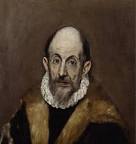
El Greco was a man of three worlds, and each left its own layer in him. He was born on Crete and learned to paint icons — not pictures but prayer on a panel, where there is neither air nor shadow, only gold and the holy face. Then he went to Venice, to Titian, and saw that paint could be flesh, light, breath. Then came Rome and Michelangelo, in whom the human body itself is already a tragedy. In 1577 he reached Spain, and Toledo. And there all of this suddenly fused into one.
The fusion was no accident. Sixteenth-century Spain breathed mysticism: Teresa of Ávila and John of the Cross wrote of how the soul strains toward God through pain and ecstasy, how an earthly creature is drawn upward and in that surge almost loses its own outline. This experience had no pictorial language — and El Greco found it. The elongated figures, the cold flame of the colors, bodies that seem lightened and no longer quite belong to the earth — this is not a distortion of nature but its transfiguration.
All of it is gathered in The Burial of the Count of Orgaz — a single painting that holds two worlds. Below, the heavy earthly life: armor, brocade, a row of grieving faces, the weight and density of matter. Above, a light, glittering heaven where time moves differently and everything is woven of light. The boundary between them is thin as a blade, and it is precisely on that edge that the whole thing balances: earth is not abolished by heaven, yet heaven does not tear itself away from earth — they touch one another.
Here lies his secret subject. Every time, El Greco paints the same event — the meeting of heaven and earth, the moment when the weightless bends down to the heavy and gathers it into its arms. Hence that strange, almost electrified stillness of his canvases: in them everything is already poised for the upper and the lower to close together.
His contemporaries did not understand him. He offered to decorate the Escorial — and Philip II refused: too strange. El Greco stayed in Toledo and to the end painted what he saw fit, yielding to no one. His View of Toledo is a landscape as a premonition of catastrophe: a black sky, green light before a storm, a city on the very edge. No one had seen nature this way before him — not a calm terrain but a world on a threshold, trembling at the nearness of something immense.
He was rediscovered only at the beginning of the twentieth century. When Cézanne came, and the Expressionists after him, it turned out that the old man from Toledo had been three hundred years ahead — that he had already done what painting would reach only centuries later. Mad, he was called by those who looked at the earth. He, all that time, was looking where earth meets heaven.