the green why
all 21 stations · station 14 of 21

Is sacrifice the ultimate form of love?
Is any freedom freer than in a willing sacrifice?

The Passion · The New Testament Drama
♪ Tomás Luis de Victoria"O vos omnes" (1585)
The same subject, through the eyes of painters ↔
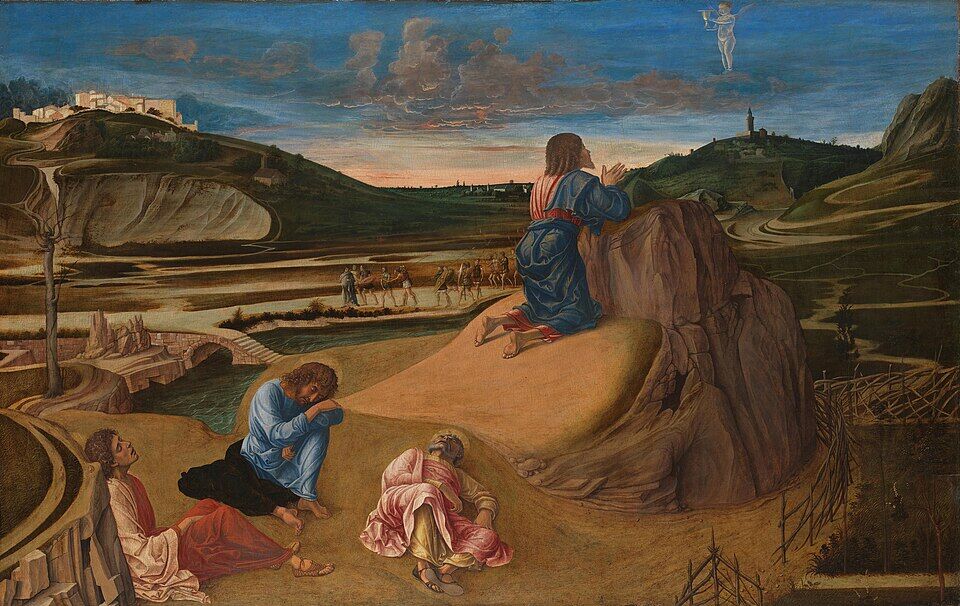
Giovanni Bellini, "The Agony in the Garden" (c. 1465). Christ prays on a rock in the first light of dawn; an angel appears in the sky bearing a cup; below, three disciples sleep, while in the distance Judas already leads the guard across the bridge. All of Gethsemane in a single frame: the cup, the sleep of those closest, the betrayal drawing near.
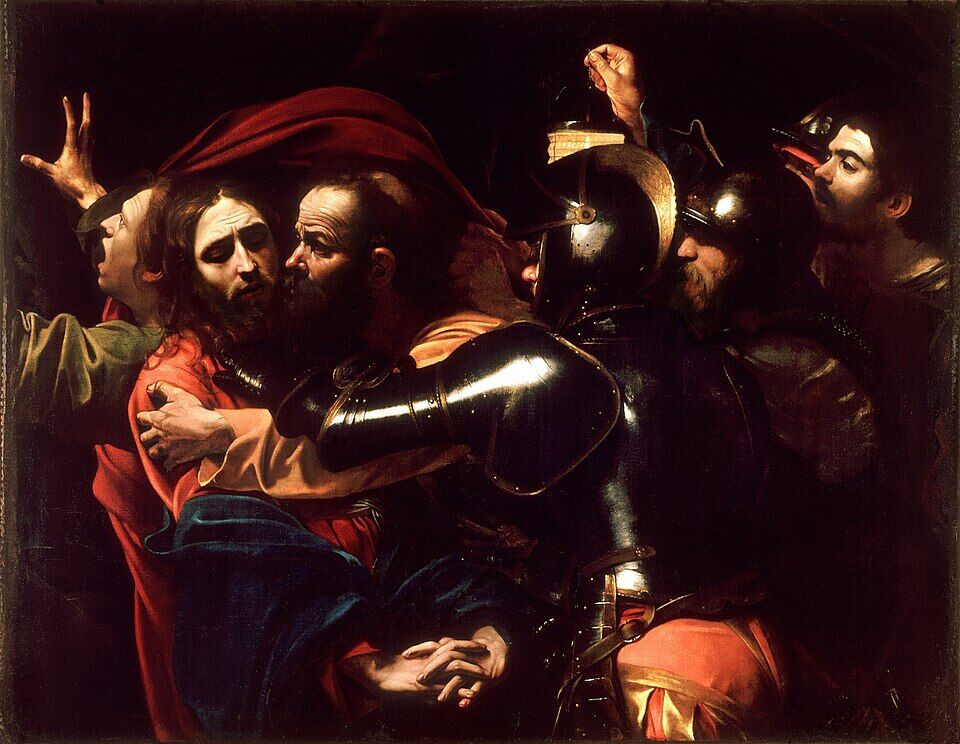
Caravaggio, "The Taking of Christ" (1602). Judas seizes and kisses the Master; the black-armored guard reaches out to grasp him; Christ's hands are folded without resistance — he is not a victim of circumstance, he chooses. At the left a fleeing disciple cries out; at the right Caravaggio himself holds the lantern.
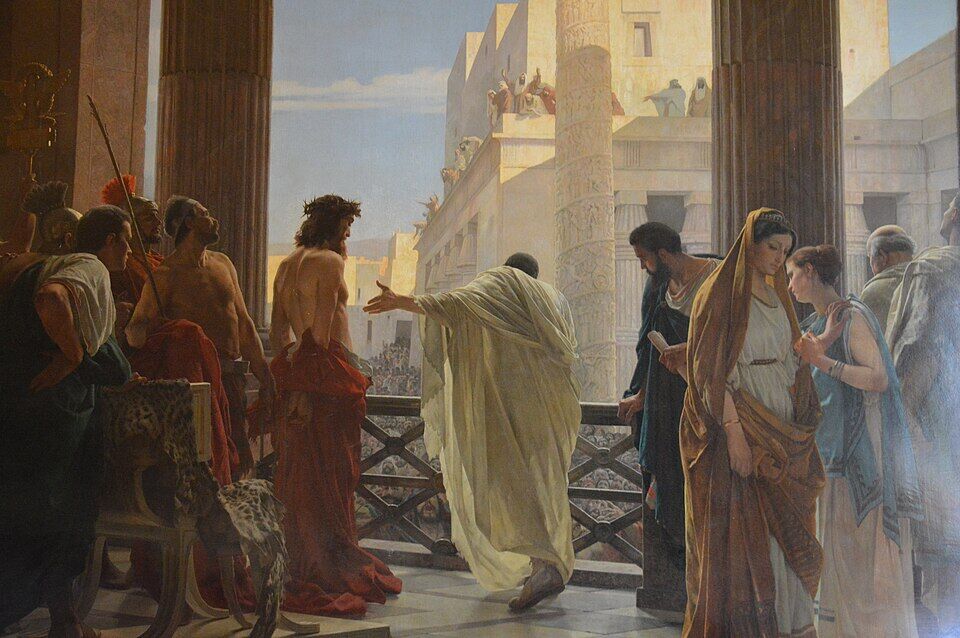
Antonio Ciseri, "Ecce Homo" (1871). From the balcony Pilate shows the crowd the beaten, thorn-crowned Christ: "Ecce homo." Below, the square roars; at the right, the women turn away. The trial is over — freedom that has chosen sacrifice leads to the cross.

In El Greco, Gethsemane is painted as a vision, not a report. The figure of Christ, drawn out like a flame, in crimson and blue robes; an angel descending with the cup; the disciples asleep, curled within a fold of stone as though in a womb; and far off, in the cold light of torches, the crowd of Judas already drawing near. Past, present, and future are pressed together into a single stormy night. Everything is motionless — and everything trembles with the inner strain of choice.

Here everything is decided. "O My Father, if it be possible, let this cup pass from Me: nevertheless not as I will, but as Thou wilt." This is the second great human "yes" — the echo of the Nazareth "be it unto me according to thy word," with which the New history began. But now it is spoken not in glad tidings but in mortal anguish: "My soul is exceeding sorrowful, even unto death," and "His sweat was as it were great drops of blood falling down to the ground." No one drags Him. He Himself says that He could pray to the Father, and He would give Him "more than twelve legions of angels." He is not a victim of circumstance. He chooses the cup.

And in this lies the heart of the whole theme. Objectification is what happens when you are made a thing, a means, an instrument of another's will. Its opposite is not power but the gift of oneself. A man compelled would have been turned into an object; but Christ is not compelled — He gives Himself. Freedom is never so free as in this moment, when it freely binds itself with love. The disciples sleep; God begins to fall silent. Man is left alone with his choice — and chooses.

The road through this question: Is sacrifice the highest form of freedom? →
Read the chapter from the book: “The Fifth Seal: The Souls of the Slain”
← previous stationWhat is servant leadership in the Bible?next station →Where is God when we suffer?
The chapters behind this station — the four books. Who makes this, and why.
The spine of it all — the arc. The same law through the four voices: philosophy · literature · painting · music.
all 21 stations · Russian version
🇬🇧EN