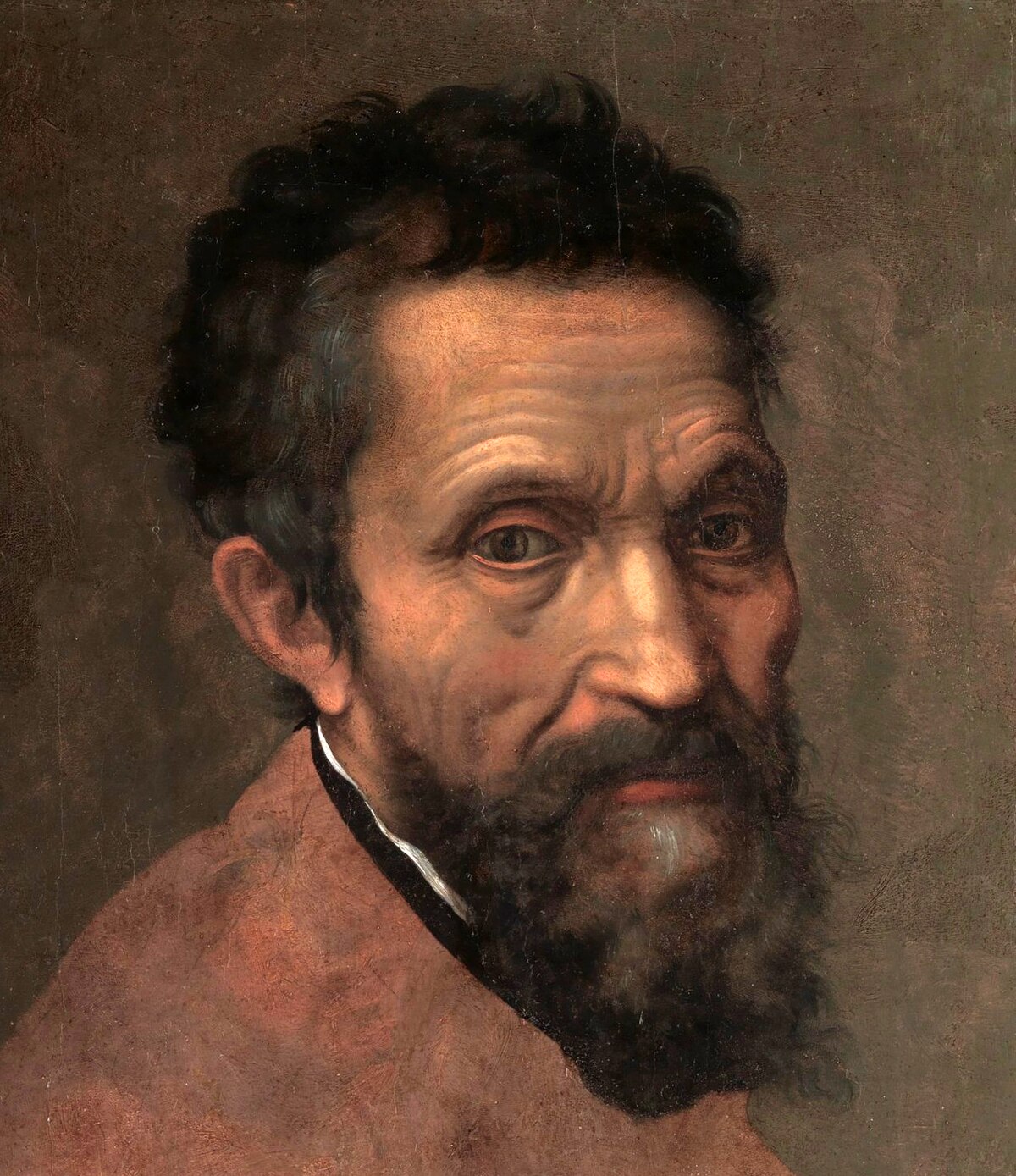
In 1508 Pope Julius II summoned him to Rome and said: paint the ceiling of the Sistine Chapel. Michelangelo refused. He was a sculptor, not a fresco painter. The pope insisted. For four years Michelangelo lay on his back on the scaffolding, staring upward while the paint dripped into his face.
When the chapel was opened in 1512, Raphael — his rival and, perhaps, his enemy — came to look. And he reworked his School of Athens, adding the figure of Heraclitus with Michelangelo's face.
Michelangelo Buonarroti was born in 1475 in the small town of Caprese. His father, an official, dreamed of giving his son a respectable education. But at thirteen Michelangelo entered Ghirlandaio's workshop, and then the garden of Lorenzo de' Medici, where antique sculpture was studied.
He was twenty-three when he made the Pietà: the Virgin Mary holding the dead Christ across her knees. The stone lives — the folds of cloth, the hands, the face. Someone doubted the authorship. That same night Michelangelo returned secretly to the basilica and carved his name into the band across Mary's shoulder. It is the only work he ever signed.
David, Moses, the Slaves, the Last Judgment on the altar wall of the Sistine — he created monuments that exist outside time. All the while he hardly slept, rarely washed, and worked in boots he took off once every few months — the skin came away with the boot.
He lived eighty-eight years — a record for his era. To his last day he worked on the Rondanini Pietà. He died without finishing it.