Walter Benjamin left behind an image that holds this question better than any treatise — the Angel of History. Looking at Klee's watercolor "Angelus Novus," he saw an angel turned to face the past. Where we see a chain of events, the angel sees one single catastrophe, tirelessly piling wreckage at his feet. He would like to pause, to raise the dead, to gather up what has been shattered — but a storm blows from paradise; it beats against his wings, and he cannot fold them; the storm irresistibly bears him into the future, to which his back is turned. "That which we call progress is this storm."
Thus secular eschatology stands unmasked. Progress is not redemption but a storm; the future is bought with the wreckage of the present. This is precisely the Berdyaevan thought with which the whole map began: progress turns every generation into a means, sacrifices the living of today to a radiant tomorrow. History without an end lying beyond its limits is a meaningless circling; only in eternity are human destinies resolved. So the question of the telos is universal and ineradicable. One question remains: what the end is.
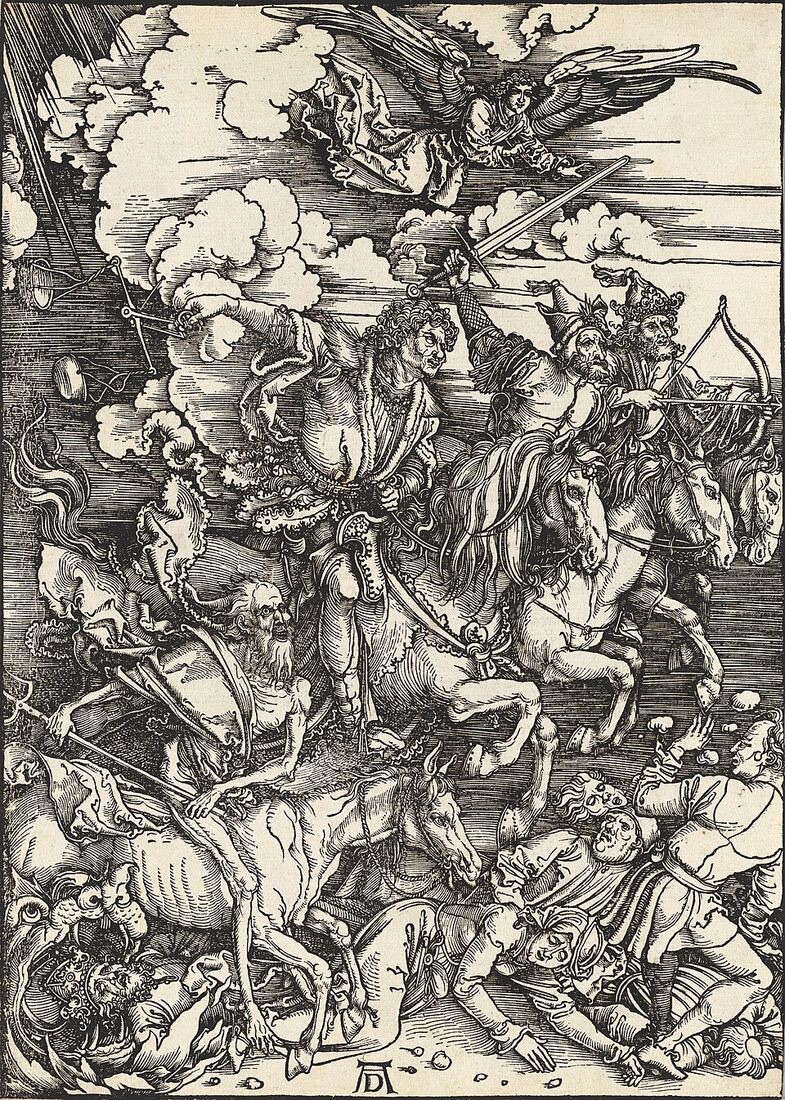
Dürer carved the end as a thunderclap: four horsemen — conquest, war, famine, and death on a pale horse — race across heaps of bodies, and even the emperor is flung beneath the hooves. This is the end-as-horror, the very wreckage the angel sees, the apocalypse-as-disaster as the popular imagination paints it. But the word "apocalypse" (ἀποκάλυψις) itself does not mean "catastrophe." It means "the lifting of the veil" — revelation. The horsemen are not the meaning of the end; they are the tearing of the curtain. Beneath the catastrophe the image seeks not ruin but what is laid bare when the scenery burns away.
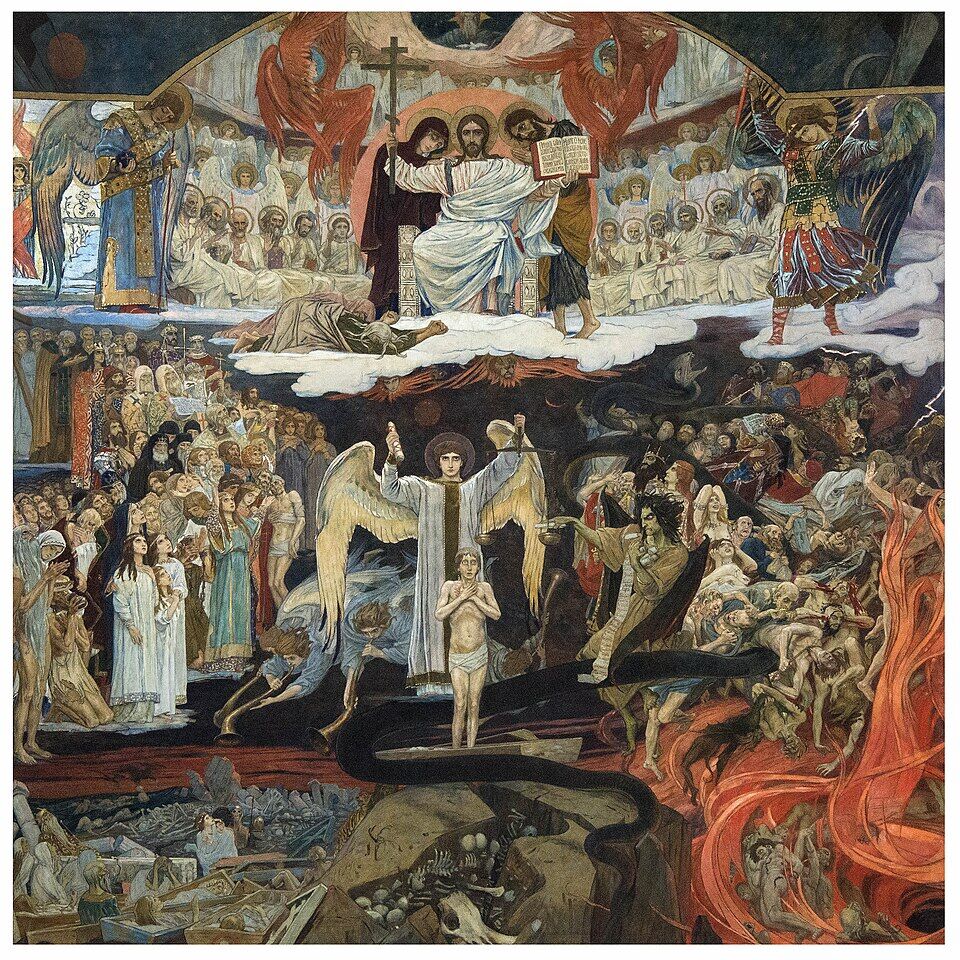
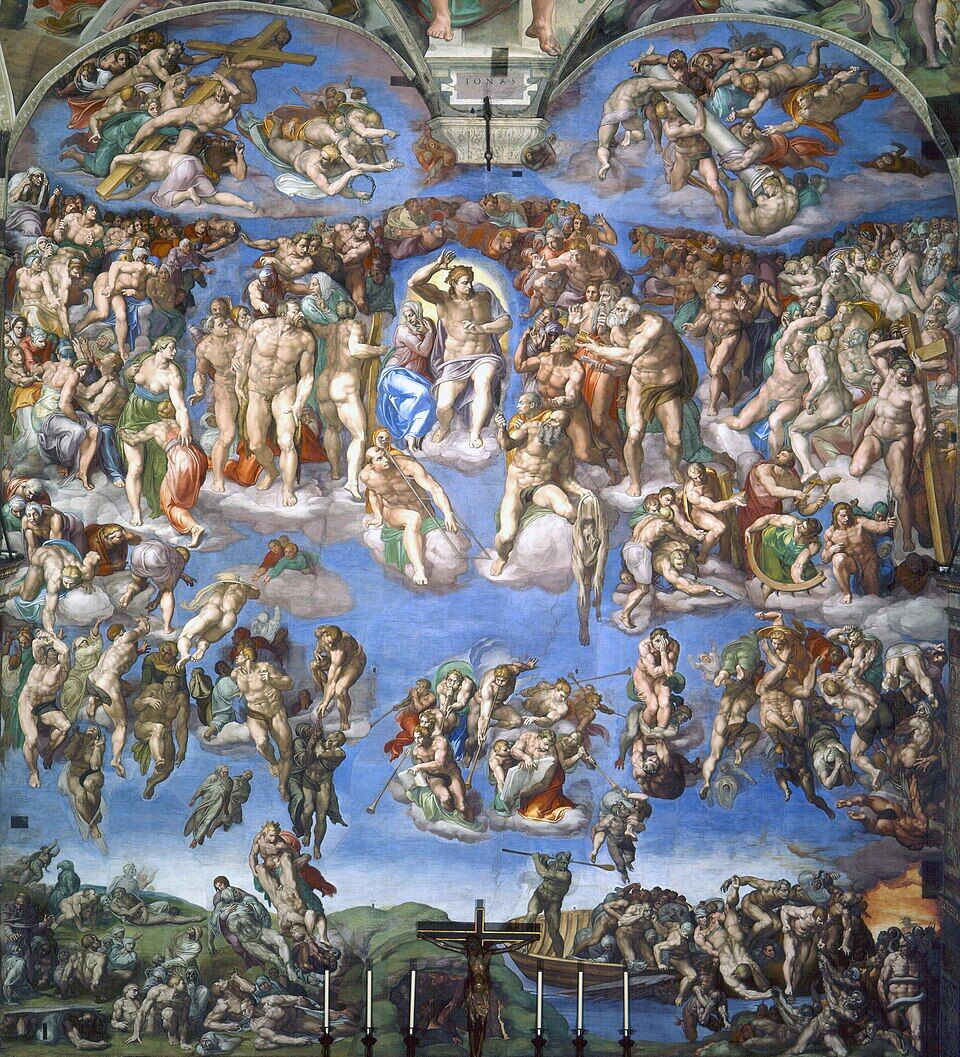
Vasnetsov painted the Judgment across the whole span of the cathedral wall: an angel with scales, the hosts of souls, the Judge in glory. The fear of Judgment is the fear of being at last seen, known to the end — the fear of the objectifying gaze that will reduce you to your worst deed, to a line in a file. But here comes the overturning. The Judge is the One who was crucified; the Judge bears the wounds (that same Risen One at point-blank range in Piero). And then Judgment proves to be not objectification — not reduction to a dossier — but its opposite: to be seen to the end by Love and not annihilated. The last defeat of objecthood: in the end you are not a case, not a unit, not a production quota — you are a face, beheld by a Face.
And then the end is a meeting. "And God will wipe away every tear from their eyes, and death shall be no more; neither shall there be mourning, nor crying, nor pain anymore." The end of the world of objects: there is no more death — and death was the last triumph of objecthood — there are no more tears. The wreckage over which Benjamin's angel grieves is, the believer confesses, gathered up: the dead are raised, the shattered made whole — precisely what the angel wished to accomplish and was denied by the storm. The Eschaton is the storm reversed: not a progress that bears us backward over the wreckage, but a Face coming to meet us and taking the wreckage up into resurrection.
The Berdyaevan thread here closes with the beginning: the meaning of history is not within history but at its edge, where eternity breaks through time. The Eschaton is the completed breakthrough.
Here again runs the boundary between archetype and confession, though more gently than at the empty tomb.
As an archetype, the longing for a meaningful end — for justice, for the wiped-away tear, for redeemed wreckage — is universal. "Here you are, yourself": this every heart desires; the atheist Benjamin, grieving over the wreckage, thirsts for it no less than any saint. The hope that history is not a meaningless storm is the most human of hopes.
But behind the hope stands a confession: not merely "would that the tears were wiped away," but "and God will wipe away every tear" — a promise bound to a Person who comes. Why is this wall quieter than the Resurrection wall? Because here the universal longing and the confession almost touch: the wiped-away tear is what everyone awaits; the believer only confesses Who wipes it and what He has already begun — for the Risen One is the firstfruits. The wall is gentler because hope and faith here are neighbors; the line runs between "so let it be" and "so it will be, and His Name is —." The essay does not push you beyond the wall; it only observes that no one escapes eschatology, and asks which one you live by: the storm — or the meeting.
Here the map closes upon itself. The pre-worldly freedom to say "yes" or "no" (Essay No. 1) — the Face at the empty tomb (No. 2) — the Body enduring through time (No. 3) — the open question and the witnesses (No. 4) — the end as a meeting (No. 5). The last "yes/no" is the greatest: it is no longer about a single tomb but about the telos of the whole. The drama has brought you to the final wall — the quietest. Beyond it lies either the storm or the Face. Beyond that — you.
The spine of it all — the arc. The same law through the four voices: philosophy · literature · painting · music.
all 21 stations · Russian version