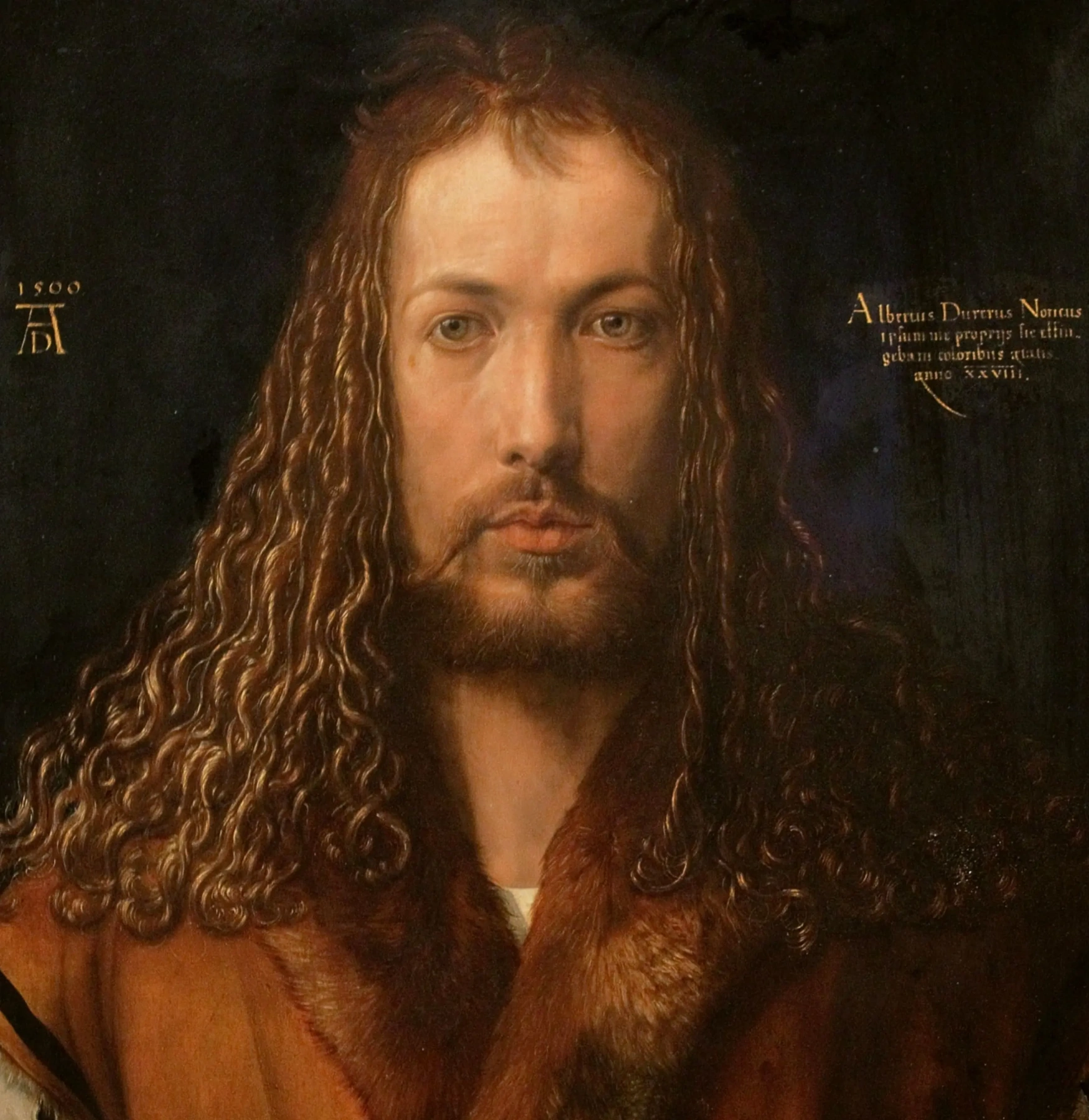
Albrecht Dürer (21 May 1471, Nuremberg – 6 April 1528, Nuremberg) was the greatest of German painters and engravers, world-famous in his own lifetime — and also a distinguished geometer and fortification engineer, the founder of the European watercolor, a mechanic, an architect, and a theorist of art. In his work the discoveries of the Italian Renaissance met the artistic traditions of northern Europe.
What sets Dürer's art apart: his engravings retain the precision and fineness of detail native to German culture, yet astonish with a compositional inventiveness never seen before. The master was preoccupied with the harmony and beauty of the human body, the laws of proportion, the exact rendering of human hands. His paintings are distinguished by bright, resonant, enamel-like color; his watercolors, by an uncanny fidelity to the phenomena of nature.
Among his celebrated paintings and prints: Melencolia I, The Great Piece of Turf, Adam and Eve, Young Hare, The Four Horsemen of the Apocalypse, The Feast of the Rosary.
For Germany, Dürer is — like Goethe — "our everything." Germans prefer to call their Renaissance "the age of Dürer," and since 1815 the country has kept an annual "Dürer Day." His character and life present a union, paradoxical at first glance, of burgher practicality and philosophical detachment, of creative genius and everyday scrupulousness. It is this combination, apparently, that has made the artist a national symbol and a cultural hero.
"I Am the Door," or the Origins of Albrecht Dürer
In his autobiography — a genre Dürer was, incidentally, the first among German painters to attempt — the artist reports: "Albrecht Dürer was born in the Kingdom of Hungary, not far from the little town of Gyula, in the nearby village called Ajtós, and his family made its living raising oxen and horses." He is speaking not of himself but of his father and full namesake, the respected Nuremberg goldsmith Albrecht Dürer the Elder.
So the greatest German artist of all time was a Hungarian? And what of it — the greatest Russian poet was an Ethiopian, a "blackamoor," "and yet how he wrote, how he wrote!" A healthy society understands that a culture profits from infusions of foreign blood. But when a society sickens with Nazism, the very thought becomes unbearable to it. By a strange coincidence, Nazism took shape in Germany precisely where the painter had been born five hundred years earlier — in Nuremberg. To prove that this pillar of the German nation was no Hungarian but a pure-blooded Aryan, the Nazis went so far as to exhume his father's remains, hoping to match the measurements of the skull against the Aryan standard.
To this day there is no consensus about the artist's origins. Some prove, documents in hand, that he was unquestionably Hungarian; others insist he descended from German colonists who had drifted into Hungary in the distant era of the Mongol invasions.
And the surname — is that not an argument in itself? The guttural "Dürer" sounds so thoroughly German. True — except that the name was his father's invention, a linguistic joke and a kind of pen name at once. It derives from the name of their Hungarian homeland, the village of Ajtás, or Ajtós. Ajtós comes from the Hungarian word for "door," and "door" in German is die Tür. Recast in the German fashion, the name was first Türer; later, worn down by local pronunciation, it became Dürer.
On the family coat of arms the Dürers invariably displayed wide-open doors. So the exceedingly devout artist could with full justice repeat of himself the words of Christ in the tenth chapter of the Gospel of John: "I am the door." And should the pun strike a reader as unseemly, recall that in the most famous of his self-portraits the master painted himself in the image of the Savior, so that one cannot tell at first glance whether it is Christ gazing straight at us or a strikingly handsome artist. To a modern viewer such audacity borders on blasphemy; the medieval mind saw it otherwise. To become like Christ is, after all, the chief aspiration of any Christian, and Dürer was God-fearing and virtuous to a rare degree. A contemporary wrote of him: "In the whole of his life not a single act is known that would deserve censure, or even indulgence. He was entirely blameless."
The Early Years
Dürer's father arrived in Nuremberg on 25 June 1455. That day the local patrician Philipp Pirckheimer was celebrating a wedding by the castle, beneath the great lindens. The Hungarian gold- and silversmith took it for a good omen and settled in the city for good. He found work with the burgher Hieronymus Holper, who, soon coming to value the Hungarian Albrecht's honesty and industry, gave him his daughter in marriage — "a beautiful, nimble girl named Barbara, fifteen years old." The match made Dürer's father a citizen of Nuremberg.
The omen held. The Dürers had an enormous number of children — eighteen, of whom only three sons lived to adulthood, the artist among them; he was the third child of the eighteen. His father noticed early how steady young Albrecht's hand was and how exact his eye: he could draw a line or a circle without ruler or compass. Naturally the father hoped his son would become a goldsmith and carry on the dynasty.
The son wanted otherwise. At about ten he discovered the incomparable joy of pencil touching paper: "I drew in secret from my father. I knew he would be displeased. But drawing had already become as necessary to me as air."
The elder Dürer gave in and apprenticed the boy to Michael Wolgemut, a painter and sculptor well known in Nuremberg, whose portrait Dürer would later paint. The chief thing he learned there in three years was the art of the woodcut. In those early days line, form, and proportion interested him more than paint and color, and engraving answered his natural bent perfectly.
A New Technique and Famous Works
When Dürer turned eighteen, his father decided it was time for him to see the world — the traditional "wander years" of a craftsman's formation. He is thought to have visited the Netherlands and southern Germany. What is certain is that he went to Colmar, hoping to meet the painter Martin Schongauer, to whom his father had given him a letter of introduction. But news traveled slowly at the end of the fifteenth century: arriving in Colmar, Dürer learned to his astonishment that Schongauer had been dead a year.
Schongauer's brothers, however — Caspar, Paul, and Ludwig, goldsmiths and engravers — received him warmly, and from them he acquired a most valuable, almost exclusive skill: engraving not on wood but on copper. It was a new technique, favored by goldsmiths and demanding exceptionally fine, exact work; by no means everyone could master it. In burin engraving on copper the master does not move the burin — he shifts the copper plate beneath it while his hand stays still. In this most difficult of techniques, which defeated nearly everyone, Dürer proved unsurpassed. And his most famous works — Saint Jerome in His Study, Knight, Death and the Devil, Melencolia I — are precisely copper engravings.
After Colmar, Dürer lived several more years in Basel, a city of printing and the book trade, and in that time produced some 250 book illustrations. Their number, and above all their quality, was astonishing — the more so since their author had only just turned twenty. Small wonder: his godfather was Anton Koberger, owner of Nuremberg's largest printing house, with twenty-four presses and more than a hundred workers.
Marriage and Family Life
The journey, four years long, ended abruptly. A letter from his father summoned Albrecht home on a matter of the first importance: the elder Dürer had found his twenty-two-year-old son a suitable bride. Fifteen-year-old Agnes Frey was the daughter of a wealthy mechanic who owned workshops producing precision instruments — and Nuremberg in Dürer's day was famous for its craftsmen; the pocket watch, and even the globe, were invented there. The future father-in-law sat in the city's government and was rumored to be related by blood to the Medici, the Italian banking dynasty. For the son of a Hungarian with many children and modest means, in short, it was an extremely advantageous match — and Agnes came with a tidy dowry of 200 guilders.
Judging by the documents, this courtship arranged in his absence stirred no inner protest in Dürer. He was a most respectful son who loved his father and worshipped his mother; disobedience never occurred to him. More than that: the famous Louvre self-portrait, with its red curls and clothing ornate to the point of extravagance — for which the artist would be reproached more than once with vanity, as he would be for the later self-portrait in the Prado — Dürer painted expressly to send to a bride who had never laid eyes on him. He was presenting the goods to best advantage.
The marriage lasted until Dürer's death and was outwardly quite respectable; few dared call it happy. His closest friend, the humanist Willibald Pirckheimer — of that same patrician family whose wedding the elder Dürer had so fortunately happened upon — wrote: "The family life of Albrecht Dürer and Agnes Frey did not prosper — perhaps because they had no children. Or perhaps they had no children precisely because their life did not prosper…" Dürer's letters to his friend bristle with coarse jokes about Pirckheimer's amorous escapades, but say nothing of any of Dürer's own. It seems this melancholy beauty of a man — fine features, long fingers, an expressive gaze, far from indifferent to his own appearance — was rather indifferent to what many will stake their lives on: amorous passion and romantic adventure.
The wedding took place in July 1494; by September Dürer had left Agnes for the first time, as he would do again and again. He sent his wife to the countryside on the pretext of the plague then bearing down on Nuremberg, and departed himself for Venice.
The Italian and Nuremberg Periods
Venice could not fail to overwhelm the young Dürer: the extravagant luxury, the fantastic mingling of tongues and new ideas, colors and a tempo of life he had never seen. While the Middle Ages still reigned in Nuremberg, Venice and the other Italian cities were booming; the Renaissance was in full flower there. Dürer is known to have been acquainted with the Bellini brothers, possibly with Titian and Giorgione, and with many lesser masters. He learned much and noted much, but relations with his colleagues did not run smooth. He complained to Pirckheimer that the Italians thought the Germans hopeless colorists while being rogues and swindlers themselves: "I have many good friends among the Italians who warn me not to eat and drink with their painters. Many of them are my enemies; they copy my work in the churches and wherever else they can find it, and then they revile it and say it is not in the antique manner and therefore bad."
On one of his Italian journeys — there were several — Pirckheimer goaded his friend into proving to the Italians that he commanded color and composition as well as they did. The result was the triumphant Feast of the Rosary, a painting that delighted Giovanni Bellini and with which, it is commonly held, the German Renaissance began.
Home again, the inspired master opened an engraving workshop of his own. It was not painting that fed the family — the patrons who commissioned pictures caused Dürer no end of grief, hurrying him and forever underpaying — but the series of engravings run off in quantity at his godfather Koberger's press. His wife and mother sold the prints on market days in Nuremberg, and soon they were so popular that they spread across Germany and beyond. It was the engravings that brought the thirty-year-old Dürer worldwide fame. They were pirated relentlessly, and more than once the master took his imitators to court.
The runaway hit was the Apocalypse series, above all The Four Horsemen. It was the "millennium," the turn of the fifteenth century into the sixteenth, and rumors of the end of the world were everywhere — rumors to which the devout Dürer himself listened not without a shiver. He saw with his own eyes a comet in the sky, that harbinger of Apocalypse, and had nightmares of a great flood.
Dürer cut engravings in wood and copper, painted pioneering watercolor studies (Young Hare, The Great Piece of Turf), produced portraits and large religious canvases, labored over a drawing manual, theoretical treatises, and geometrical calculations, and did not disdain painting vases, designing stained glass, or making jewelry. None of it brought a stable, guaranteed income. Even the most exalted of his patrons, the Emperor Maximilian, never paid on time. Maximilian did, it is true, oblige the city of Nuremberg to pay Dürer a hundred guilders a year out of the municipal taxes — in effect a pension — for which Dürer was profoundly grateful. But the moment Maximilian died, the city treacherously cut the master off, and the aging artist conceived a whole adventure: to travel — with his wife, for once! — through the Netherlands to Aachen, where the next emperor, Charles V, was to be crowned, and there plead in person for justice to be restored.
Miserly? A Knight!
Dürer left us a fascinating document, the diary of his journey to the Netherlands. It is not a diary in the strict sense but something closer to an account book. He describes briefly what he saw and whom he met, but his expenditures he records with far greater diligence and detail. The punctiliousness of the entries raises an involuntary smile.
Dürer reports how many guilders, pfennigs, stuivers, and white pfennigs (the currency changes as he travels) he paid for pears and wine, a cedarwood rosary and a buffalo horn, an ivory skull and a small turned box, a shirt of red wool, an elk's hoof, a little tortoise. We learn what he paid for kitchen firewood and shoes for his wife, for parchment, candle snuffers, two Calicut saltcellars, and a basket of raisins; what a bath cost him, and how much he gave the messenger, the porter, the furrier, and the tailor. Several times he notes with satisfaction that he managed to exchange spoiled guilders without loss, or that his dinner was paid for by someone he had met along the way — that one acquaintance sent him a hundred oysters, and others four jugs of wine, a velvet purse, a box of good medicine, seven Brabant ells of velvet, or a case of lemon sugar. He scrupulously sets down what he earned from his prints and what he drank away with friends, what he gave the apothecary for enemas and what to the monk who heard his wife's confession.
Had we only these records, we might conclude that Albrecht Dürer was the most practical genius in history. In fact the matter stood exactly — well, almost exactly — the other way around.
An oppressive fear of poverty haunted Agnes Dürer all her life. Her brilliant husband worked himself to exhaustion, and still the pressing bills were not always covered. In his last four years Dürer all but gave up the art that fed him in order — sensing death near — to finish his major theoretical treatise on measurement and proportion and his manual on the fortification of castles, towns, and cities: a work on fortification might yet be of use to Nuremberg, which had treated him none too kindly but was his native city all the same. Even the mysterious illness that sapped his strength in the years before his death he owed to sheer impracticality: elderly and far from well, he set out in haste, through cold and wind, for the town of Zierikzee only to catch sight of a natural wonder — a whale washed ashore. "The desire to know much, and through it to grasp the true essence of all things, is implanted in us by nature," Dürer devoutly believed.
He died on 6 April 1528, at fifty-six. Willibald Pirckheimer, as he had promised, composed the epitaph for his beloved friend: "Beneath this mound lies what was mortal in Albrecht Dürer."