Can the human spirit be broken?
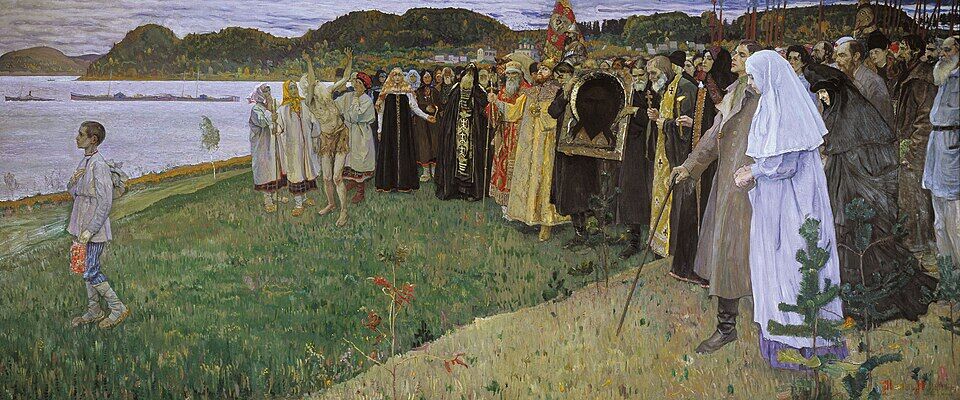
Nesterov painted the procession of a whole people along a river: peasants and soldiers, monks and a holy fool, figures in whom one can make out Dostoevsky and Tolstoy—and at the head of them all a sick boy leads the way. All of them are on the road, all are searching, and the horizon toward which they walk remains beyond the edge of the canvas. The painting was finished in 1916—on the eve of the collapse.
The 20th century answered the question "can one live without God?" not with reasoning, but with an experiment: godless utopias that promised heaven on earth and built camps. Here the Berdyaevian and Benjaminian critique of progress is fulfilled to the letter: a utopia that turns each present generation into material for the future is objectification on an industrial scale, man reduced to a unit, to a production quota, to a line on an execution list. And against this total objectification the witnesses rose up—those who chose to die rather than reduce themselves and another to a thing.
A note of legal caution is needed here: I speak only of history, without living actors. Among the new martyrs of the past century there are figures already indisputably historical. A theologian who wrote in prison of "religionless Christianity" and of how "before God and with God we live without God"—and who was executed for resisting tyranny. A prisoner of the camps who discovered there that "the line dividing good and evil runs through the heart of every human being"—not between classes and nations, as ideology insisted, but through every heart. This is testimony from within the very machine of depersonalization: the person is not reducible to a unit.
And here is the crux: the martyr does not prove God. The martyr shows what no argument can show—that in a human being there is something the state cannot reach, something that cannot be bought, broken, or objectified. And he calls this "something" not by the abstract word "dignity," but the Person, faithfulness to the Risen One. This is testimony, not proof; the answer is given not by an argument, but by a way of living and dying.
Here is the most delicate fork in the whole map, and the wall must be held honestly.
As an archetype, the martyr is universal: the figure of integrity unto death—Socrates, Antigone, anyone who refuses to become an object even at the cost of life. "This is you yourself": you too may be set before a choice, and the inviolable core in you is real—regardless of whether God exists. The humanist has the right to claim the martyr entirely, as the highest proof of human dignity. And the humanist is not mistaken.
But there is a remainder that the martyr affirms and that humanism cannot take in without loss: the martyr says "I die for the Person who has risen," not "for the idea of dignity." In this remainder lies confession. It cannot be proved, only witnessed; and you, looking on from the side, remain free—the wall here is the same as Camus's, but quieter: you have the right to read the martyr as the glory of man or as the evidence of confession. The essay does not push you past the wall. It only keeps the question open—truly open—and notes one thing: in the bloodiest of centuries the question "can one live without God?" received an answer from people who lived and died as if the answer were a Face.
What to carry away from here is precisely this openness. Do not mistake the death of an idol for the death of God; but neither mistake a surviving ethics for a surviving faith. The honest position stands together with the monk before the sea—and looks upon the witnesses who answered without words.
The spine of it all — the arc. The same law through the four voices: philosophy · literature · painting · music.
all 21 stations · Russian version