Can you be moral without religion?
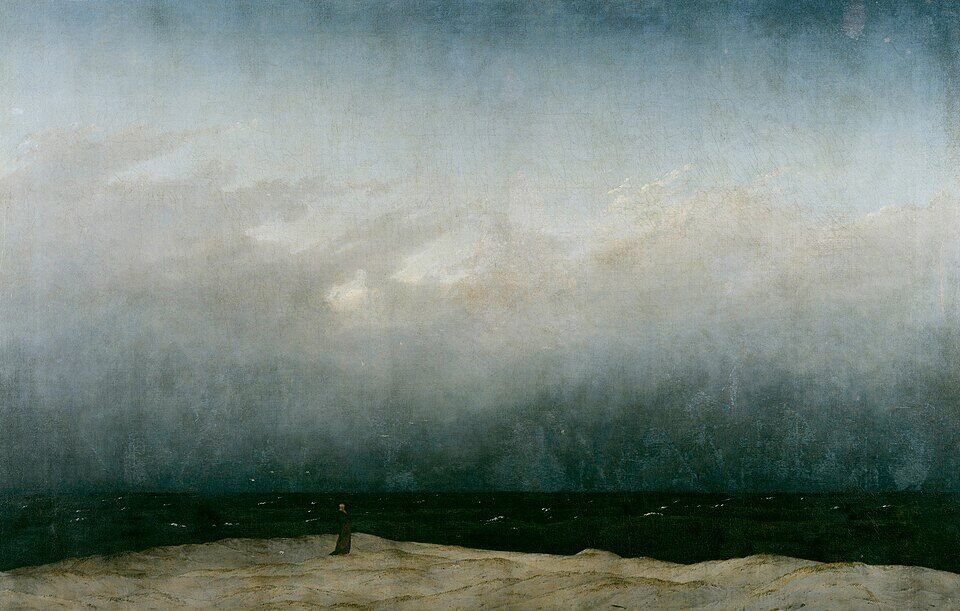
Friedrich painted the most radical reduction in all of Romanticism: an almost empty canvas — a boundless sky, a dark strip of sea — and on the narrow rim of the shore a tiny monk. No ship, no anchor, no second figure. This is precisely the condition of modern man: faith stripped of all its supports, standing alone before the silence. The same wall before which, in the previous drama, Camus stood. And before this wall four voices arise, and they must not be turned into straw men — they must be heard at full strength.
Feuerbach. Theology is anthropology. God is a projection of the human essence: our reason, our will, our love, alienated into the heavens and returning to us as something foreign and higher. "The consciousness of God is the self-consciousness of man." His truth: we do indeed project; an enormous part of what is called "God" is a self-portrait of humanity, and to worship it is idolatry.
Marx. Religion is "the opium of the people" — but one must read the whole thought: it is the sigh of the oppressed creature, the heart of a heartless world, a consolation that makes the unbearable bearable — and thereby postpones its overthrow. His truth: religion has indeed been put to use to sanctify oppression, to command the poor to endure and wait for their reward in heaven. A real wound has been named.
Nietzsche (§125, "The Madman"). In broad daylight a man with a lantern runs out into the marketplace and cries: "God is dead... and we have killed him." He does not triumph — he is in horror: who gave us the sponge to wipe away the whole horizon? Are we not falling through an infinite nothing? Nietzsche saw more clearly than the complacent believers the abyss that opens when the foundation gives way — and he refused the cheap substitutes (a god smuggled into "progress," "science," "morality"). The God who died for him is the moral God of resentment, the otherworldly God who devalues life here below. Perhaps such a God ought indeed to have died.
Freud. Religion as illusion — not necessarily an error, but a wish-fulfillment: a cosmic projection of the father, a longing for protection, a collective neurosis. His truth: faith does at times become an infantile consolation, a refusal to grow up, a heavenly Father who guarantees that we are not alone.
Now look closely at their quarry. In every case what is killed is the God-object: God-as-projection (Feuerbach), God as social opium (Marx), God as guarantor of morality and prop of the horizon (Nietzsche), God as cosmic Father-protector (Freud). This is the God of objectification: a God conscripted as a guarantee, a consolation, a means of control, a heavenly overseer.
And the whole earlier map has already shown that such a God ought to die. The Old Testament drama is a God refusing to be a tribal god of war. The New Testament drama is a God refusing power and dying in God-forsakenness. The drama of the Church is the catastrophe of a God who became imperial force. The critics, strange as it may seem, are here doing the work of prophets: they shatter idols. Berdyaev knew this and was not afraid: he accepted the atheism that destroys a false god, because the death of the idol clears a place for the living God — who is not an object at all, not a thing among things, and therefore invulnerable alike to proof and to refutation.
This is why the question remains open. Secularization killed the idol; whether it killed God is the very question — and it cannot be closed by an argument, because the living God could never have been produced as an object among the demonstrable.
The spine of it all — the arc. The same law through the four voices: philosophy · literature · painting · music.
all 21 stations · Russian version