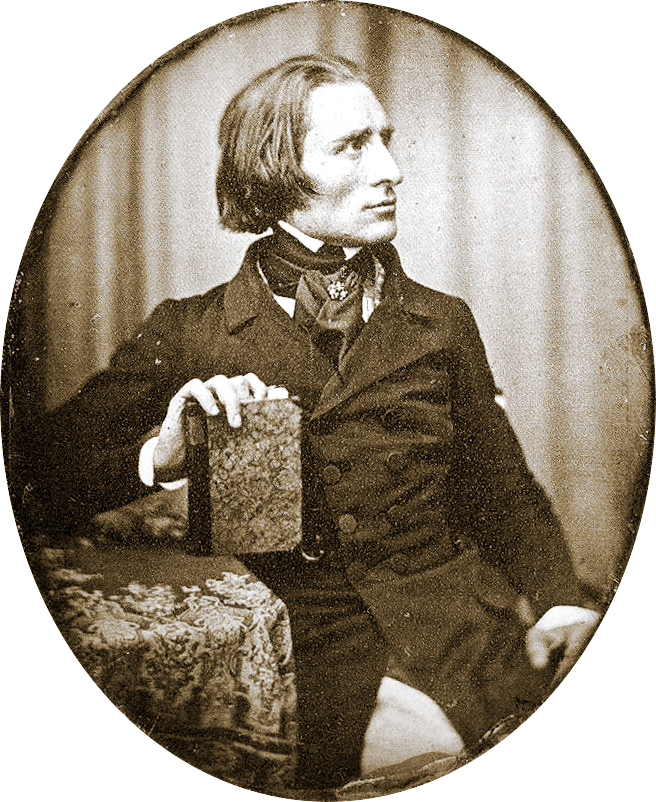
Franz Liszt (1811–1886), Hungarian composer and piano virtuoso, was the man who reinvented the piano recital as a form of public art. The son of a musical steward from a Hungarian village, he astonished Vienna with his playing as a boy, conquered Paris as a youth, and by his early twenties was spoken of as the brightest star on the European stage. It was for Liszt that the nineteenth century first used the word "recital" in its modern sense: a single pianist, alone, before a hall.
His virtuosity was without precedent. He enlarged the technical possibilities of the piano — arpeggios sweeping the whole keyboard, octave passages, hand-crossings, new effects of pedaling. But behind the brilliance there was always thought: the Hungarian Rhapsodies, the Years of Pilgrimage, the Transcendental Études, Liebesträume, and the late Sonata in B minor, one of the summits of the Romantic piano literature. In orchestral music Liszt created the symphonic poem (Les Préludes, Tasso, Orpheus), a genre later developed by Smetana, Richard Strauss, and Sibelius.
In the second half of his life Liszt withdrew from the concert platform, settled in Weimar, and gave selfless support to younger composers, from Wagner (who married his daughter Cosima) to Borodin and Grieg. He took minor orders as an abbé and wrote austere sacred music — the Hungarian Coronation Mass, the oratorio Christus, and the late "black" pieces that anticipate the harmonic language of the twentieth century.
To listen to Liszt is to hear the birth of the pianist as artist — and, at the same time, of the first modern impresario of European music.