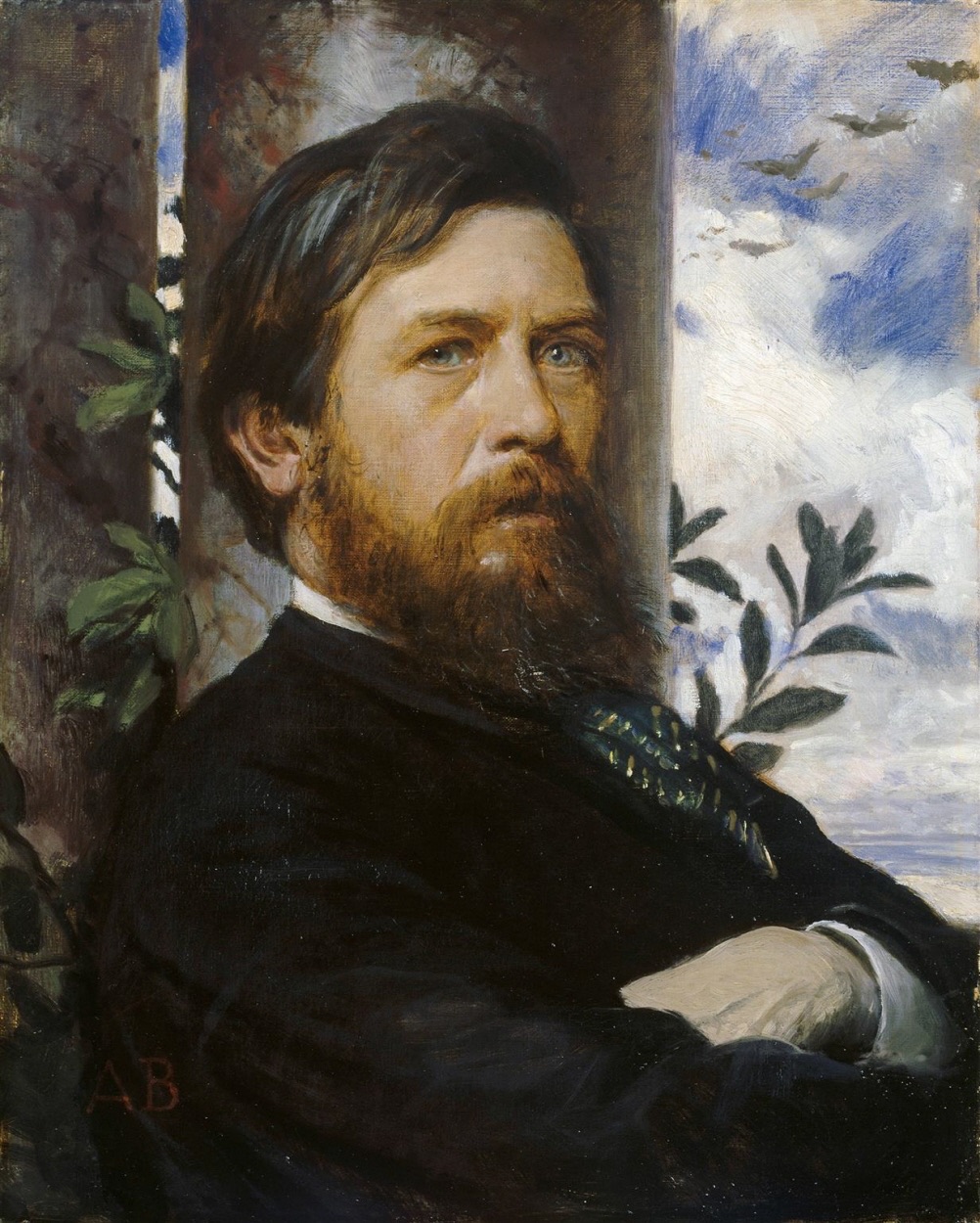
Arnold Böcklin (October 16, 1827, Basel, Switzerland — January 16, 1901, San Domenico di Fiesole, Italy) was a Swiss painter, printmaker, and sculptor, one of the outstanding representatives of Symbolism in nineteenth-century European art.
He trained at the Düsseldorf Academy of Arts (1845–1847), then in Munich, with further study in Geneva (1847) and Paris (1848), and made an educational journey through Switzerland, the Netherlands, and France. From 1850 to 1857 he worked in Rome; from 1860 to 1862 he held a professorship at the Academy of Arts in Weimar. He worked in Basel, Munich, and Italy, spending his final years alternately in Basel and Italy. He was among the most contested artists of his day: some marveled at the wealth of his imagination, while others dismissed him as a weak painter.
Seeking to escape the depiction of reality, he built in his pictures an invented world, often deliberately mysterious. He began with Romantic landscapes peopled by mythological figures, then moved on to fantastic scenes of nymphs, sea monsters, and the like ("Triton and Nereid," 1873–1874).
In his last years Böcklin exerted a strong influence on the literary circles of the Symbolists, who were looking for a counterweight to Naturalism. His late compositions ("Isle of the Dead," 1880, Kunstmuseum Basel), where contrived symbolism joins a naturalistic fidelity of detail, told on the formation of German Symbolism and Jugendstil. Among the Surrealists, Max Ernst, Salvador Dalí, and Giorgio de Chirico all stood under his influence.
Böcklin's paintings, bright and harsh in color, were executed mainly in tempera. The artist himself never gave his pictures titles and never signed them. He died in San Domenico di Fiesole, Italy, on January 16, 1901.