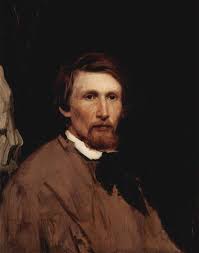
Do you consider self-doubt a problem? Even the classics can offer a lofty example in this regard. Self-doubt is passing the entrance examination for the Imperial Academy of Arts with flying colors, yet learning of one's admission only a year later, upon arriving to sit the examination anew. It was simply that, on his first attempt, Viktor Mikhailovich Vasnetsov could not even conceive that he — he alone! — might be admitted into that holy of holies. And yet the great Russian painter of fairy tales did not consider the year lost, and, incidentally, he never did complete his course of study at the Academy.
Having passed the examinations without even attempting to learn the result, Viktor Mikhailovich Vasnetsov enrolled instead in the Drawing School of the Society for the Encouragement of the Arts. Together with Ilya Repin, he studied under Ivan Kramskoi. Kramskoi, too, believed that Vasnetsov had been issued enough self-doubt for three men, but, fortunately, he had not been shortchanged on talent either: "Self-doubt is your undoing, my dear fellow. You are far too modest. Be bolder, be daring. You have an eye — an enviable one." Before the Academy. The First Paintings of Viktor Mikhailovich Vasnetsov. Several decades later, people would have said that Viktor Mikhailovich Vasnetsov was "not of the right origins." He came from a priest's family. No, no — these were not the bloated priests so vividly depicted by Viktor's comrade, the celebrated Ilya Repin, in his Religious Procession. The daily life of the village priest Mikhail Vasnetsov differed not at all from that of the peasants, except that his intellectual and artistic interests were broader. And the peasants themselves had been friends to little Vitya since childhood. He never had to descend to the common people, nor to "draw them up" to himself, and still less did he need to prove — to himself or to anyone else — that "the lowly are people too." His childhood simply passed among them; they were his friends without any implied caveat of "as if." Perhaps this explains the extraordinary authenticity of the "insulted and injured" whom Vasnetsov portrayed.
For the son of a priest burdened with a large family (six children) but by no means large means, the path led to the theological seminary — for the simple reason that the children of clergy were admitted there free of charge. In Vyatka, Vasnetsov met the first true artist of his life — the exiled Pole Elviro Andriolli. It was he who, upon examining the future master's drawings, declared categorically that the world had priests enough already, whereas people with such artistic sensibility were rare indeed. He told him of the Academy of Arts and suggested holding an auction to sell two of Viktor Mikhailovich Vasnetsov's paintings — The Reaper and The Milkmaid — which raised enough money for the journey to St. Petersburg. His father accepted his wish and, having informed the seminary that his studies there were at an end, Viktor Vasnetsov set off for St. Petersburg to enter the Academy. Vasnetsov's Involvement with the Wanderers and His Journey to Europe. When Viktor Mikhailovich attended the first exhibition of the Wanderers, it seemed to him that this was indeed his path. For the traveling exhibitions Vasnetsov painted several works. Moving House was singled out for particular praise. Pavel Tretyakov, too, took notice of him, which was considered a serious achievement. In the first place, Tretyakov possessed exquisite taste, and in the second, his interest promised artists the chance to forget about poverty. The Wanderers, for their part, pinned their hopes on Vasnetsov as a master of genre painting who would go on depicting the poor and the destitute. But Vasnetsov himself sensed that, despite his closeness to the Wanderers, he had not yet found his own direction.
Repin and Kramskoi urged him to go to Paris, and indeed everyone around him insisted that a painter could not come into his own without having seen other countries. In Paris he lodged with Kramskoi. The new movements failed to impress him; Vasnetsov preferred the classical masters in the museums to the exhibitions of his contemporaries. Even Repin surrendered to the charm of French chic, but Paris left Vasnetsov unmoved. He soon moved out to the suburbs and rented a small house in Meudon. Viktor Mikhailovich lived in France for a year, from which he brought back the painting Fairground Booths in the Environs of Paris, along with numerous sketches and watercolors. One Love for a Lifetime. Viktor Vasnetsov met the love of his life back home. In the spring of 1871, having fallen ill from the fogs of St. Petersburg and from his diligent studies, he traveled to his family in Ryabovo to warm himself and rest. He planned to return to his studies in the autumn, but he lingered, and then lingered again, and again. The principal reason fit neatly with the French adage counseling that in any perplexing situation one should look for a woman. Viktor had met Sashenka (Alexandra) Ryazantseva at the museum in Vyatka, and it was she who left him without the strength to return to St. Petersburg. On his way back from Paris in 1876, Vasnetsov's very first stop was Vyatka, to see Sasha. They arrived in St. Petersburg together, were married, had five children, and lived half a century in love and harmony, once again shattering the myth of the artist inevitably condemned to a bohemian existence and an unhappy personal life. To Moscow, to Moscow! Sometimes one must find one's place geographically, and it is precisely there that one manages to do what one is in the world to do. For Vasnetsov, that place was Moscow. Refined, ceremonial St. Petersburg was, for him, too European and too cold (and this was not only, or even chiefly, a matter of the weather). In Moscow, by contrast, everything seemed a miracle and, at the same time, the most genuine of realities. "What wonders I have seen!" he would tell his wife, returning from an ordinary walk.
Viktor Mikhailovich Vasnetsov took the first step toward his true gift when he painted a canvas based on The Tale of Igor's Campaign. To say that it was coldly received would be to soften reality considerably. The academicians and the Wanderers, for once in their lives, agreed with one another that the painting was worthless. Only the support of his teacher from the Academy, Pavel Chistyakov, allowed Vasnetsov to withstand the barrage of criticism. His teacher captured the very essence not only of the painting but of Vasnetsov's talent as a whole: "Such a distant, such a grand and singularly original Russian spirit breathed upon me…"
It was this original Russian spirit that Vasnetsov would go on to embody in his fairy-tale subjects, in his bylinas, and even in his landscapes. One cannot say whose tradition Vasnetsov continues — he does not continue a tradition, he creates one. What had fairy-tale subjects been before him? Lubok prints or book illustrations. He transferred them onto canvas, and did so with such power that, while remaining perfectly recognizable, they ceased to be mere illustrations. These are not scenes from fairy tales; they are "legends of hoary antiquity" in their pristine form. It seems that Vasnetsov, more than anyone, succeeded in fully embodying Pushkin's line: "here the Russian spirit dwells, here it smells of Rus'." The Wanderers were mistaken in supposing that this was possible only in depictions of an oppressed people. Political systems may replace one another, sometimes very swiftly, as history has shown; fashions in artistic movements are likewise inconstant; yet the flying carpets, the Grey Wolf and Alyonushka, Koschei and Baba Yaga, to whom Vasnetsov flung open the door into "serious art," have proved timeless. Viktor Vasnetsov in Kyiv: St. Vladimir's Cathedral. To the proposal of Adrian Prakhov, the Kyiv art historian and scholar, that he paint the murals of St. Vladimir's Cathedral, Vasnetsov at first responded with a refusal. He thought it over the whole night through, and in the morning sent a telegram after Prakhov informing him that he accepted the proposal. Before taking up the work, he traveled to Italy to study the frescoes there. Instead of the three years originally planned, the work on the cathedral took ten, and Vasnetsov was ultimately proclaimed the founder of a new school of icon painting (1, 2, 3, 4, 5). The House of the Artist Viktor Mikhailovich Vasnetsov. Upon returning from Kyiv, Vasnetsov was able to build himself a house. Both the interior decoration and the architecture were created entirely according to his own designs. In it he lived out the rest of his life together with his family. By that time his name already resounded throughout Russia and Europe, and his solo exhibitions were being held. The settled course of his life was disrupted by social upheavals. Vasnetsov did not accept the Revolution, yet he also refused to emigrate, choosing instead, it would seem, an inner emigration — which took the form of the cycle The Poem of Seven Fairy Tales. In the Soviet years he was not consigned to oblivion — the government even granted him a personal pension — yet the fact that he did not welcome the new order, and referred to the country that had come into being as "non-Rus'," was something people generally preferred not to mention.
Author: Alyona Esaulova