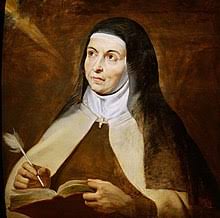
"My life was harder than anything one can imagine, because I found no rest in God and no happiness in the world... I thirsted for life, since I was aware that I was not living but wrestling with the shadow of death... My soul was weary, and though I longed for rest, my old habits would not let it rest for a single moment..." (Autobiography 8, 2.12; 9,1).
The woman who speaks of herself this way, in a moment of hopeless spiritual exhaustion, is Teresa of Ávila. She was then about forty years old, and she had not yet given herself over to God without reserve, though she had already been a Carmelite nun for twenty years.
Of this first period of her monastic life she writes:
"I spent nearly twenty years upon that stormy sea, falling and rising again, but rising to no purpose, since in the end I always fell once more" (8,2): "it is so contemptible a story that I would wish my readers to be filled with horror as they read this description of a soul so hardened and so ungrateful toward the One who had granted her so many gifts of grace" (8,1).
So what was happening within the walls of the Convent of the Incarnation in Ávila, where Teresa de Ahumada had already spent twenty long years? "
I am the weakest and most contemptible creature of all people" (7,22), she confesses, and we can only guess at the profound inner drama unfolding in her soul.
Yet it is a drama that is, of course, unfamiliar to us; it is easy for us to picture carnal temptations, essentially banal, with their falls and repentances, but hard to picture a spiritual warfare, a genuine battle whose sole concern is the love of God.
Teresa speaks of her "graceless" life in that period, of a "ruinous life," but if we were to look in it for what we usually call "grave sins," the search would leave us disappointed. She herself warns us of this when she writes:
"My soul was sick... I had fallen into the snares of vanity, yet not so far as to fall knowingly into mortal sin, even in moments of the greatest distraction... and indeed, had my conscience told me that anything of the kind was happening to me, I would by no means have remained in such a state" (7,14).
So there was something in her life that could not even be called sin (indeed, some of her confessors reassured her, telling her that her conduct was for the good of her neighbor), yet it seemed to her so serious that Teresa said of herself: "I was like someone who carries her own perdition within her."
All this is enough to stir our curiosity, and more than that, to awaken the conscience, which so readily makes its peace with the habitual, growing idle and dull.
To understand what kind of drama this is, we must return to Teresa's childhood.
At the beginning of the sixteenth century, when Teresa de Ahumada was born in Ávila in 1515, Castile was opening itself to the world: it was no longer merely a county, nor even merely a kingdom. With the accession of Charles V, Castile became the center of an empire on which the sun never set. Teresa was not yet sixteen when her little town of Ávila, beautiful as a castle, received the queen, who came there in spring with the four-year-old Philip II: three hundred pairs of maidens from noble families (among them, of course, Teresa) danced at the festival held in honor of their royal majesties' arrival. A few years later Charles V himself (who in 1530 received the golden royal crown from the hands of the Pope in the church of San Petronio in Bologna) made his solemn entry into Ávila, staging one of those festivities on which he was capable of spending enough money to arm a whole army.
In the house of Don Alonso de Cepeda y Ahumada there lived six sons and three daughters—their mother had died when Teresa was only twelve. One after another the sons sailed across the ocean to the New World that Christopher Columbus had discovered, drawn partly by the desire to make a career and by a thirst for conquest, and partly by missionary zeal.
Three daughters remained at home, and of them the most impetuous by nature was undoubtedly Teresa.
At six she could already—in those days!—read on her own, and her favorite book was the Flower of the Saints (Flos sanctorum), which, alongside the life of Christ, gathered the heroic lives of certain saints (martyrs, hermits, and holy virgins).
On long evenings this book was read together by the family, but afterward Teresa would take it up herself and discuss it with her eight-year-old brother Rodrigo.
They would begin to play a kind of spiritual "game": "There is life eternal, eternal, eternal!" Teresa would say.
And Rodrigo had to repeat exactly: "Yes, Teresa, eternal, eternal, eternal!"
Then the little girl would relentlessly go on: "And there is torment eternal, eternal, eternal!" And Rodrigo would obediently repeat: "Yes, Teresa, eternal, eternal, eternal!" The two children would fall silent, imagining together the fearsome eternity—with a certain dread, but not without pleasure.
The game grew so serious that one early morning the two children ran away from home: they wanted to set out for the mysterious "land of the Moors" (Spain had only recently been freed from Arab rule) in order to suffer martyrdom for the faith and enter into the eternal life that beckoned them so.
To the uncle who managed to find them (when everyone was already mourning them as dead, thinking they had fallen into one of the many garden wells), and then to their mother, who reproached them sorrowfully, Rodrigo answered through his tears that he had obeyed Teresa, but Teresa answered rapturously and stubbornly: "I want to see God!"
In her autobiography she later wrote with gentle humor: "The greatest obstacle to carrying out our plans was our parents."
Be that as it may, the little girl did not admit defeat: if they could not become martyrs, they could at least live as hermits (the second category of saints they knew of); and she persuaded her little brother to build, together in the garden, something like stone hermit cells. She writes: "We tried to build walls out of small stones, which almost at once came tumbling down."
This childish fervor may of course strike us as amusing, yet when Teresa had already attained her great mystical experience, she wrote, recalling these episodes of her early childhood:
"I think with reverent tenderness of how God gave me at once, from the very beginning, what I later lost through my own fault."
In essence, this is something any one of us might say—one has only to think of baptism.
The saint attached great importance to these events, explaining them in terms that are somewhat unusual but very telling:
"It pleased the Lord that from my earliest childhood the way of truth should be imprinted on my soul" (1,4).
And yet, in her searching analysis, she points with the utmost sincerity to the not entirely good motives that guided her in this and that later had harmful consequences for her spiritual life.
She says:
"...I passionately longed to die in that way (that is, as a martyr), yet not because I loved God with true love, but rather in order to enjoy the goods of heaven quickly and without much effort—the goods I had read about in the book" (1,4).
How exacting Teresa was toward herself, even as a child! Yet here lie the very origins of the drama that tormented her throughout her life: in those days she was drawn more to the "game" of paradise than to the love of God.
And so, as Teresa entered the full flower of girlhood and then of youth, she began to understand that she did indeed love God, as one loves beauty, happiness, eternity, but she also began to understand that she loved life, her own body, that she cherished human attachments and success.
She loved, if one may put it so, both heaven and earth, without quite understanding how the two could be reconciled.
Just as at six Teresa had read and reread the "Flower of the Saints," so now, in her early youth, she read on the sly the chivalric romances that were then flooding Spain and that entertained her mother, confined to her bed by illness...
Teresa spent "long hours by day and by night" reading these romances in secret from her father, and they so took hold of her imagination that, with that same brother Rodrigo, she wrote a chivalric romance of her own, which circulated among their relatives and cousins. It seems it even enjoyed great success.
Meanwhile she had grown into an enchanting young woman, and afterward, throughout her whole life, she charmed everyone she met.
People said of her: "Teresa is like golden silk, which goes well with any fabric and any shade of color." And she herself remarked with simplicity:
"It pleased the Lord that everyone should love me, and so it always was."
She began to attend to her appearance too carefully for her years and her station:
"I began to dress elegantly and longed to go out. I took excessive care of my hands and my hair. I used perfumes and every kind of vain contrivance, and, since I was very spoiled, I never had enough of them."
At the same time, among her cousins and relatives she became the confidante of all their little affairs of the heart, the center where the threads of every attachment came together. She played this role innocently, with an innate nobility, but she was then at the most dangerous of ages, and what she observed and heard was deeply imprinted on her heart.
Thus took shape the drama with which we began our story, and which would deserve a deeper psychological and theological analysis. Here we can speak of it only in the broadest terms.
On the one hand, Teresa still longed to devote her life entirely to eternal, unconditional values (which, especially in those times, meant a monastic vocation); on the other hand, she was drawn to everything in the world that was beautiful, desirable, noble, refined, exquisite.
At times the thought of the convent, of renouncing the world's vanity, enchanted her, and at times she felt toward it "the strongest aversion." Then again, it seemed to her that marriage, too, would set limits on her longing to embrace all that exists.
But she was a noble Spanish girl whose brothers were setting out to conquer the New World.
And so, at the age of twenty, Teresa resolved to stake everything: in secret from her father, who would not so much as hear of a monastic vocation, at dawn on 2 November 1535 she fled from home to the Carmelite Convent of the Incarnation.
Incidentally—since Teresa was then still very young—she persuaded one of her brothers to do the same, and to flee at the same time to a Dominican monastery.
She later wrote:
"I remember, and I think I speak the plain truth, that when I left my father's house I felt such a heartrending pain that it seemed to me one could not feel a sharper pain even in death: it was as if my bones were being broken one by one" (4,1).
In her beautiful, almost untranslatable Spanish she wrote:
"no creo sera mas el sentimiento cuando me muera":
"I do not think that, when I come to die, I shall feel a greater grief."
And so, "gathering her courage," she made, if one may put it so, her decision in favor of God. Teresa's heightened perception of life in its "eternal" dimension (life is that which is eternal) drove her to make a resolute and generous choice, setting out on the path of monastic life; yet she regarded this life as a "purgatory," a period of transition, when one must suffer in order later to ascend to heaven, a time of burdensome waiting.
In truth, monastic life suited her, and she at once threw herself zealously into the ascetic work of self-mastery, displaying great self-denial and virtue; but perhaps because she took to the task too zealously, and because the new life differed too greatly from the one she was used to, and perhaps because it cost her too great a psychological strain, it took a toll on her health. She was seized by a strange illness, and no one knew how to treat it. Teresa writes: "My whole body, from head to foot, was one continuous pain." A misguided and grueling treatment finished the work: Teresa's condition worsened and her life was in danger. Indeed, for several days she was even thought dead.
In the end she came to her senses, but she was completely paralyzed and tormented by the fear of death.
Those who saw in this illness a complex of hysterical phenomena have always had to reckon with the unanimous testimony that Teresa was a person of even temper, charming, kind, able to encourage others, patient and gentle even when she was suffering terribly. On the other hand, throughout her life this secret contradiction always remained: an ardent soul in a fragile body that seems unable to withstand the pressure from within, but which Teresa would subdue, subjecting it to harsh trials (journeys, hardships, cares).
Little by little her strength returned: she became a wise, mature nun; she learned to pray; she was loved, and people were drawn to her both inside the convent and beyond its walls—especially those who wished to follow the path of holiness. Often even Teresa's father would come to her for spiritual counsel and, under her guidance, attained such maturity that he died like a saint.
A circle of friends soon formed around the nun of Ávila, enchanted by her manly gentleness and gentle severity.
We must remember that she lived at a time when spiritual questions interested even people immersed in worldly cares and bustle. Prayer and the spiritual life were then discussed in the salons of duchesses.
And so the old problem confronted Teresa with new force. She writes: "I had a very serious fault, which became the cause of many evils for me, and it was this: as soon as I noticed that someone I found agreeable loved me, I grew so attached to that person that they never left my mind. Of course, I did not wish to offend God in any way, but I took delight in seeing that person, in thinking of them and of their good qualities, and I truly ran the risk of ruining my soul" (37,4).
Before going on, we must fully grasp the depth of these feelings: for Teresa this was not a matter of those somewhat ambiguous, unhealthy relationships that even spiritual persons sometimes form when they are not fully sure of their vocation. The relationships Teresa writes of were genuine, deeply spiritual friendships (many years later, when one of her novices asked her about temptations of the flesh, Teresa answered with simplicity that she did not know what they were); yet she felt herself "unworthy of God," unworthy to pray.
In trying to explain her drama, on the one hand she says that she did nothing wrong (and in this her confessors not only agreed with her but urged her to continue her "apostolic ministry"); on the other hand she maintains that she was "dooming herself to perdition," explaining:
"There was no wholeness in me," "I felt irresolute before the need to give myself wholly to God," "I could not shut myself up within myself (in order to pray) without dragging all my vanity along behind me."
In short, in the face of the two great commandments—the commandment to love God with all one's heart and to love one's neighbor—Teresa understood that on her spiritual path the time had come to place God not in first place but in the only place (loving Him "with all her heart"), renouncing all attachments, all other love, in order then to receive everything, even her neighbor whom she was to love, from His hands.
Teresa felt that this call was addressed to her (the call God addresses to a person when they have truly reached maturity in faith), but she was afraid to give up everything—she still could not fully believe that the love of God, by itself, could fill her heart. Perhaps because she did not dare to trust in God?
But then something happened that helped her to resolve.
One day, returning from one of those spiritual conversations that now only troubled and impoverished her, she passed before an image of Christ being scourged, which had happened to be brought into the convent for a festal service.
Here is Teresa's account: "...
As soon as I looked at Him, I felt such pain, such remorse at the ingratitude with which I had answered His love, that it seemed my heart would break. I threw myself at His feet, bathed in tears, and begged Him to grant me the grace never to offend Him again." At almost the same time Teresa met a young priest who, in hearing her confession, helped her to judge herself not from the standpoint of the evil she did or did not do, but from the standpoint of the good she might be hindering, by resisting the abundant outpouring of God's grace.
It was like a new birth; Teresa speaks of it as the beginning of a "new life."
She underwent a profound conversion, which is hard to describe, but which one might put in the simplest words this way: the ancient contradiction between the world of God and the world of humanity, between eternity and time, between love of the Lord and love of neighbor, was suddenly resolved when she realized directly, vividly, as if a veil had fallen from her eyes, that Christ is at once our God and our neighbor—eternity that has entered into time, a friend beside whom one can live, with whom one can talk and pass the time as with any other friend, and better.
Moreover, she understood that Christ is the center in which everything can and must once again be gathered.
From then on she gave herself over wholly to prayer, understood in a distinctive way, as the striving to follow Christ in the mysteries of His earthly life with the greatest possible realism: the realism of images, and above all of the Eucharist.
And into her soul poured visions and mystical experiences, as though the veil that always separates us from Christ had truly been torn away—the veil that constantly sets before us the temptation to regard Him as an abstract idea, a feeling, an image.
Teresa wrote:
"It seems to me that Jesus always walks beside me... I clearly felt that He was at my right hand and saw everything I did, and I never—it took only a little concentration, or not being too distracted—could forget that He was beside me."
One day Jesus said to her: "From now on I do not want you to speak with people," and Teresa obeyed; not in the sense of spiritual muteness (on the contrary, her life was as full as ever of intercourse with people, conversations, activity), but in the sense of a deep, ultimate silence—the silence of a person who, whatever they do or say, from then on always remembers what has happened to them... "and the memory fills them with silence" (the hermit Lawrence).
And so everything can once more be "said" and everything can once more be "loved," but "in Jesus."
Outwardly incidental circumstances required her once again to reflect on her vocation: as you will perhaps remember, she had entered the Carmelite convent as though into a purgatory, in order to be purified. The nearness of Christ, filled with love, helped her to understand an old truth: already here on earth one must learn to anticipate heaven, the hundredfold reward promised by Jesus Himself to those who follow Him.
Teresa lived in a convent where nearly two hundred nuns were gathered: there was no shortage of practical or economic problems, nor of problems of discipline (all of this, too, was reminiscent of purgatory); yet she later said that the many inhabitants of the convent did not distract her from communion with God, as if she were entirely alone.
Nevertheless she listened to the counsel of friends who set before her the plan of founding a small, poor convent with only a few sisters (twelve, after the number of the apostles), where deep silence and true poverty would reign, and which would be "a corner of paradise."
After many vicissitudes Teresa founded such a convent, gathering into it several young women from Ávila and becoming their spiritual mother, and there she lived in the conviction that she had found a quiet harbor in her life, delighting that at last the synthesis had been reached between eternity and time, between love of God, loved without limit, and an equally full and ardent love for those creatures He Himself had entrusted to her.
Teresa was immeasurably happy—not, of course, in her own holiness, of which she never thought, but in living "with such holy and pure souls, who desire only to serve the Lord and to glorify Him... He provided us with everything we needed, though we did not ask for it, and when, by His permission, we were left without what we needed—which happened rather rarely—our joy was all the greater."
These are the opening words of the book of the "Foundations," in the first chapters of which Teresa gathers the "little flowers" of Carmelite spirituality, akin to the Franciscan ones.
It seems that everything is complete, but on the contrary, everything is only beginning. For now Teresa "is dying of the desire to die"—that is, she lives, in her own words, rejoicing each time the clock strikes, at the thought that the final meeting with Christ has drawn a little nearer.
"This house," Teresa writes at last, "is heaven, if heaven is possible on earth."
But from now on she belongs wholly to Christ and is ready for anything.
At times she does indeed have a foreboding that something is not yet complete. She writes:
"...It has often occurred to me that God, having filled these souls (she is speaking of her sisters) with such riches, must have had some great purpose."
Moreover, there grows in her the desire to share with others the good she experiences in her own life. She says of this:
"...it has often seemed to me that I am like a person possessing a great treasure and wishing to share it with everyone..." (Foundations 1,6).
Of what was destined to happen we may say in advance this: until now Teresa had experienced as a personal drama her at times anguished and beautiful relationship with Christ; now Christ willed to make Teresa's whole experience part of the living drama of the Church of her time.
For any Spanish nun of that period, the Church was a given with which everyone lived in peace: the world was a Christian world, and everything found its appointed place in it: the Pope and the king, ecclesiastical culture and secular culture. Although the unity of the Christian world had been shattered by Luther, Teresa knew nothing of this, and Spain was then a united country.
And then suddenly there was revealed to her the tragic and grieving image of the Church of that age.
Just when she had founded her first new Carmelite convent, the wars of religion broke out in France; the Cardinal of Lorraine, arriving at the Council of Trent, told of the horrors being committed in his homeland, and news of them reached the little convent from two sources: from Teresa's friends among the clergy (some of whom took part in the Council as theologians) and from a circular letter sent by Philip II to all the convents, in which he described what was happening and called for fervent prayer.
Before Teresa's mind's eye there rose an unheard-of spectacle: Christians fighting other Christians and killing them, churches set ablaze and plundered, monasteries stormed and sacked, desecrations of the Eucharist, hatred and contempt for the Pope and the bishops. Even for us today it is hard to imagine the cruelties that accompanied the religious strife which all but destroyed Christian Europe.
Teresa was too intelligent not to understand at once that these "great calamities of the Church," as she called them, were the sad result of everything that had gone before, which she called "a most lamentable state of affairs": too many Christians had been unfaithful to their vocation, especially among those who should have devoted themselves wholly to Christ and the Church, and too many had defiled the face of the Virgin—the Bride of Christ. Of the decline of monastic life, moreover, she had known even earlier.
She had not yet recovered from this first shock, from which she suffered even physically, when she was struck by another piece of news, perhaps still more terrible.
A Franciscan friar came to stay at her convent, having returned "from the Indies," that is, from the new lands discovered by Columbus.
Teresa had followed their conquest from afar with joy and pride—it was a national enterprise in which her own brothers took part. She considered it a glorious, chivalrous mission. When, some years earlier, she had received the news that Rodrigo—the companion of her childhood ventures, who had then shared her mystical aspirations—had fallen fighting on the Río de la Plata, she spoke of it with the other nuns in the conviction that at last she had a brother who was a martyr, "because he died defending the faith."
Her brother Antonio (the one whom she had also persuaded to take monastic vows) died in battle.
But the Franciscan who brought tidings from the New World was the famous Fr. Maldonado, one of the most ardent followers of Bartolomé de las Casas: the great Dominican bishop, worn out by superhuman labor, was at that time near death, and Fr. Maldonado was taking his place, bringing to Spain the last "Memorial" that Las Casas had written, for the court of Madrid, the Council of the Indies, and the Supreme Pontiff.
Fr. Maldonado's brethren said that, if given the chance, he would talk all day of what was on his heart: and that is precisely what happened at the grille of the little convent.
Before Teresa's mind's eye and conscience there passed cruel scenes: the new peoples were not only failing to be brought to Christ but, on the contrary, were perishing, having become prey to the inhuman and brutal Spanish conquistadors. Of course, not all of them were like that. But how must Teresa have received words like those terrible ones attributed to Las Casas: "I have seen the Indians, as they lay dying, refuse the last sacrament with weeping, because they did not want to enter a Spanish paradise."
Perhaps this is only a striking phrase, but in hurling its accusation at the Spaniards it renders the situation exactly.
"I was so distressed," Teresa later recounted, "that I went away, bathed in tears..."
"These Indians cost me dearly," she wrote in a letter to her brother Lorenzo, who was still overseas, "...so many misfortunes both here with us and there with you: ...many people tell me of it, and often I have nothing to say except that we are worse than wild beasts..."
But we must not forget that Teresa was not the kind of person who would listen to dreadful news, be troubled, and then... gossip about it, as so often happens with us: everything she heard became for her an object of prayer, of conversation with Christ, a spur to making a decision.
Of necessity we can speak only in the broadest terms of Teresa's inner evolution.
First of all, there was born in her the awareness of her own responsibility, characteristic of the saints, who are always conscious of their share in what happens:
"Perhaps it is I who have angered Christ with my sins, and He has brought so many calamities upon the earth."
This is not false humility, nor self-pity, but so profound an awareness of the Church as the one Body of Christ, so vivid a sense of the abyss into which a person is cast down by committing evil (even if outwardly it seems harmless), that the soul is filled with a feeling of its own share in what is happening. In her autobiography Teresa wrote:
"It seemed to me that I was so wicked that all the evil and all the heresies of the world were the consequence of my sins" (30,8).
Very similar expressions are also found in St. Catherine of Siena and in other mystics.
Yet Teresa did not sink into despondency and despair, but began to act energetically.
The second conclusion Teresa reached was that there was no suffering on earth that could be compared to the suffering of the Church. She said: "It seems to me impermissible to grieve over anything else." And we can only imagine how free a person becomes who knows that they suffer only for what is worth suffering for, not squandering themselves on endless trifles.
Teresa's third conclusion was that she must, in her words, do the little that lay within her power.
Yet this "little" astonishes us by its resolve and its refusal to compromise: Teresa made a vow to God to act with the greatest possible perfection—that is, she promised in every situation to choose whatever seemed to her the most perfect.
If one reflects on this without being a person of truly great soul, it is a fearsome promise, one that can shackle the soul in heavy chains. And indeed, Teresa's confessors released her from this vow and had her make it in a milder form.
Finally, by a concurrence of circumstances and at the request of the spiritual authorities, she understood that she must devote herself not only to guiding the little convent she had founded, but to filling all of Spain with monastic communities like this one, and ultimately to reforming (some say "re-creating") the whole Carmelite Order.
By the time of her death there were sixteen new convents in Spain, conceived and created as small communities, where the mystery of the Church—Bride, Virgin, and Mother—found its most living and ardent embodiment.
This great work is recounted in detail in her book the "Foundations." Let us mention only that, owing to the state of the Church of that time and to certain vicissitudes that the Carmelite Order was undergoing, as well as to the tangled social and ecclesiastical situation in Spain, Teresa had to undertake an enormous labor. She had not only to make long and exhausting journeys and negotiate the founding of new communities, but also to take on the heavy task of making sense of a mass of orders and counsels, often contradictory, coming from persons who spoke in the name of one and the same Church.
In the end she even fell into the hands of the Inquisition; the papal nuncio called her "a disobedient woman, a vagabond, who violates the prescriptions of the Council of Trent," and in Rome the general of the order listened with irritation to everything that in any way concerned her.
Teresa bore all this patiently, sensibly, without losing heart, preserving her womanly dignity (her writings have come down to us that would greatly please the more sensible among feminists), and above all loving Christ without limit, imparting to all around her a new understanding and experience of the mystery of prayer.
Before her it had often been held that prayer—at its highest and deepest level, that which is called "contemplation"—meant an attempt to attain the serene purity of the world of God, having withdrawn from earthly cares.
Teresa taught her nuns that to contemplate means to fix the mind's eye upon the Sacred Humanity of Christ and, consequently, upon the whole mystery of that Humanity: upon the glory of His Resurrection, but also upon the sorrowful Passion—not only the Passion as a historical event, but also the passion that still befalls the Body of Christ, the Church.
The Church, with its concrete dramas, sufferings, problems, and the individual people of whom it is composed, is not only that for which one should pray (Teresa taught her nuns that otherwise they would not be fulfilling their vocation, however much time they devoted to silence and to the contemplation of God's mysteries), but is also, if one may put it so, the matter of prayer, that which nourishes communion with God.
And while Teresa spent her life in activity that seemed feverish, yet did not disturb the deepest peace of her nuptial union with Christ (she was granted the most powerful mystical experiences, which she calls the "spiritual marriage," and she was aware that the love of Christ had truly pierced her heart), she had, almost against her will, to carry on a great work of theology and teaching.
On this we must dwell in more detail.
By Teresa's time the Church had already existed for fifteen centuries, but if one imagines a library of all the works written by Christian authors, in it one could scarcely find a single theological work written by a woman: only a few works, most of them composed in a state of ecstasy.
Teresa is the first woman theologian in the Church in the strict sense of the word.
She was well enough educated: she knew the Bible fairly well, some of the Fathers of the Church, and many spiritual authors, both medieval and those best known in her own day.
And the paradox is that Teresa lived precisely when the Inquisition, seeing errors and dangers in everything, placed on the index of forbidden books almost all the spiritual books in the vernacular that Teresa possessed, ordering them destroyed, which she obediently did (Christ told her: "I will be your living book").
And so this woman, who would gladly have sat quietly at her spinning wheel, had to write out of obedience in the last period of her life, from the age of 50 to 67. If one bears in mind the average life expectancy of the time, she was at an age that today would correspond to 70 or 80.
Even in her handwriting there is so much resolve that graphologists are struck by the youthful energy with which she drove her pen across the page. She described her Life, above all her inner life, as if recounting a journey into the depths of her own soul.
She described her long journeys along all the roads of Spain and everything that happened to her during the founding of the various convents. She wrote spiritual works (the Way of Perfection) to teach her sisters and friends to pray, and to create something new in response to the Inquisitor's decree ordering other books to be burned. She wrote thousands of Letters, in which she conversed with the most varied people (the king, theologians, confessors, her collaborators, members of her household, monks and nuns)—letters in which there unfolds before us a remarkable picture not only of her activity and her interests, but also of the relationships she formed with different people and that lasted a long time: in those days there was no ecclesial movement that did not find in her an attentive, well-disposed interlocutor.
As one of her contemporaries said, many people, even King Philip II, "received her letters as living instruction for their good." And finally, in the last period of her life she wrote her masterpiece, the Interior Castle.
She wrote this work out of obedience, not without resistance. She said:
"Why do they want me to write? Let learned people, who have studied, take up such things; I am unlearned and do not know how to write; in the end I shall write one word instead of another... let them leave me sitting at my spinning wheel, taking part in the choir and fulfilling the duties of monastic life along with the other sisters. I was not born to write; for this work I have neither the health nor the head..."
And indeed, her health was not good: her headaches were becoming more frequent. Cares consumed her more and more: not the least of them was the fear of the Inquisition, which was meanwhile carefully studying the "Book of Life" (the Autobiography).
Teresa wrote the Interior Castle in five months: part of it at once, part with constant interruptions caused by journeys and unforeseen circumstances.
Perhaps many of you know that in our own century, too, a famous book was written called The Castle. It is a novel by Kafka, whose protagonist is summoned by the owner of a castle and taken on under contract. He gives up everything to go there, but then finds himself in an absurd situation: he cannot enter the castle, but neither can he depart from it. He belongs to the castle because he is bound by contract, but he cannot enter it because no one has any need of him and the castle, it seems, has no way in. The castle is unattainable.
In this terrible parable Kafka sought to describe the absurd condition of modern man.
Now, three hundred and fifty years before this, Teresa of Ávila, on the contrary, described the castle of the soul, with its many mansions and thousands of rooms—all of them arranged concentrically around the central mansion, the most secret one, in which the Divine Trinity dwells and from which streams the brightest light, illuminating the whole castle.
Of course, the farther you are from the center, the dimmer your foreboding, and the closer you draw to it, the more deeply you apprehend the beauty of God and of the mansion itself, as though approaching the sun.
The entrance door for everyone, even for those who still dwell in the cold and darkness of sin, in the company of the animals and reptiles that swarm on the outskirts of the castle, is prayer: whoever prays, as best they can, without giving up prayer, even if they are mired in sins, leaves the door open and nourishes the desire to step onto the path they ought to walk. And above all, they leave the door open for God, who can always address to them His call, filled with an irresistible power of attraction.
Once across the threshold, a person, drawn on by an ever-growing sense of assurance, warmth, light, and beauty, will continue their way until, already here on earth, they meet the owner of the castle. Teresa describes in detail all the stages of this path in vivid poetic images, interpreting them one by one.
For example, when a person reaches the mansion where the soul must at last surrender itself to God, give itself over to Him so that He may transform it, the saint tells us the parable of the little silkworm, which gradually grows until it begins to secrete a silken thread with which it builds around itself a house where it can hide and die, and from which it is later reborn as a beautiful white butterfly.
Teresa explains this parable:
"This house is Christ... Indeed, our life is hidden in Christ... O greatness of God! In how exalted a state does the soul emerge that has for a time been plunged into the infinity of God and deeply united with Him!"
Teresa wrote of this when she had already reached the center of the castle of her soul, which she calls the "final mansion."
Asking a person close to her to let a theologian read in secret the pages describing this final point of the journey, Teresa humbly confessed:
"Tell him that the person known to him (that is, herself) has reached this mansion and enjoys the peace described there. That is why her soul is very much at rest."
Yet this confession should not mislead us. Teresa wrote: "God does not caress souls"—the more He loves them, the more unswervingly He leads them along the whole path traveled by Jesus Christ, all the way to the Cross. And so, by the mysterious Providence of God, in the last days of her life there happened to her what until recently would have seemed to her impossible: she experienced what her biographer calls "the anguish of feelings bleeding" and "the encounter with loneliness."
The last journey Teresa undertook, against her will and only out of obedience—for she already felt herself "very old and weary"—was one unbroken succession of humiliations and disappointments: at one convent, because of questions bound up with an inheritance, she was received badly and all but driven away; at another, whose prioress had always been very attached to her, but who, having received a reprimand, met her so hostilely that the distressed Teresa could not sleep and in the morning left in a fever, not daring even to ask for provisions for the road. During the long journey she felt ill and asked for something to eat; the nun accompanying her could find nothing, and, weeping with grief, brought her a few dried figs left in the sack.
Teresa said to her:
"Do not weep, my daughter—this is what God asks of us now."
Her companion recounted: "She comforted me, saying that I should not be upset, because the figs were really very good and many poor people did not have even that."
At last she arrived at Alba de Tormes and wished to go to bed at once:
"My God," she said, "how weary I am!
It is more than twenty years now since I lay down so early."
Repeated hemorrhages finished her. She lay in bed like a feeble old woman, repeating: "O God! Despise not my humble and contrite heart."
She grieved, remembering her sins, and asked God's forgiveness for having served Him so poorly.
To her sisters gathered around her bed she taught faithfulness to their vocation and their Rule, and told them not to look at the bad example she had set them. She gazed at them and said: "Blessed be God, who has brought me to you!"—as if they were her refuge and defense.
She often repeated, as if to convince the Lord: "In essence, I am a daughter of the Church," and added:
"I thank You, O Lord my God, Bridegroom of my soul, that You have made me a daughter of Your holy Church."
She was asked whether she wished to be buried in Ávila, in the convent she loved so much. She was greatly surprised and said: "Jesus, can one ask about such things? Do I have anything of my own? Will they not give me a little earth here?"
Her biographer recounted:
"At five o'clock in the evening she asked for the Holy Mysteries. She was already so ill that she lay motionless... When she noticed that they were coming to her with the Eucharist, and saw that the Lord, whom she so loved, was entering the door of her cell, then, although she was utterly spent and bound by the heaviness of death, so that she could not even turn over, she rose without any help, so that it seemed as if she wished to throw herself down from the bed, and she had to be held back... She said:
'O my Lord and my Bridegroom, the longed-for hour has come. It is time for us to see each other. It is time for me to go, the hour has come...'"
Toward nine o'clock in the evening, shortly before her death, Teresa's face shone wondrously, and the hand that held the crucifix clenched with such force that it proved impossible to take it from her. She died smiling and as though speaking with Someone who had come at last.
The nuns of all the convents told of the miracles that occurred everywhere while their mother lay dying.
The nuns of Alba de Tormes told of the most moving miracle: before the window of the cell where Teresa was dying stood a little withered tree that had never blossomed or borne fruit. And then, after that night, at dawn the whole tree was covered with flowers as white as snow. This happened on 5 October.
And it happened because, if Teresa loved Jesus as her Bridegroom, Jesus loved Teresa still more.