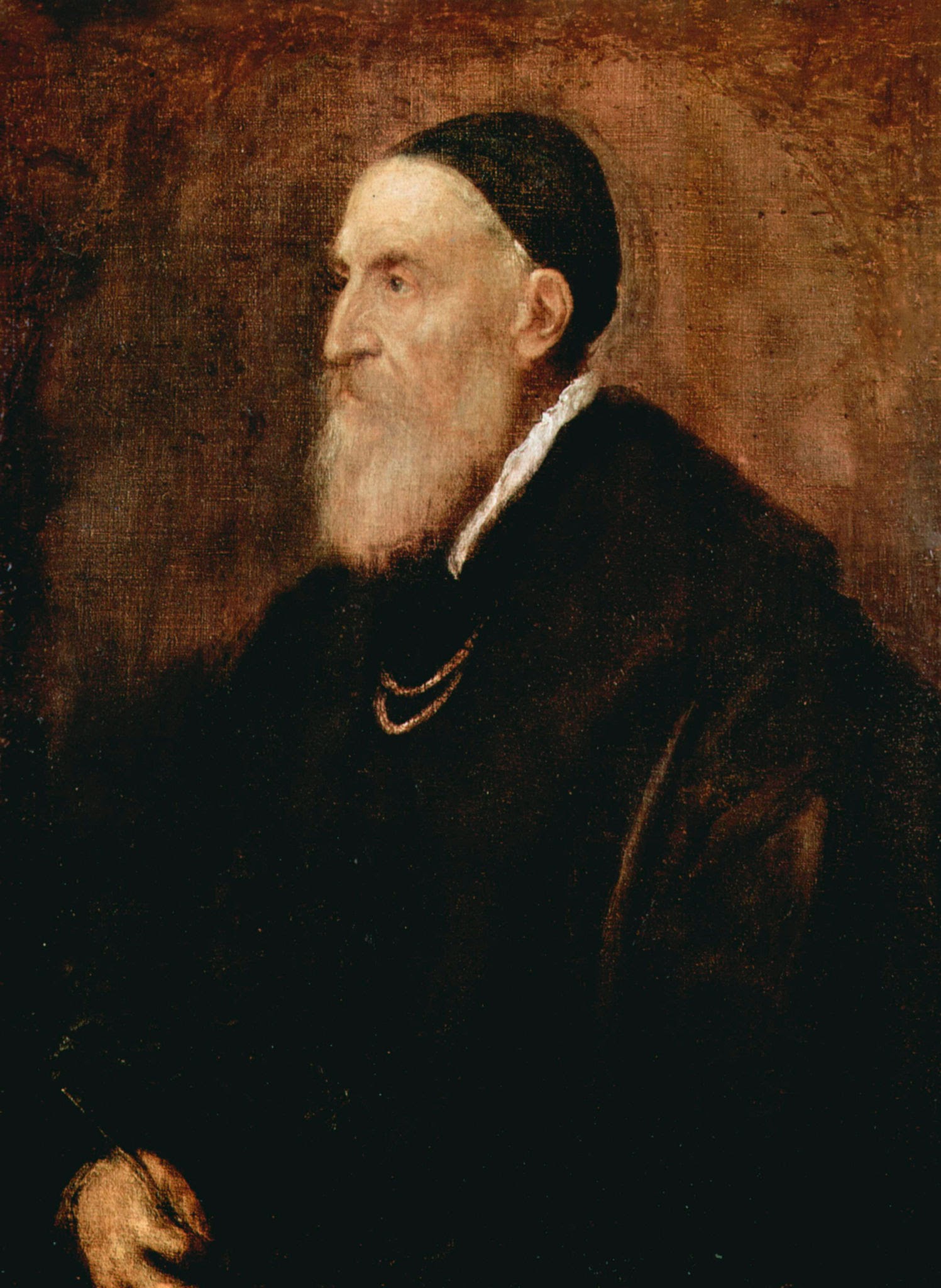
He lived almost a hundred years — the exact date of his birth is unknown, but he died of the plague in 1576, and he was at least eighty-five. In those years he changed the very idea of color in painting.
Titian Vecellio was born around 1488-1490 in a small town in the Dolomites. At nine he was sent to Venice to study. He entered the workshop of Giovanni Bellini, the finest painter in Venice, and later moved to Giorgione's.
When Giorgione died of the plague at thirty-two, Titian was at hand. He finished several of his pictures — and scholars still argue over where Giorgione ends and Titian begins.
Venice in the sixteenth century was light on water, festival, luxury, trade with the East. Titian understood the city better than anyone and gave it a painterly language. His color is not a description of form but a force in its own right: his red burns, his blue breathes.
He painted everything: mythology, religion, portraits. Charles V, Philip II, popes, doges — everyone wanted a portrait from Titian's hand. Charles V, legend has it, picked up the painter's fallen brush with the words: "Titian is worthy to be served."
The Venus of Urbino, Sacred and Profane Love, the Assunta — the grandiose altarpiece in Santa Maria Gloriosa dei Frari before which visitors still stop in the doorway.
In his last years his brush grew free to the point of near abstraction: broad strokes, patches of bare canvas. This is what is called the "late Titian" — and it is what painters admire most of all.