Why did the Catholic Church become so powerful?
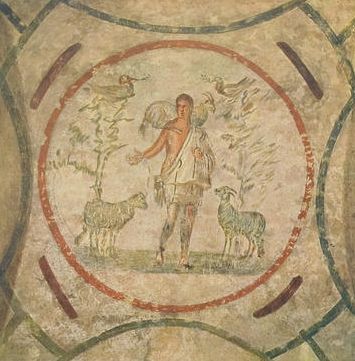
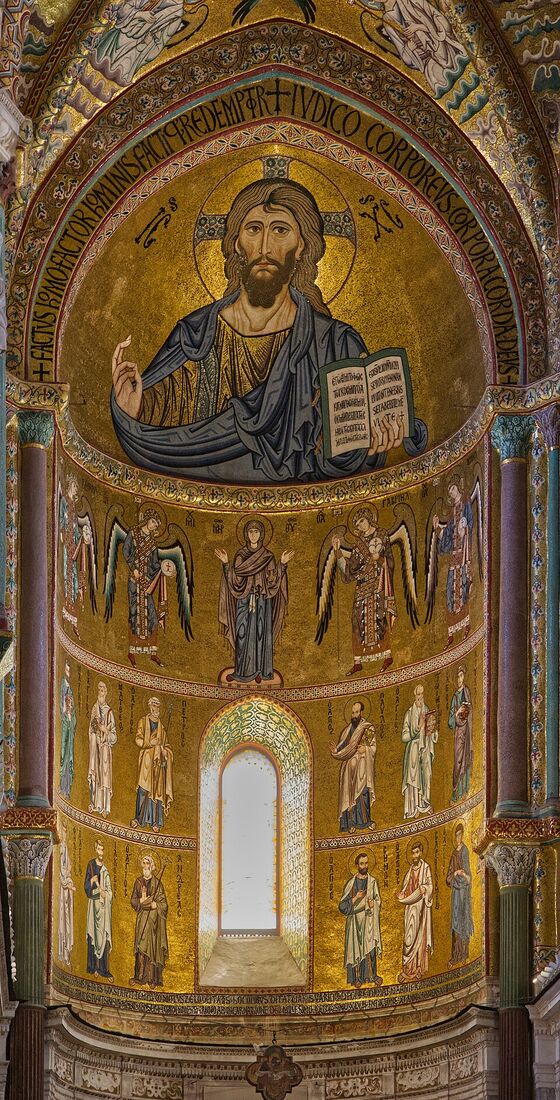
The earliest image of Christ is not the fearsome Pantocrator with a golden halo but a young shepherd bearing a sheep on his shoulders. He was painted on the ceilings of burial chambers, underground, the very posture borrowed from pagan bucolic. Here, in the catacombs, the Church is pure communion: no power, no property, no empire. Only the broken bread, the Name spoken in a whisper, and the dead, buried in hope. This is the direct continuation of the Ministry from the last drama: the face restored to the depersonalized, the Kingship as a multitude of persons and not as a system.
Tertullian will write of these persecuted communities the phrase that will become their motto: "The blood of Christians is the seed." The more they are killed, the more of them there are. The Church of the catacombs has nothing but faithfulness — and precisely for this reason it cannot be objectified: there is nothing to confiscate, no one to bribe, no apparatus to be seized. This is the Bride, not yet turned into a bureau.
Piero painted this night as a quiet miracle: the emperor sleeps in his tent, the guard has frozen still, and from above, within a circle of warm light, an angel descends with a cross. "By this, conquer." The most beautiful night in the history of the Church — and the most dangerous. Within one generation the persecuted becomes the privileged; the catacomb turns into a basilica; the Shepherd who bore the sheep ascends the imperial throne of the Almighty. The ideal becomes an institution, the institution becomes power.
Here the Berdyaevan line first cuts through in full force. The objectification of spirit is its fall into the world of objects, where living communion congeals into apparatus, into instrument, into a thing that can be owned and disposed of. And now it is no longer the individual man that is objectified but the Church herself. The Cross — the sign of the defeat of power, the instrument on which all force died (the whole of the last drama turned on this) — becomes a military standard, a sign of conquest. The symbol of the defeat of objecthood is conscripted into the service of domination.
Honesty requires holding both truths at once. Without the institution the memory would not have survived even a century: it was precisely the ecclesiastical order that preserved the Gospel, the canon, the sacraments, that carried the testimony through the darkness of the ages. Love had to take on a body in order to endure. But the body has its own weight: it constantly tends to confuse the Kingship with an empire, the Bride with a bureaucracy, the gift of the Spirit with an administrative resource. Berdyaev distinguished the Church as organism from the Church as organization, conciliarity from power: the first is life, the second a necessary and dangerous shell. The drama is that the shell forever tries to pass itself off as the content.
The spine of it all — the arc. The same law through the four voices: philosophy · literature · painting · music.
all 21 stations · Russian version