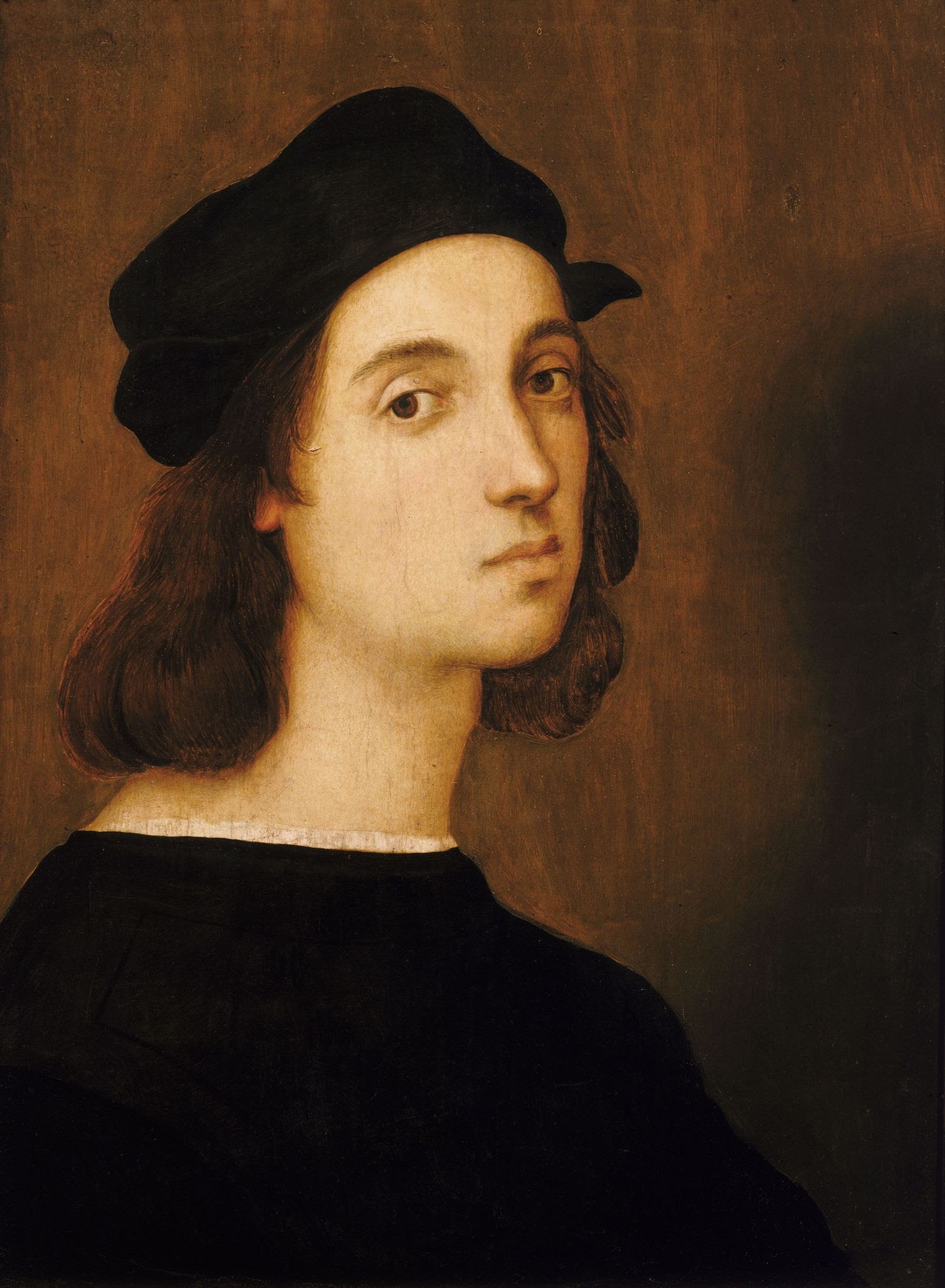
He was born in 1483 in Urbino, at a small court where art was still known how to be valued. His father was a painter and a poet — and died early: at eleven the boy was left alone. But he already knew how to draw. This, it seems, is the one thing he never had to learn — it was with him from the very start, like the color of his eyes.
In Perugia he entered the workshop of Perugino and took over his softness, his clear distances, his serene faces. And in 1504 he moved to Florence — and Florence in those years was not a city but a field of tension between two giants. There Leonardo da Vinci was at work, and there Michelangelo had just returned. The young man from Urbino looked at both — and learned from both, imitating neither.
This is Raphael entire. In Leonardo there is mystery, a haze in which the outline dissolves. In Michelangelo there is tension, muscle, the struggle of the body with its own weight. And in Raphael himself there is repose. That which is in no dictionary of painting and which is hardest of all to reproduce: harmony. His Madonnas smile without ambiguity. His figures stand exactly where they should stand — not further left and not further right. In his pictures there is nothing superfluous and nothing lacking, and so they seem not made but simply existing.
In 1508 Pope Julius II summoned him to Rome — to decorate his apartments. So arose The School of Athens: an imagined disputation of all the great Greeks under a single vault, a gathering of minds who were never in one room. At the center are Plato and Aristotle. Plato raises a finger upward: truth is there, beyond the visible. Aristotle draws his palm downward, toward the earth: truth is here, in the things themselves. Two gestures, the whole dispute of philosophy in one movement of hands.
He managed to do so much that thirty-seven years is hard to believe. The Sistine Madonna, where an earthly mother carries the Christ Child out toward us — and in her step there is neither fear nor triumph, only assent. Dozens of portraits in which faces live. The frescoes of the Vatican. And even this was not enough for him: he designed buildings, and after the death of Bramante he directed the construction of St. Peter's basilica — the largest undertaking of his century.
In his Madonnas lies the very thing for the sake of which all this was painted: the union of the earthly and the heavenly that does not tear in two but holds together. An ordinary woman and a Child who is greater than the world — and between them not a crack, not a strain. Harmony here is not an ornament but a testimony: the impossible has been joined, and it has proved beautiful.
He did not quarrel, did not make scenes, did not flee. He simply worked — and died as he had lived, quietly. Of a fever, said some. Of love, added others. And Rome put on mourning — for an artist, as for a sovereign.