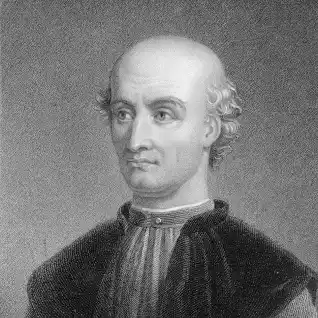
Bramante spent his youth in Urbino, where he came under the influence of the painters Piero della Francesca and Luciano Laurana, and he began as a painter himself. In 1476 he was invited in that capacity to Milan, to the court of Duke Ludovico il Moro, where he met Leonardo da Vinci, whose ideas on city planning left a deep mark on him.
In 1499, after Milan fell to the French, he moved to Rome, and there his art took on classical purity and monumentality. He achieved his greatest plastic unity in the little rotunda chapel of the Tempietto (1502), in the courtyard of the monastery of San Pietro in Montorio. Under Pope Julius II he became chief papal architect; from 1503, at the pope’s commission, he directed extensive works in the Vatican. He designed and began the principal church of Rome — St. Peter’s Basilica (from 1505) — and lived to raise it to the height of the arches. His work stands among the summits of Renaissance architecture.
In Urbino he had absorbed the advanced humanist ideas of Piero della Francesca and Luciano Laurana; before 1477 he moved to Milan, where he encountered the architectural experiments of Leonardo da Vinci. He worked at first as a painter, and this shows in his first architectural undertaking, the rebuilding of Santa Maria presso San Satiro in Milan (1479–83): having covered the nave and transept with massive barrel vaults, Bramante used perspectival painting and relief to conjure a choir roofed by a vault of the same kind; there too he carried out the harmonious centralized compositions of the sacristy and the small Chapel of the Deposition. In Santa Maria delle Grazie in Milan (1492–97) he built the choir and a bright, spacious crossing crowned by a light dome, uniting wholeness of conception with the decorative manner traditional to Lombard architecture. The basic design of the cathedral of Pavia (1488–92), its dome lifted high on eight slender piers above a vast crossing, is his as well.
Once settled in Rome in 1499, Bramante took a leading place among the architects who forged the pan-Italian style of the High Renaissance, which came to influence building across Europe. The facade of the Palazzo della Cancelleria, which he completed between 1499 and 1511, is severe and stately; to its inner courtyard, with its two tiers of graceful arcades, he gave lightness and plasticity. The little courtyard of Santa Maria della Pace (1500–04) is original in composition: its piers carry an arcade in the lower tier, while above, alternating with Corinthian columns, they support a flat architrave. His greatest plastic unity and clarity, his most joyous harmony, he attained in the small domed rotunda of the Tempietto (in the courtyard of the monastery of San Pietro in Montorio; 1502), ringed at its base by a Roman Doric colonnade and articulated on both levels by semicircular niches.
From 1503 Bramante directed extensive works in the Vatican for Julius II. He created there the Cortile di San Damaso (about 1510) and the Cortile del Belvedere (1503–45), some 300 meters long and closed by an immense niche, intended for tournaments and spectacles; the difference in level between its three terraces was turned into seating for spectators and a grotto with fountains. Developing the devices of ancient Roman ensembles, the Belvedere court anticipated the layout of many villas of later times. To the end of his life Bramante designed and built the grandiose Basilica of St. Peter in Rome. He proposed a centralized structure on the plan of a Greek cross inscribed in a square, with a mighty spherical dome over the crossing, four lesser domes, and towers at the corners. The project was never executed, but its ideas found embodiment in many centrally domed buildings in Italy and beyond.
Bramante’s achievement is one of the summits of Renaissance architecture: he created architectural images remarkable for their harmonious perfection and wholeness, and for their free, creative use of classical forms.