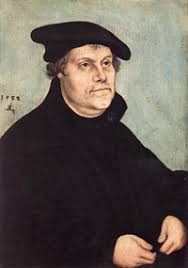
He was born in Eisleben on November 10, 1483, into the family of a miner who hoped his son would become a lawyer. Martin studied at the University of Erfurt and earned his master's degree — and then, in a single day, everything changed. In the summer of 1505, returning from his parents' home, he was caught in a thunderstorm near the village of Stotternheim. As the story goes, terrified by a lightning strike, he cried out a vow to Saint Anne: if he survived, he would enter a monastery. Two weeks later Luther knocked at the gates of the Augustinian monastery in Erfurt, to his father's despair.
Monastic life brought him no peace. He fasted, confessed for hours, wore himself out in obedience — and still felt unworthy of forgiveness. His theological studies at the University of Wittenberg, where he became a professor and received the chair of biblical studies, led him to a different understanding of faith: salvation is granted not through merits and rites but through a person's trust in God. This idea underlay everything he would do afterward.
The occasion was a Dominican friar, Johann Tetzel, who traveled about Germany doing a brisk trade in indulgences — documents that promised a reduction of the punishment for sins after death. On October 31, 1517, Luther made public ninety-five theses against this practice. He wrote them in Latin for a scholarly disputation, but the theses were almost at once translated into German and reproduced by the printing press throughout the country. A university argument turned into a public upheaval that Luther could no longer halt.
Rome demanded a recantation. In January 1521 Pope Leo X excommunicated Luther, and a few months later Emperor Charles V summoned him to the Diet at Worms. Luther was offered one thing — to renounce his writings. He refused to retreat and was declared an outlaw: from then on anyone could punish him without consequence, and sheltering a heretic itself became a crime.
On his way home a band of horsemen, sent by the Saxon Elector Frederick the Wise, staged an abduction of Luther and carried him off to the castle of the Wartburg. There, hiding under an assumed name, he spent almost a year and accomplished a work that transformed the German language: he translated the New Testament from Greek into German — not into the Latin of the chancelleries, but into a language a townsman and a peasant could understand. Later, back in Wittenberg, he continued the work and completed the translation of the entire Bible — it appeared in full in 1534.
From a fugitive Luther turned into the head of a new religious movement. In 1525 he married Katharina von Bora, a former nun who two years earlier had fled her convent. The marriage of a former monk and a former nun was a challenge to the whole old order and a decisive gesture in favor of a new life without vows of celibacy. Luther went on writing theological treatises, sermons, and hymns — one of his hymns, "Ein feste Burg ist unser Gott," became the chief anthem of the Reformation; two centuries later the sacred music of Bach would grow out of this chorale tradition.
Luther died where he had been born — in Eisleben, on February 18, 1546, at the age of sixty-two. He did not want to destroy the church — he wanted to return it, as he saw it, to the original meaning of faith. The result was the schism of Western Christianity and the birth of Protestantism, and, along with it, the German literary language, which took much of its shape thanks to the translating labor of one professor from Wittenberg.