the green why
all 21 stations · station 12 of 21

Why did God become man?
Can the eternal enter time without ceasing to be itself?

The Incarnation · The New Testament Drama
♪ Adolphe Adam"Cantique de Noël" — "O Holy Night" (1847)
The same subject, through the eyes of painters ↔
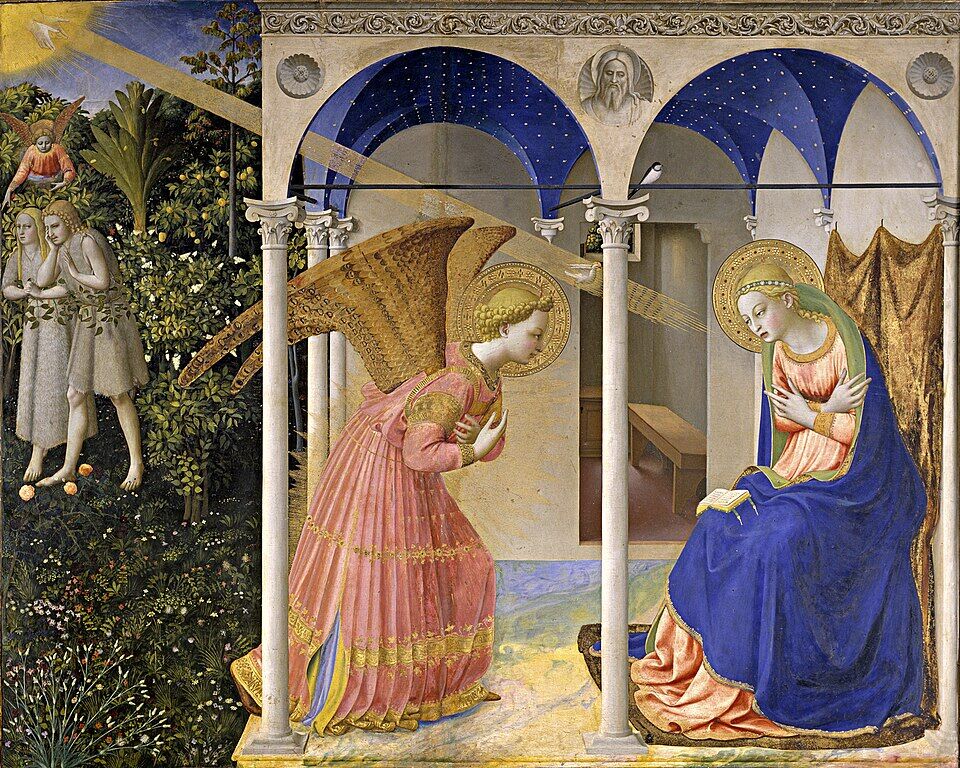
Fra Angelico, "The Annunciation" (c. 1426, Prado). The archangel and the Virgin lean toward each other beneath an arch; in the upper left corner, the expulsion of Adam and Eve from paradise. A single panel binds the two "noes" of Eden to the one "yes": at the very spot where the ancient couple walked out of the garden, Mary says "let it be to me according to your word" — and the door once slammed shut is opened by the first free human consent.
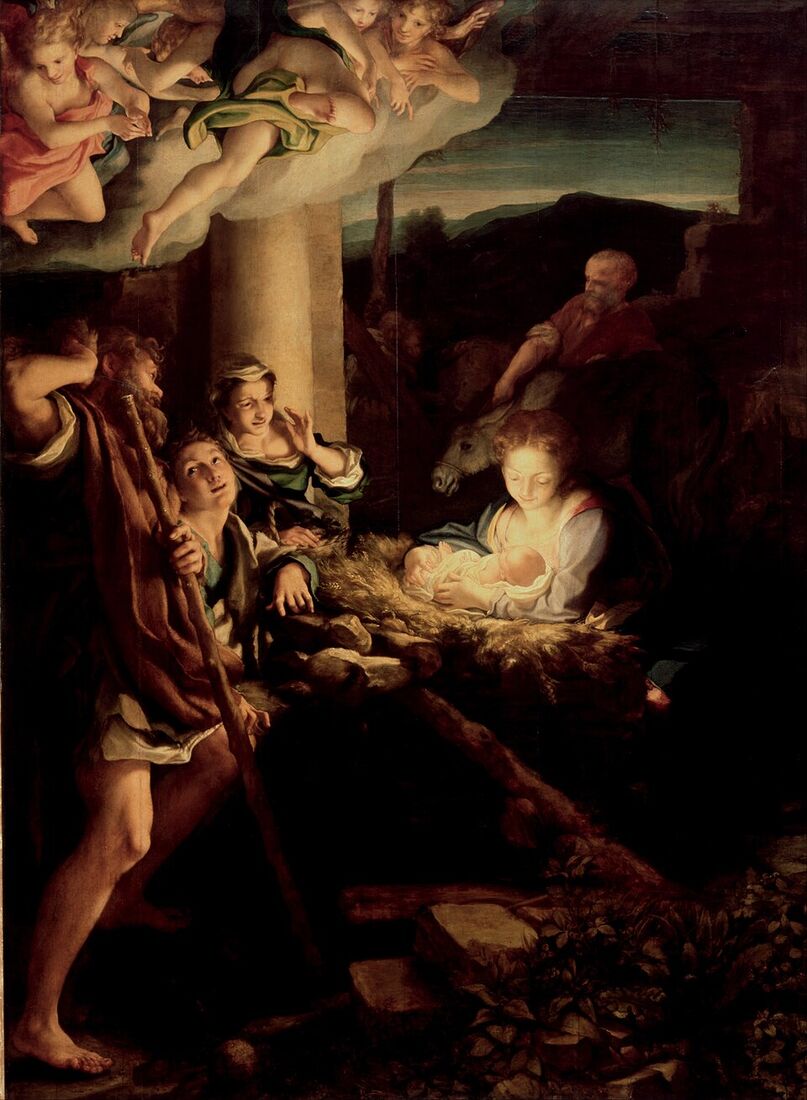
Correggio, "Holy Night" (c. 1525–30). The picture has no source of light but the Child himself: from him comes a radiance so strong a servant shields her eyes, and out of it the shepherds' faces emerge from the darkness. The theology of the Incarnation written in light — God enters the world not as thunder from above but as light from below, out of weakness.
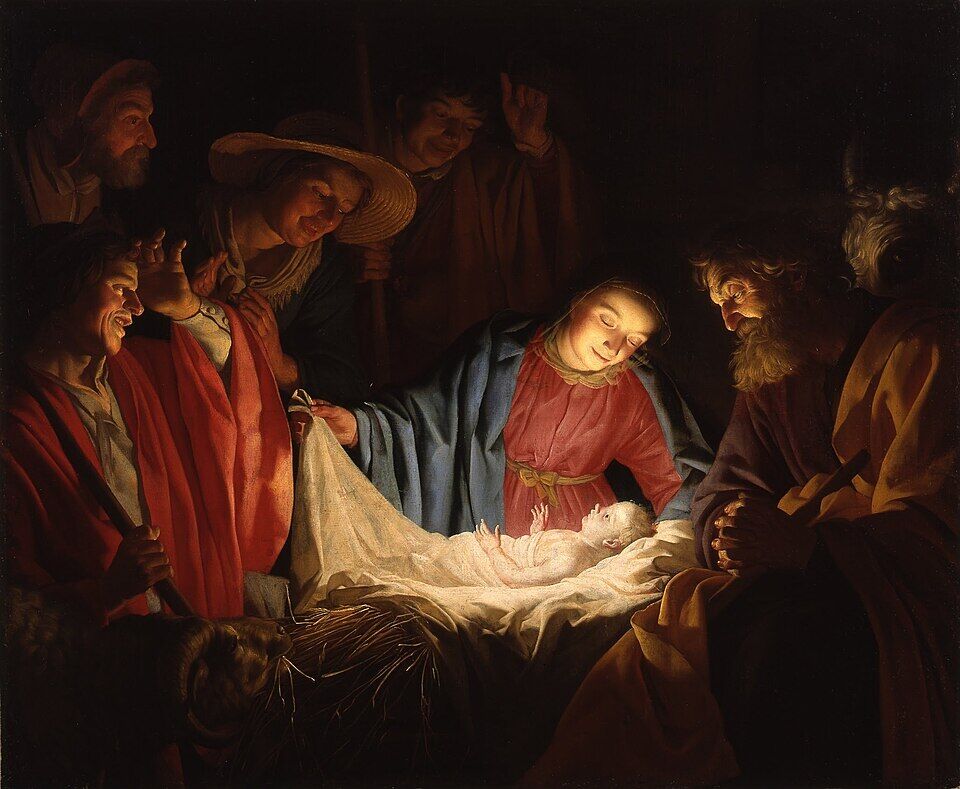
Gerard van Honthorst, "Adoration of the Shepherds" (1622). The darkness is nearly total — and the only lamp within it lies in the manger. The shepherds' coarse faces take on features for the first time, drawn out of the gloom by the light coming from the Child: the first to come to the light are those who had no face.

In Geertgen's dark night there is no moon, no torch, no angelic glow from above. The single source of light is the Child Himself. From Him, as He lies in the manger, a radiance streams forth, and in that radiance faces emerge: the bowed face of Mary, the muzzles of the ox and the ass, the coarse features of the shepherds, the wings of the angels. The light travels not from heaven to earth, but from the lowest point of the earth—from a feeding trough for cattle. This is the theology of the Incarnation, painted in pigment: God enters the world not as a force from above, but as a light from below, out of weakness.

The Apostle will call this by the word kenosis—self-emptying: "Who, being in the form of God… emptied Himself, taking the form of a servant, being made in the likeness of men." The eternal enters the temporal and consents to become finite. The boundless becomes an infant who can be swaddled. He who cannot be conceived becomes one who can be taken into the arms. God makes Himself vulnerable not as a stratagem, nor as a means to future glory—vulnerability is itself the very manner of salvation.

And the first to come to the light are the shepherds. Here, for the first time, they are granted faces: the light streaming from the Child snatches them out of the darkness. Thus, from the very first scene, the theme of the whole drama is announced—the restoration of a face to those from whom it had been taken. The darkness of self-will, in which the old paradise slammed shut, is not dispelled by new thunder. Within it a light is born—defenseless, and for that very reason invincible.

The road through this question: Can God really become a man? →
← previous stationWhy is God silent?next station →What is servant leadership in the Bible?
The chapters behind this station — the four books. Who makes this, and why.
The spine of it all — the arc. The same law through the four voices: philosophy · literature · painting · music.
all 21 stations · Russian version
🇬🇧EN