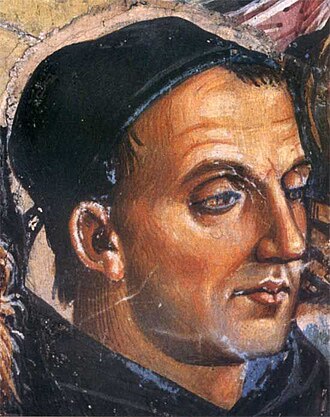
Before he became a painter, he became a monk. In the world his name was Guido di Pietro, but history has kept the nickname — Fra Angelico, "the angelic brother." He took his vows in the order of the Dominicans, the preachers, for whom word and image were equally a form of service. And the brush in his hands remained a continuation of the monastic vow: he painted not for the glory of a workshop and not for the commissions of noble families, but as he prayed — quietly, with concentration, with the sense that he was undertaking something greater and higher than himself.
For him painting was not a craft among crafts. It was a sermon in colors — a way to show the unlettered and the learned one and the same thing: the presence of the sacred in the world. Where the theologian reasons, the artist shows; and Angelico believed that the holy could be shown only by drawing near to it oneself. Hence the tradition that, depicting the Crucifixion, he painted on his knees and wept. Whether this is true or a pious legend, it conveys the essence exactly: for him an image was not the depiction of an idea but an encounter.
The purest embodiment of this intent is the frescoes of the monastery of San Marco in Florence. He painted the cells of the brethren, one scene for each tiny room. It was an almost invisible painting: it was not put on display, it was not seen by guests or patrons. The fresco was meant for a single monk who sat before it in silence and stillness. Each wall became a window for contemplation — not an account of an event but an invitation to enter into it. Sparse details, clean spaces, not one superfluous figure: everything that might distract from prayer has been removed.
It is there that his "Annunciation" is born — a subject to which he returned in several versions. The angel and the Virgin stand beneath light vaults, and between them are air and silence. There is neither storm nor pathos: only the bowed, accepting posture of Mary and the golden light in which the outlines dissolve. In this scene the eternal enters time without thunder — as morning light enters a room. The moment when the Word becomes flesh he painted as a moment of complete silence and complete humility.
In his painting two epochs meet. From the Gothic he inherited the gold of the backgrounds, the fragile tenderness of line, the bodilessness of figures seemingly woven out of light. But his space is already new, of the Renaissance: clear perspective, calm architecture, the human softness of faces. A few generations before him Giotto had given figures back their weight and feeling; Angelico joined this earthly truth to the gold of the old icon — and arrived at something midway between heaven and earth. Later masters of harmony, all the way to Raphael, would seek the very balance of clarity and tenderness at which he arrived through prayer, and not through theory.
That is why he is spoken of as an artist whose art was theology in colors. He did not illustrate dogmas — he let them be lived through: the mystery of the Incarnation, meekness, the light entering the world. The Church appreciated this centuries later: centuries after his death he was numbered among the blessed and named the patron of artists. Belated recognition, but exact — for all his life he had been precisely what he was at last called: a painter for whom to paint meant to pray.