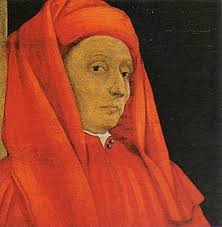
Before him, the figures in frescoes were flat. A golden ground, frozen poses, conventional gestures. Everyone did it that way — they had done it that way for five hundred years. Then Giotto came, and it became possible to weep.
Look at his Lamentation of Christ in the Scrovegni Chapel in Padua — 1305. The women bend over the dead body of Christ: one cradles the head, another gazes into his face. Angels hover in the air — and they too grieve. The sky here is not golden but blue. The figures are three-dimensional; they have weight. And Mary has not a holy mask but the face of a mother who has lost her son. Before Giotto this was impossible: grief could be indicated by a sign, but not shown as another's living pain, over which one longs to bend alongside these women.
Giotto di Bondone was born around 1267 in Tuscany. According to legend, he was discovered by the painter Cimabue: the boy was drawing a sheep on a rock so well that the master took him into his workshop. A legend — but a plausible one. In it one already hears the essential thing he could do: to look at the living and carry it onto a flat surface in such a way that it stayed alive.
He worked in Florence, Rome, Padua, Naples, and Milan. And he was famous in his own lifetime — so famous that Dante set his name into the Divine Comedy. This was the first time in history that a living artist was mentioned in a great poem — earlier, art had been a nameless craft in the service of the church, and now suddenly it mattered by whose hand it was made.
Giotto's innovation can be stated dryly: he understood that space can be depicted, that figures can have volume, that faces are able to express feelings — not conventional ones but specific ones. But behind this lies something greater than a technical device. He gave the body and the face back the right to be real, heavy, suffering — he gave man back his weight.
And here his step coincides with the very subject he was painting. Christianity says an incredible thing: God became flesh, entered a human body with all its heaviness, pain, and mortality. As long as painting painted gold and signs, there was nothing to show this tidings with. Giotto gave it flesh. His blue sky and his three-dimensional, grieving figures are the Incarnation seen through the eye of an artist: the holy ceases to hover above the world and descends into it, so that it can be truly wept over.
Two hundred years before Leonardo, he took the step without which Leonardo would have been impossible. He died in 1337. Florence mourned him officially — the city was bidding farewell to the man who taught painting to weep.