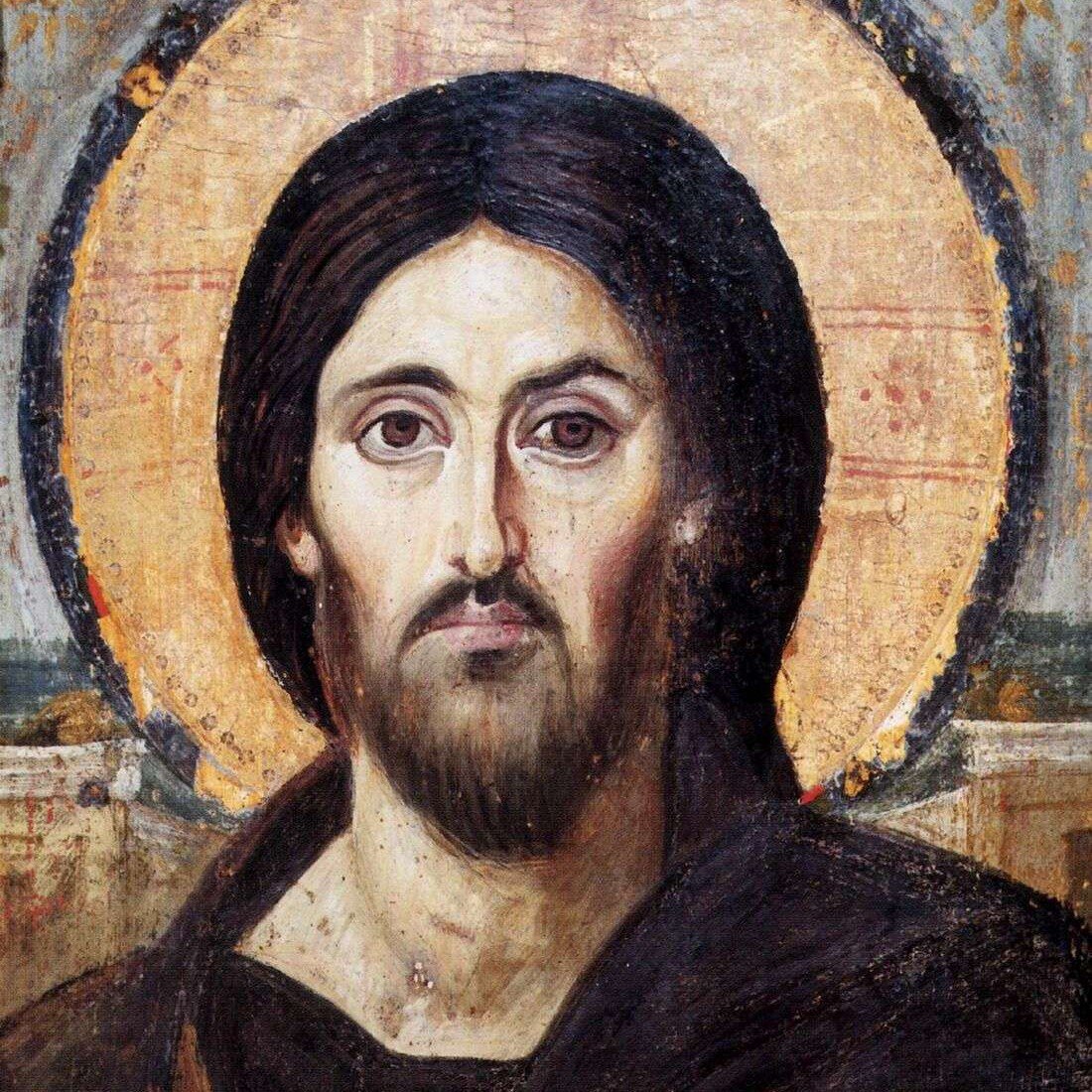
At the centre of this station stands a question that seems impossible: can the eternal enter time without ceasing to be itself? The Christian faith answers it not with an abstract formula but with a name. The Second Person of the Holy Trinity, God the Word, the Logos, the Only-Begotten Son of God, begotten of the Father before all ages — Light of Light, true God of true God, begotten, not made, of one essence with the Father. He "by whom all things were made," by whom all was created. And this fullness of the Godhead was incarnate of the Holy Spirit and the Virgin Mary and became man.
The Chalcedonian Definition of 451 uttered the mystery with the utmost precision: Christ is perfect in Godhead and perfect in manhood, in two natures — without confusion, without change, without division, without separation. The Godhead did not dissolve into the manhood nor absorb it; the manhood diminished nothing of the Godhead. One Person, two natures. The eternal entered time and remained eternal. The infinite was contained in an infant at Bethlehem and remained infinite. This is neither compromise nor commingling, but something that can only be confessed: the fullness of the meeting of Creator and creature in one Person.
The earthly side of this meeting is almost offensively plain. Born in Bethlehem, raised in Nazareth — a backwater town of Galilee. A carpenter. At about thirty He came forth to preach, and the preaching lasted three years. He wrote not a single line. He held no office. He chose twelve disciples — fishermen, a tax collector, a zealot: not one priest, not one educated man. In the way God enters history there is nothing of the splendour of power — and it is by this defencelessness that He overturns the very notion of greatness.
The core of His teaching is the Sermon on the Mount, the most influential ethical text in history. "Blessed are the poor in spirit" — the Kingdom belongs not to the strong but to those who have recognised their need of God. "Love your enemies" — for the first time love is declared an act of will, directed against the nature of fallen man. "Judge not, that ye be not judged" — judgment belongs to God, not to men. And the parable of the Good Samaritan overturns the very measure of kinship: your neighbour is not the one who shares your blood, but the one who showed mercy. He taught in parables — the mustard seed, the prodigal son, the labourers in the vineyard — and each was an overturning: the last become first, the tax collector more righteous than the Pharisee, one lost sheep dearer than ninety-nine obedient ones. He drove the traders from the temple, ate with sinners, healed on the Sabbath: "The Sabbath was made for man, and not man for the Sabbath."
And then — the cross, the most shameful execution of Rome, appointed for slaves and rebels. He accepted it willingly. And here the mystery of the Incarnation is disclosed to the full: God does not watch over suffering from afar — He passes through it Himself. "In the tomb in the flesh, and in Hades with the soul as God," He descended into Hades, slew it with the radiance of His Godhead, shattered its gates, and led out the righteous of the Old Testament from Adam to John the Forerunner. Trampling down death by death, and upon those in the tombs bestowing life, He rose on the third day, ascended, and sat at the right hand of the Father. The cross turned the symbol of shame into the symbol of salvation. The Apostle Paul named this threshold the whole of the faith: "If Christ be not risen, then is our preaching vain, and your faith is also vain."
The consequences of that preaching in Galilee outgrew it many times over. The idea of the equality of all men before God became the foundation on which human rights would later grow. "Render unto Caesar the things that are Caesar's, and unto God the things that are God's" separated spiritual power from secular. Linear time, with a beginning and an end, took the place of the eternal pagan cycle. Hospitals, universities, the abolition of gladiatorial combat — distant consequences of a single event. The calendar of humanity is still reckoned from His Nativity, and more than two thousand years later there are on earth about two and a half billion Christians.
Over His words the most restless minds have never ceased to ponder: Dostoevsky, Pascal, Kierkegaard, Bonhoeffer. Nietzsche declared God dead — but found nothing to replace the Sermon on the Mount. Three years of preaching. Not a single written line. The cross at thirty-three. The Resurrection. The eternal entered time without ceasing to be itself — and the world has still not contained what was said.