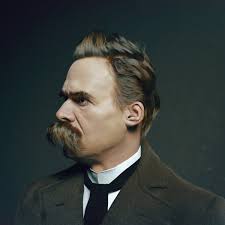
He did not overturn the European consciousness — he reflected within himself the upheaval that had been ripening all through the nineteenth century, and became its herald. That is why he was taken up not by philosophers but by the crowds. German youths went off to war carrying three books in their packs: Luther's translation of the Bible, "Faust," and "Thus Spoke Zarathustra." "I am no man, I am dynamite," he wrote; "my name will be remembered in connection with a crisis such as the earth has never known." He prophesied his own fate — and it came to pass.
The son of a Lutheran pastor, having lost his father at the age of four, he set early to fashioning his own myth. In a secondhand shop he bought "The World as Will and Representation" and saw in Schopenhauer "sickness, cure, and refuge"; at the same time he cast off Christianity. At twenty-four, before he had even defended a dissertation, he was given the chair of philology at Basel; then came friendship with the composer Wagner, and a first book, "The Birth of Tragedy." The Greek soul, he said, is a synthesis of two principles: the Dionysian — passion and natural power (the chariot of Dionysus drawn by panthers) — and the Apollonian — harmony and measure. The real Greece is the pre-Socratics; Socrates destroyed her with his rationalism, "saying no to life."
He was tormented by a grave disease of the brain — the pains would not release him for three days at a stretch; in his early forties he gave up his chair. Out of his suffering he drew the distinction between two pessimisms: the romantic — the flight of the defeated, who now believe in nothing — and the tragic, which accepts life in its full horror. So was born amor fati, the love of fate: not to escape it but to strive toward it.
In "The Gay Science" a madman proclaims: "God is dead." "We have killed him — you and I. We are all his murderers." The death of God is not mere unbelief but the renunciation of the whole Christian civilisation; and at this he rejoices. But Nietzsche is too intelligent not to see the abyss: with the death of God every hope collapses — hope in a rational cosmos, in eternity, in the correspondence of morality and future. What remains is emptiness. Hence nihilism — the inevitable consequence of a Christianity gone dark. And what remains is the natural man, enacting his instincts, the highest of which is the will.
The will to power is the supreme secret of life: every being craves to realise wholly the possibilities hidden within it. Hence the revaluation of all values. Christianity, the religion of compassion, weakens man and turns him into a dwarf; in its place comes the morality of masters and slaves. The aristocratic morality is self-sufficient, saying "yes" to itself; the slave morality is its inversion, ressentiment: the rancour and spite of the weak, hiding behind virtue and humility. The very division into good and evil is a mark of slavery; the master lives "beyond good and evil." For his heroes he takes not Plato but Alexander, Cesare Borgia, Napoleon — those who lived for themselves. Above the crowd rises the superman, called to fill the emptiness; he will appear not as the outcome of evolution but as the fulfilment of will — the state for him is merely an instrument, "the coldest of all cold monsters."
Linear progress he rejected in favour of the eternal recurrence: everything has already been and will return again, down to the smallest detail. And here are two positions — that of the slave, who submissively endures his fate, and that of the superman, who in this storm finds himself: "this is what I wanted, want, and will want always." In "On the Genealogy of Morals" he draws the image of the blond beast — the animal into which the higher man threatens to turn. Through all of 1888 he read Dostoevsky — but inside out, as revelation rather than as a verdict upon nihilism. At the beginning of 1889, in Turin, he lost his mind for good and faded away in madness for ten years. Later his legacy was distorted: his sister Elisabeth falsified the late texts — and only a mid-century edition based on the archives restored the true Nietzsche.
And yet his name is alive. He argued with Socrates and Plato over whether reason had killed life itself — and the argument is not closed. To the crisis he proclaimed one could have answered otherwise: Vladimir Solovyov, in his legend of the Antichrist, showed how such a superman becomes the Antichrist — and defeated that superman within himself. Herein lies the bridge: Nietzsche named the sickness of the age with merciless honesty; the question of what might cure it he left to us.