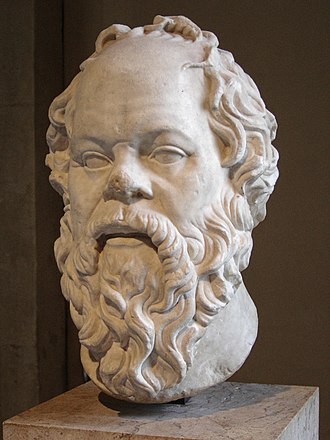
Before Socrates, Greek philosophy looked at nature — at what the world is made of. Socrates was the first to turn the question back on man himself: how should one live, and what are goodness, justice, courage? "Know thyself" — the inscription on the temple at Delphi — he made the work of his whole life.
His age was the heyday of the Sophists, paid teachers of wisdom. They taught that there is no truth, only opinion; that "man is the measure of all things"; that in any argument one can prove anything and win. Socrates rose against this relativism with his whole being: truth exists, it is not for sale, and it must be sought together, not won in debate.
His instrument was the dialogue. Socrates wrote nothing and gave no lectures — he would catch a man in the marketplace and question him: "you speak of justice — but what is it?" And question by question he would bring his interlocutor to see that, for all his supposed knowledge, he in fact knew nothing. Socrates himself called this maieutics — "the midwife's art": he did not implant the truth, but helped it be born within the person himself.
Hence his famous paradox: "I know that I know nothing." The oracle called Socrates the wisest of the Greeks — and he understood why: not because he knew more than others, but because he alone honestly acknowledged his own ignorance, while the rest imagined themselves wise. Wisdom begins with the admission of ignorance.
In ethics he drew a daring conclusion: virtue is knowledge. No one is evil by his own will — evil is done through ignorance of the true good; whoever truly knows what is good will act accordingly. And a person should care first of all not for his body and possessions, but for his soul — for making it as good as it can possibly be.
For this he was put to death. Athenian democracy charged Socrates with "corrupting the youth" and "impiety toward the gods" and sentenced him to the cup of poison. He could have fled — his friends had arranged everything — but he refused: a citizen has no right to break the laws of his city even to save his own life. He calmly drank the hemlock, conversing with his students about the immortality of the soul to the very end. For the first time a philosopher died for fidelity to the truth — and by this he made philosophy not a doctrine but a way of living and of dying.