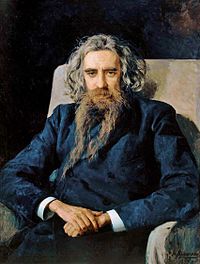
He was almost exactly contemporary with Nietzsche in time — born a few years later, he died in the same year as him, in August 1900 — but while the German herald of the superman spent his last decade in madness, our thinker remained lucid and active to his final hour. The son of Russia's foremost historian, raised in the intense intellectual milieu of Moscow, at the age of seven, walking near a church, he experienced his first vision of the beautiful Maiden — the one he would later describe in the verses "Three Meetings." As an adolescent he gave four years to the fashion for nihilism and materialism, and at sixteen, having read Spinoza, he returned to faith and to the Church, having understood that Christianity itself could be expounded in the language of the new philosophy.
Already at twenty-one he defended his master's dissertation, "The Crisis of Western Philosophy," directed against the positivists, and by twenty-seven he had become a doctor with the work "A Critique of Abstract Principles." He called abstract any principles severed from the whole: bare reason without faith, bare experience without reason. Against these he set integral knowledge — a synthesis of science, philosophy, and religion, in which philosophy is handmaiden not to social interests, as with the materialists, but to a higher, theological end. This was an answer to Marxism on its own ground: not to reject the thirst for a perfect ordering of life, but to transfer its foundation from earth to the absolute.
His fundamental intuition is All-Unity: the unity of man, of all humanity, and of man with God. Here he inherits the ancient tradition — the intelligible cosmos of Plato and the contemplation of the One in Plotinus — but he conceives humanity as a single, real organism, a subject of history, in which there is no difference between peoples, faiths, and colors of skin. Hence too his remarkable openness: he wrote with warmth about Islam and Judaism, and on the day of his death memorial services were held even in synagogues.
The core of his system is the teaching on the two absolutes: the Supra-existent God and the world as the absolute in the process of becoming. God, as it were, posits Himself in the other, and the one disperses into multiplicity — the world turns out to be a mirror shattered into billions of fragments at war with one another. Evil he understood not as the guilt of human freedom but as an objective disintegration, a chaos behind which there nonetheless stands a ready-made cosmos, like the picture on the lid of a box of scattered mosaic pieces. And then the task of man is to gather the world together as it is gathered in God; the task of the philosopher is to show people this integral picture.
The bearer of this gathering power is Sophia, the Wisdom of God, the soul of the world, "the great royal feminine being," receiving God into herself as a bride receives the bridegroom. Her central and perfect manifestation was, for him, Christ, and Godmanhood is not the God-man alone, but the enduring, historically unfolding interaction of God and man. In this development of spirit one hears Schelling and Hegel, from whom he also took the idea of the intuitive contemplation of the absolute: God cannot be proven logically, just as one cannot prove the existence of the person sitting beside one — He is attested by an inner intuition, accessible to anyone, not to the scholar alone.
In the nineties, disillusioned both in his own proud dreams of a universal theocracy and in his personal attachments, he wrote "Justification of the Good" — against Nietzsche. Here is his bold thought: the good is not chosen; man is drawn to it by his very nature, it determines the will by the whole infinity of its content; freedom remains only in the refusal of the good, in the fall into evil. And in "The Meaning of Love" he shows that love is not for the sake of the continuation of the species, but a path to the overcoming of death and the restoration of the whole human being, the unity of the masculine and the feminine, idealizing the other unto communion with All-Unity.
In his last year, horrified at the caricature into which his sophianic insights were being turned, he completed "Three Conversations" with its prophetic "A Short Story of the Antichrist" — a bitter glimpse of the coming collapse of a century he himself would never enter. And so he stands upon the threshold: the father of Russian religious philosophy, on whose questions of All-Unity, integral knowledge, and Wisdom all the thought that followed him would live — Berdyaev, Frank, and those who could not pass him by, whether in agreement or in dispute.