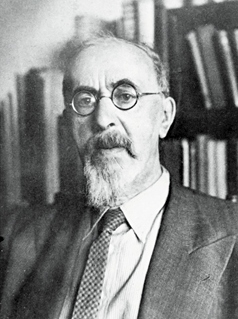
There are themes that philosophy gropes toward anew in every age. One of the greatest is total-unity (vseedinstvo): the intuition that the world is not scattered into separate things and warring "selves" but is bound from within by a spiritual unity with the Absolute, with God. It was first read religiously by Plato, deepened by Plotinus with his "beyond being," and it sounded in Dionysius the Areopagite and Nicholas of Cusa. In Russia Vladimir Solovyov pondered it. But its most profound thinker became Semyon Lyudvigovich Frank, whom without hesitation people called the greatest Russian philosopher of all.
His path passed through the full measure of human experience. Born in 1877 into a cultured Jewish family, he learned as a boy, at his grandfather's insistence, Hebrew and the Talmud — and the memory of that touch of the holy remained with him forever. Then came a long interruption: under the influence of a Populist stepfather the young man became an atheist, was drawn to Marxism, was arrested and expelled from the university towns. But already his first work criticized Marx's theory of value, and Frank was moving toward idealism. The death of Tolstoy, he confessed, brought something whole crashing down within him — and in 1912 he was baptized into Orthodoxy. This was no career move: he understood the "religious tragedy" of conversion and went toward it alone.
He met the revolution as a catastrophe of division. In 1922 he was expelled from Russia with no right of return — aboard the "philosophers' ship." In Berlin he entered the religious-philosophical academy founded by Nikolai Berdyaev; from 1930 he lived in France, and during the years of the occupation he hid from the SS near Grenoble — hungry as a hunted beast. "Love devours evil," he would repeat. For him philosophy was not a play of concepts but a confession: "a confession of what one dimly senses and loves, of what helps one to live."
The core of his teaching is a theory of knowledge that became a metaphysics. All being is rooted in the Absolute, and therefore every object, even before reasoning, stands in immediate contact with us. Beyond ordinary logic, where "A is not not-A," lies a metalogical unity in which "A" and "not-A" are joined without ceasing to differ; Frank called this monodualism. Hence two kinds of knowledge: abstract logical cognition deals only with things cut off from the whole — while living knowledge not only contemplates its object but lives it, encountering it in the Absolute.
To this is devoted his summit book — "The Unknowable." The title does not mean that knowledge is powerless: it marks the boundary beyond which concepts end and a reality more profound than any thought begins. The unknowable is not somewhere far off — we are ourselves within it, and the whole world is steeped in its saps, as in an eternity that seeps "through all the pores." In this primal ground there is no frozen givenness: it lives, and within it there is freedom.
God, for Frank, is not an object outside us but a primal reality that opens from within. "Addressing me, the nameless first acquires a name — the name of God": in the experience of prayer the Absolute becomes a "Thou," and through this encounter my own "I" is disclosed. Personality thereby is indestructible: it does not dissolve into the abyss but draws itself from it; "I" and "we" are equally primary, and Divine-humanity (Bogochelovechestvo) is the very fabric of our soul. Before one thing alone did he honestly halt: before the mystery of evil. If all is pervaded by the perfection of the Absolute, whence comes evil? Frank confessed that he could not contain within himself the notion of original sin, that to explain evil would be to justify it — and he left the question open.
In this lie both the strength and the limit of his work. He showed the immanence of our consciousness within the Divine being and restored to the thought of total-unity its ancient pathos of overcoming discord — in an age that was rolling toward a new war. His "Meaning of Life," "The Unknowable," "The Light Shineth in Darkness" are not a reference book of ideas but a testimony suffered through. He continued the tradition of total-unity that runs from Solovyov; beside him, in exile, thought Berdyaev — a voice of the same longing for wholeness. And if Hegel dissolved personality in the march of the spirit, Frank defended its freedom: man is not the willful master of life but a "free executor of the higher biddings," able to rise above himself and to conquer the evil that is not from God but from us.