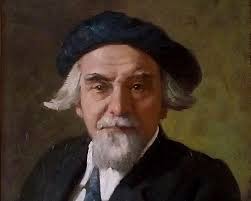
He came out of a world that felt itself standing over an abyss. Russian educated society at the turn of the century had already poisoned itself with godlessness and a craving to tear everything down — and, weary of a flat positivism, it reached toward a new religious consciousness, travelling the road from Marxism to idealism. Nikolai Berdyaev — grandson of a general, raised without a trace of faith in his family (it was Schopenhauer, not the Psalter, that sank into his soul) — walked that road to its end. As a student he was expelled from Kiev University and exiled; he exchanged Marxism for a philosophy of spirit, but a rebel he remained forever. "All my life I have been a rebel," he confessed in "Self-Knowledge," the very book with which one ought to begin knowing him.
The heart of his thought is the primacy of freedom. For the Marxists freedom was "recognised necessity"; for Berdyaev it lies on the far side of all necessity. Following Immanuel Kant, he separated two kingdoms: the kingdom of necessity, where causality rules, and the kingdom of freedom, to which the moral law belongs — a law given for this world yet not of this world. And he takes a still bolder step: for him human freedom is uncreated. God is all-powerful over being — but not over the freedom of man. This bottomless, unconditioned freedom is prior to being itself.
From freedom is born his teaching on creativity as well. Man need not justify himself before salvation — "creativity justifies life." God awaits from man not passive obedience but a creative response: "God became man so that man might become god." Here Berdyaev touched on what is central to Christianity — the divinity of man — even if in words too daring. He distinguished three ethics: the ethics of law, the ethics of redemption, and his own ethics of creativity. True creativity is not "painting a picture" but giving rather than taking, freeing oneself from the lust of possession; it is the continuation of the deification of the world.
But all creativity, on entering the world, risks freezing into rigidity. This Berdyaev called objectification — the enslavement of spirit to the laws of the fallen world, the source of bondage. To it he opposed expressiveness — the utterance of oneself according to the laws of one's own divine "I," which does not destroy the world but transfigures it. Hence his personalism: the person is prior to being and stands above society and state, for the design of the person in God is older than the world itself. It was not for nothing that he called "Slavery and Freedom" an essay in personalist philosophy: we are servants of God only voluntarily, and in that voluntariness lies the highest freedom.
The Revolution he experienced as a catastrophe — as a bacchanalia of evil in which the pagan "elements of the world" broke loose. The early Berdyaev rejected the state almost as satanism; but, having seen the chaos, he wrote one of his strongest books — "The Philosophy of Inequality." Men are fiercely unequal to one another, and inequality, held in check by authority, guards the world from disintegration. The mystery of power is unfathomable, and its ontology reaches up to God — even though the actual state also rests on falsehood.
His very life became a trial of freedom. He was imprisoned four times — twice under the old regime, twice under the new — faced eternal banishment to Siberia, and was in the end expelled from Russia, among the exiles of the "Philosophers' Ship." In the poverty of emigration he published the journal "The Way," and "The New Middle Ages" brought him worldwide fame. Here his eschatology matured as well: every truly creative act is in essence the end of this world. Cosmic time has passed, historical time is passing — and there comes existential time, when man consciously creates, in God, the meaning of history.
The West was not mistaken in calling him the greatest philosopher of the new Orthodoxy — a man who had never been either professor or academician. His thought is a knot of Russian religious philosophy: he is heir to the tradition of Vladimir Solovyov and contemporary of Semyon Frank, with whom he rose up against the nihilism of the intelligentsia. A singer of freedom, he was also a passionate opponent of Friedrich Nietzsche, whose aphorisms, he held, in the end do not respect man. Berdyaev, by contrast, set man incredibly high — and remains one of the most living voices Russia has ever known.