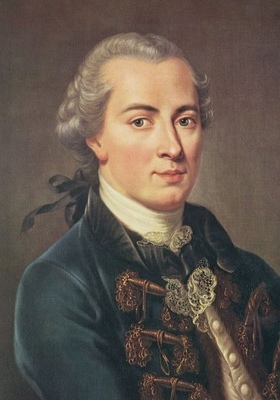
The eighteenth century led thought into a dead end. The English philosophers — Locke, Berkeley and, carrying the argument to its limit, Hume — reasoned like this: all we have are sensations, and sensations are relative (one man finds a thing sweet, another salty). It follows that we cannot prove the world exists outside our perceptions; and cause and effect itself is merely a habit of the mind, not a law of nature. But this undermined the whole edifice of science, which at that very moment was advancing by leaps and bounds. Philosophy had parted ways with reality. Kant called this "the scandal of philosophy" — and in 1781 he answered with the Critique of Pure Reason.
He himself compared the revolution he wrought to Copernicus. Copernicus halted the Sun and set the Earth turning. Kant did the same with knowledge: it is not the subject that conforms to the object in order to "copy" it — rather the object discloses itself to the subject only insofar as the subject is able to perceive it. We do not walk around the thing from outside; the thing appears to us, and exactly to the degree that we are made to receive it. A colour-blind man sees a different spectrum, a deaf man a different music; and none of us sees the green leaf whole.
Hence his famous distinction. What appears to us in experience is the phenomenon. And that which stands behind the appearance and grants it being is the thing-in-itself (the noumenon): it exists objectively, but can never be fully known. Here lies the world's rescue from the Humean disintegration: the world is — it simply cannot be reduced to our sensations.
His boldest move concerns space and time. We are used to regarding them as properties of the world. Kant shows that they are forms of our perception, the "optics" without which we could see nothing at all. Space is the form of the outer sense (its mathematics is geometry); time, of the inner sense (its mathematics is arithmetic). They cannot be "subtracted": close your eyes and the appearances vanish, yet time still flows on.
This also explains the very possibility of science. There are judgements that are neither derived from experience (they are a priori) and yet add to our knowledge (they are synthetic): "7 + 5 = 12" — the twelve is contained neither in the seven nor in the five, yet it holds always and before any experience. Both mathematics and physics rest on such "synthetic judgements a priori."
But reason has a limit. When it tries by the same means to step beyond experience, it goes astray: about the world as a whole it falls into insoluble contradictions (antinomies); about the soul as a thing, into spurious proofs (paralogisms); about God, into the illusion that His existence can be demonstrated by reason. Metaphysics is impossible as demonstration; it is possible only as critique — reason's honest knowledge of its own limits. And here Kant utters the words that lead straight into the drama of this site: "I had to limit knowledge in order to make room for faith."
God cannot be proved by the means of reason — but the moral law within us points toward a higher justice. For Kant, faith is not knowledge but a free step taken at the very limit of reason.