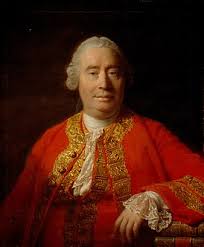
David Hume carried to its conclusion what others had begun before him. English empiricism advanced by stages: Locke declared that nothing in the mind is innate — only experience; Berkeley took the next step and dissolved matter into perception. Hume, a Scot from Edinburgh (1711–1776), pushed this line to its limit — and found that at the end of it almost nothing remains: no things, no causes, not even the "I" that supposedly perceives it all.
He begins with a simple observation. Everything we possess divides into impressions (what enters the soul vividly and forcefully — the taste of honey, the cold of water) and ideas — the pale copies of those impressions in memory. An idea is always fainter than an impression and always secondary: to a child who has never tasted anything sweet it is impossible to explain what "sweet" means. Every concept, then, must have an impression as its source; where there is no source, the word is empty.
Hume then turns this instrument against the most trustworthy things. Substance — that which supposedly stands "beneath" the properties and holds them together — corresponds to no impression. We see a green binding, gold lettering, pages — a "bundle of perceptions"; and the thought that behind them lies the thing itself is only a pale, habitual idea. We do not perceive an object outside us — we construct it.
The boldest stroke falls on the human being. If an idea is born of an impression, then where does the idea of the "I" come from? Impressions are changeable and succeed one another — nowhere is there a stable impression of oneself. Therefore, Hume concludes, there is no "me" as a substance either: a man is only "a bundle or collection of different perceptions, which succeed each other with an inconceivable rapidity." The mind is a theatre, where the scenes of perception come on stage one after another; but there is neither the stage nor the material out of which this theatre is made.
And finally — causality, the support of all science. We say: one thing is the cause of another. But what do we actually see? Only that one thing preceded another — many times over. From "after this" it does not follow that "because of this" (post hoc is not propter hoc). The bond of cause and effect is not in the world but in us: it is habit, the ultimate principle of all our inferences from experience. Adam, seeing water for the first time, could not have guessed that one might drown in it. What holds us back from complete collapse is not proof but belief — an almost animal instinct that the world will go on being what it was.
Hence his view of man: "reason is, and ought only to be, the slave of the passions" — it does not move us and cannot resist passion; only another impulse can resist an impulse. There is no free will in such a world, and the ground of morality is not the intellect but living feeling and a natural sympathy toward the good.
Gently, almost politely, Hume took apart the edifice of European thought brick by brick — and historians would later say that he "philosophically destroyed philosophy." Yet this very dead end proved fruitful. His books, by a famous admission, "awakened from his dogmatic slumber" Kant — and forced him to rescue both science and morality on a different foundation. What Hume called habit and a bundle of sensations, Kant would reassemble into the forms of reason itself. The end of one road turned out to be the beginning of another.