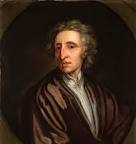
John Locke (1632–1704) is the father of two worlds at once: of modern theory of knowledge and of modern politics. An Englishman, a physician by profession ("Doctor Locke"), friend and secretary of the Whig leader the Earl of Shaftesbury, he lived through times of turmoil, fled with his patron to Holland, and returned in triumph after the Glorious Revolution of 1688. Out of his thought would later grow, almost word for word, English parliamentarism, the American Declaration of Independence, and the very idea of human rights.
He began with a simple and daring assertion: there are no innate ideas. Descartes held that the idea of God, of the good, of number, is planted in us from the start; Locke objects: what the soul is not conscious of does not exist in it — and an infant knows neither a theorem nor a commandment. Man comes into the world as a "blank slate" (tabula rasa), a white sheet without a single letter. Where, then, does all the content of the mind come from? "I answer in one word — from experience." And experience is twofold: sensation (external things give us color and extension) and reflection (the soul observes itself — thought, desire, pain).
Hence a subtle distinction of qualities. A snowball is white, round, and cold — these are primary qualities, in the object itself; but the pain of the cold is secondary, arising only in the encounter of the object with me. And behind all qualities stands the "real essence" of the thing, which is unknown to us: we know only the nominal essence — that which appears to us. In this Locke is a direct forerunner of Kant with his distinction between the thing "for us" and the thing "in itself."
But Locke's true sweep lies in the fact that from the theory of knowledge he derived politics. If man is not a subject by nature but a free, knowing reason, then "all men are free and equal to one another." Each has natural, inalienable rights: life, liberty, and property. Property arises where a person applies labor to what belongs to no one — he picked a berry, he felled a tree; and the very first property of each is his own body and powers.
To protect these rights, people conclude a social contract. And here Locke argues with Hobbes: in Hobbes, frightened men surrender everything to the monarch except life; in Locke, reasonable men cede only one right — that of being judge in their own cause — while keeping all the rest. Power belongs to society and is divided into branches — legislative, executive, judicial; the monarch is not "the anointed one descended from Adam" but a part of society, answerable to justice and removable. "The end of law is not to abolish or restrain, but to preserve and enlarge freedom; where there is no law, there is no freedom." And a state that does not protect the life and liberty of its subjects loses the very right to be called a state.
Locke was wrong in particulars — the "blank slate" did not stand the test of time: both religion and moral feeling turned out to be found among all peoples. But his greatness lies in this: he was the first to fuse into one the theory of knowledge, ethics, and politics — out of the image of man as a free, knowing, and good being the whole liberal tradition grew organically. And along his epistemological road went Berkeley and Hume — and carried experience to the edge beyond which both matter and the "I" itself dissolve.