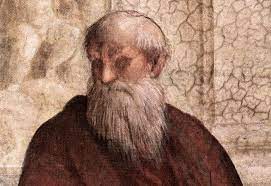
In the first centuries of our era, minds were ruled by materialism — not ours, but the ancient kind, which taught that everything that exists is body, and that even god is only the finest of matter. The Greek word for matter also meant wood, timber: the shapeless trunk from which one can hew both firewood and a statue. And a subtle question was born: which matters more in the finished statue — the wood itself, or the energy of the master who gave the inert substance its form? If the latter, then the world does not reduce to matter. In this age of great mingling, when the center of thought had shifted from ravaged Athens to Alexandria, there appeared a man who gave this question its boldest answer.
He was born around the year 205 in an Egyptian town and came to Alexandria to study. Having gone through teacher after teacher and found satisfaction in none, he heard the words of a mentor who never wrote a line, and exclaimed: "This is the one I was looking for." For eleven years he listened to him, then went east with an army — to learn the wisdom of the Persian magi — and in his later years opened a school in Rome. His treatises were collected by a pupil into six books of nine parts each — the Enneads, for nine was a sacred number to the Egyptian. As he lay dying, he left one charge: "Strive to unite the divinity within you with that which is all."
At the foundation of his teaching lies the One, taken from Plato and Parmenides. Any being remains itself only by virtue of its unity: break a chair apart, and there is no chair. Behind every multiplicity stands simplicity, and this ultimate, wholly indivisible simplicity is the One. It cannot be defined by any predicate, for every definition already introduces multiplicity; it is identical with the Platonic Good and lies beyond being — it is super-being, super-thought, the inexpressible. The One holds itself; it is the cause of itself.
But it is the nature of the Good to pour itself out without diminishing — as fire gives off heat without being spent. Thus everything flows from the One. First to be born is Mind, the Nous — the fruit of the One's reflection upon itself; in it dwell the Ideas, and these Ideas are the thoughts of God. Mind knows itself not by reasoning but by eternal contemplation. From Aristotle he takes the distinction between dormant power and power going forth, to explain the very outflow of light. Each thing carries its own, unique idea — its logos, the creative seed of being. Below Mind stands the Soul: it creates time as "the moving image of eternity" and is, in each of us, a part of the single Soul of the world.
And matter does not stand opposed to spirit as a prison to its captive; it proceeds from it. The whole world is form: form from idea, idea from Mind, Mind from the One — and matter is only the last, feeblest form, the fringe at the edge of the radiance, the exhaustion of the powers of the One, the fading of light as it recedes from its source. There is no evil as an independent essence, for everything is an outflow of the good One. Whence, then, the bad? Evil, he answers, lies not in being but in becoming: in decay, in matter that has failed to receive its form. Such matter he calls without mincing words — "a painted, decomposing corpse."
Where, then, is the soul to go? To ascent — a flight from the little "one" that each of us is, back to the One. He named four paths: virtue, love, the dialectic of reason — and, at last, ecstasy, a "going out of oneself," when everything superfluous is cast off and a metaphysical silence sets in. And here is the central nerve: the One itself does not descend to man — it is we who must open ourselves, and then the gods will come down to us. Man ascends by his own natural power, for his nature is divine and unimpaired.
Behind him stands Plato with his second voyage toward the higher foundations of being, brought here to a mystical intensity. And ahead lies Christian thought, which will take much from him and part with him in the most important thing: where he believed that man saves himself, it will speak of the necessity of sacrifice and of resurrection together with the body, not from the body. Saint Augustine will write whole pages of his light into his own "Confessions," and at the close of Russian thought his echo will sound in Vladimir Solovyov. So this thinker remained standing on the highest peak of the ancient mind — an eternal alternative to Christianity, and the background against which its face is seen most clearly.