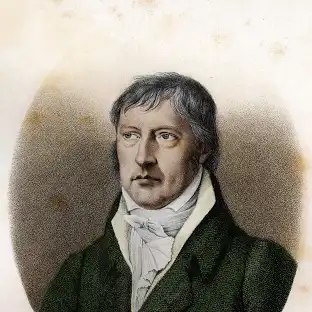
He was born in Stuttgart in 1770 and thoroughly studied the classics, philosophy, and theology. Unlike the brilliant friend beside whom he planted a tree of liberty as a young man, inspired by the French Revolution, he was no prodigy and thought with difficulty: his portraits show the face of a man looking within himself, and his philosophy is the same. Working on the Phenomenology of Spirit, he admired Napoleon, who had turned the world upside down, and secretly saw himself as just such a Napoleon in the realm of thought. His difficult language needs a key; once the key is found, the most intricate terms turn out to be surprisingly simple.
Everything rests on Absolute Spirit (Geist). This is not the God of Revelation, not a self-aware Creator in dialogue with man: spirit discloses itself through the thinking subject, and these subjects are human beings. That means spirit is humanity itself, gradually coming to know itself, nature, and nature's laws; history is the manifestation of spirit in reality. And the second half of the truth: spirit is always perfection — and so its self-disclosure in history unfolds correctly. Hence the famous formula: everything actual is rational, and everything rational is actual. There is no room for madness — only a rational process, and freedom as necessity recognized.
How does spirit move? Through dialectic — not the contemplative kind found in Plato and Aristotle, where the absolute stands at the beginning, perfect and unmoving, but a militant, spiraling dialectic with a triadic rhythm. Thesis, antithesis, synthesis — in truth, a struggle of opposites in which the third subdues the first two. He draws the purest example from spirit itself: the absolute is pure being — but being without qualities is nothing — and the union of being and non-being is possible only as becoming. Synthesis does not discard the contradiction but overcomes it. This is sublation (Aufhebung) — a word that means at once "to cancel" and "to preserve": the bud negates itself in the blossom, the blossom in the fruit, and no stage is superfluous.
In history, this becoming is the path of freedom. The despotisms of the East knew nothing of it; the Greeks and Romans became aware of themselves as free, yet kept slaves — and in doing so showed that they had not understood: freedom is the essence of every human being. The slave has no property and is therefore unfree, for property is the first, most primitive form of freedom: in owning a thing, a person is free to dispose of it. Only the Germanic peoples, under the influence of Christianity, were the first, in his view, to recognize freedom as the possession of every individual. The supreme union of property and freedom is the state, "the march of God in the world"; the citizen within it is a member of the body of the state, as a finger is to the hand.
But people do not know what they serve. Each pursues his own passion — a position, an inheritance, a beloved woman — and these self-interested wills collide and perish on the wreckage of one another; only the universal survives. This is the cunning of reason: passion is the weft from which the fabric of history is woven. Sometimes spirit acts through particular individuals — Caesar, Napoleon — whose aims coincide with the will of the world-spirit, and such men have the right to stand above the law. More often it moves through peoples, through the Volksgeist — the national spirit that predominates in its own age and one day yields its place to another.
The Phenomenology of Spirit is a science of appearances, of how spirit appears to consciousness and travels the path to itself. Consciousness ascends by stages: perception of the external world, self-consciousness, reason (which contemplates and transforms the world), spirit (reason realized by a free people), then religion, and finally absolute knowledge — the philosophical self-knowledge of the absolute. Here he inverts Aristotle: not "there is nothing in the mind that was not first in the senses," but, on the contrary — we are conscious, and therefore we feel. Logic coincides with ontology, for to think and to exist are one and the same.
Behind him stand Kant with the transcendental unity of consciousness, Fichte with the movement and boundlessness of the "I," Schelling with the philosophy of identity and the national spirit; he regarded all of them as mere preparation for himself and held that in him spirit had disclosed itself completely — the goal of being achieved. Here lies the fault line. The method — dialectic, the capacity for synthesis — remains the greatest discovery of thought. But the teaching on the people, the state, and history would later split in two: his leftward heirs would carry the negation of property to socialism, his rightward heirs the deification of the state to other, darker outcomes. And a man for whom what matters is not uniqueness but only his role as vessel of the spirit would echo through the twentieth century in a way that leaves no room for rejoicing.