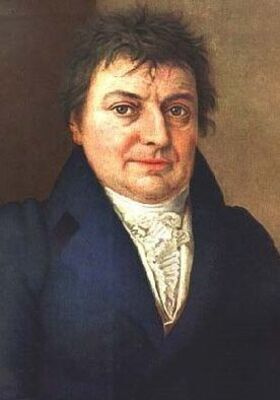
He was born in 1762 into a poor peasant family in Saxony and as a boy tended geese — nothing, it would seem, foretold a great philosopher in him. Chance proved to be a door: a passing baron regretted having arrived too late for the sermon of a famous pastor, and someone pointed out to him the little goatherd who was able to repeat that sermon word for word. Struck by the boy's memory, the baron took his education upon himself — a boarding school, then the faculty of theology. Thus from a gooseherd a thinker grew, in whom Romanticism recognized its most rigorous and honest face.
At first he was captivated by Spinoza — that is, by a world where everything is predetermined and there is no freedom of the will. The turning point came when he almost by chance opened Kant: reading the "Critique of Pure Reason," he saw, by his own admission, horizons of freedom of which he had previously known nothing. At thirty he wrote the "Attempt at a Critique of All Revelation," a work approved by Kant himself — and all-German fame came, together with a chair at Jena. His philosophy is subjective idealism, an audacious development of Kant: the thinking, knowing "I" he transforms into a creating "I," which in freedom posits both itself and all reality. Friedrich Schelling and his circle held that Romanticism was created by three things: Fichte's doctrine of science, the novel of Wilhelm Meister, and the French Revolution.
The chief labor of his life is the doctrine of science (Wissenschaftslehre), which he refined until his death. The method here is utterly strict. If science since Aristotle rests on the law of identity — "A equals A" — then Fichte begins with the formula "I equals I." This is self-positing: the "I" becomes aware of itself and in that same act creates itself. Hence the astonishing conclusion — being follows from action. For God is pure force, pure energy, pure act; and your "I," identical with the absolute, is first of all deed and only afterward being.
In Kant the thing-in-itself is unknowable. Fichte answers: the "I-in-itself" is not a fact but an act, a pure self-contemplation. Reason is active and absolute, for it is the highest principle: nothing precedes it, it does not depend on being but itself gives being. Reason has no creator — because it is itself God; the uncreated within you is you yourself. From the first principle a second grows: the "I" posits the not-I. All that is distinct from me I can perceive only because it abides within me. And a third, the synthesis: the "I" and the "not-I" limit one another. Here is where the strict sense of responsibility is rooted: I am free for myself — but responsible for you.
Thus into first place comes not contemplation but will and activity — practical reason, moral action. God, for Fichte, is not a substance but a moral order, an ought, an idea living in the graced deed. Hence his ethics: the scholar who has become aware of his kinship with the divine is obliged to be the best of the best, for his task is to move humanity toward the absolute "I." This is a responsible Romanticism, unlike the demonic kind: not "to me, the genius, all is permitted," but "since you have come to know the divine within yourself — kindly live up to it." Both law and the state are needed only in order to limit my freedom for the sake of another's freedom — hence his liberal principle.
In his later years, after 1800, the emphases shift: if formerly the "I" stood in first place and God as it were echoed it, now it is the reverse — the "I" becomes a reflection of God, knowledge as the image of God in man. "God is beyond His own being — in us," he writes. Science, for him, is a mystical union with the absolute. Outside the divine life there is neither being nor life, and death is not the destruction of the "I," for the "I" is not the body but the divine action itself: eternal reason leads our souls from mission to mission, consuming what we call death — "we are eternal, for He is eternal."
In this lies the essence of a serious Romanticism, one that places God in first position and rediscovers the thought of the kinship between man and the divine. Fichte grows directly out of Kant, carrying his freedom to the limit — to the active, creating "I." But his work has a sequel too: the same impulse feeds the natural philosophy of Schelling and the grand system of Hegel, for whom "all that is actual is rational." Thus the little gooseherd from a Saxon village became the bridge over which German thought passed from Kant to its loftiest peaks.