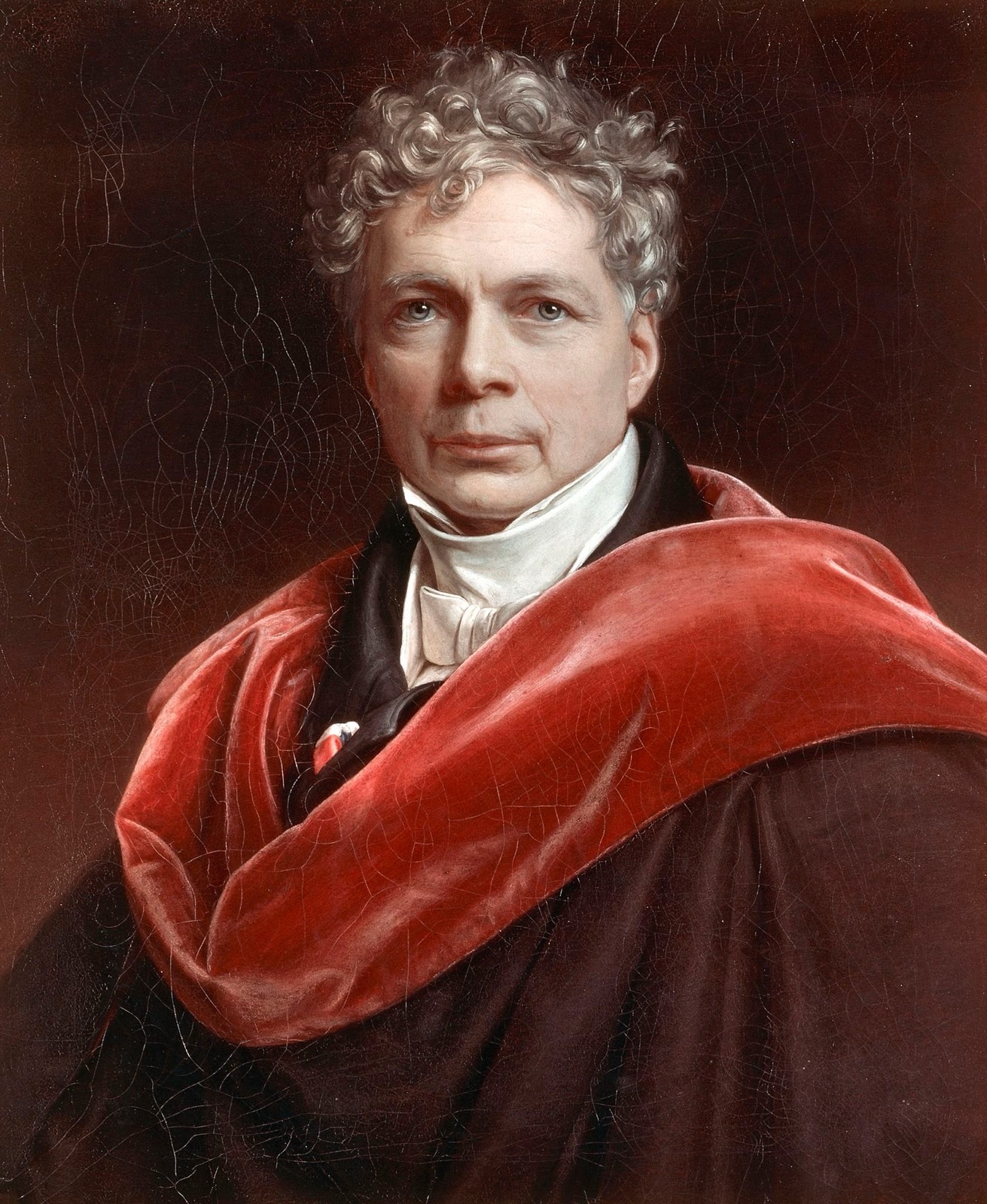
He was born in 1775 into a pastor's family and from childhood was reckoned a prodigy: at twenty-three, without defending a dissertation, he took a professorial chair — a thing unheard of in Germany. All his thought grew out of its epoch. Europe after the French Revolution and the Napoleonic wars was undergoing an upheaval that changed the very consciousness man had of himself. This crisis of spirit was cast in philosophy into two great answers — his own and Hegel's; and though the world followed rather the second path, it is the first that preserves that depth which is rediscovered to this day.
Developing Fichte and supplementing Kant, he begins with natural philosophy. Nature, for him, is not dead extension nor a sum of inert substances — it is visible spirit, as spirit itself is invisible nature. Between them there is not that chasm which Bacon and Descartes drew when they divided extended matter from the thinking "I." Nature is primary and yet strives toward a higher goal — to become an object to itself; and it attains this in no other way than in man, that point where for the first time it reflects, turns back upon itself, and comes to know itself.
From this grows his philosophy of identity, or transcendental idealism: subject and object are one, the knower and the known are a single thing. But he does not, like Fichte, dissolve the object in the subject; nor does he, like Spinoza, dissolve man in the Absolute, where there is only God and man is a fleeting phenomenon of Him. The Absolute, for him, is the coincidence of opposites: of subject and object, conscious and unconscious, being and thought. Between the real and the ideal there is no causal link: they are joined inseparably, and this unity is not deduced logically but grasped only by intellectual intuition. Herein lies his chief dispute with Hegel, who placed reason and logic at the head of everything.
If identity falls apart — and it falls apart already at the moment when the "I," having become aware of itself, separates from the world — then it is art that is called to restore it. The painter, depicting a landscape, does not repeat nature as a photographer does every twig and needle; he singles out the essential, strengthens something, passes over something in silence, brings himself in — and therefore the world he depicts is at once objective and subjective, nature filled with the personality of the master. And so art is the highest organ of knowledge and the only revelation of the Absolute: philosophy touches only the intellectual particle of man, whereas the beautiful seizes the whole man — which is why the halls overflow at exhibitions, and the listener weeps where the philosopher is left ununderstood.
At the heart of creation lies the unconscious. A genuine work is recognized by the fact that in it there is something beyond the creator's will — that inexhaustible depth which the clarity of the understanding alone cannot give; and this is why true art surpasses nature. Beauty, in his words, is nature seen through the prism of man and pervaded by moral goodness. From the unconscious in the individual he proceeds to the collective unconscious: to language, which no single man invented, and to mythology, which is born not of an individual but of the creativity of a people that has become aware of itself in a revolutionary age as a collective subject.
A catastrophe of the soul — the death of his ardently beloved wife in 1809 — almost silenced him as a writer, but not as a thinker: for years he lectured on the philosophy of mythology and the philosophy of revelation. God, for him, is now not a sum of rites but a Person, in whom a dark, blind principle and a principle rational and luminous do battle; God is not complete, else there would be no need for creation, and matter is His unconscious part, called to return to Him. Existence cannot be reduced to essence — these words of his would later become the seed of a whole philosophy, and to the negative philosophy of reason he opposed a positive philosophy, in which God is no longer a collective creation but Creator and Savior.
This late, personal path — the return from the collective to the person, to the living dialogue of man with God — Europe scarcely heard; his contemporaries forgot him. He felt a close kinship with Russia, chafing at the narrow bounds of Lutheranism, and his echo is heard in Vladimir Solovyov. Setting out from Kant and Fichte, standing beside and at the same time against Hegel, he remained that unrealized yet alluring alternative which the twentieth century discovered anew — as another, unrepealable path of new European thought.