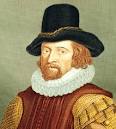
He lived at the breaking point of one age into another. The Earth was ceasing to be the motionless centre of creation and turning out to be merely one body among many, wheeling through the void; the heavens, long held to be flawless, were found to be blemished and to trace irregular, elliptical orbits. Behind all this lay a disquieting thought: if an unerring intellect builds a picture of the world that does not match experience, then it is not the world that errs but the intellect itself that is imperfect. From this humility a new road to knowledge was born — and its greatest interpreter was an English philosopher, minister, and prisoner of his own fate.
His central turn is simple, and for that very reason revolutionary: man does not hover above nature, contemplating her eternal patterns — he is part of nature and must study her from within. "Nature can be commanded only by obeying her," he liked to repeat. The old science moved from mind to world: from the head it derived the perfect form — the sphere, the circle, the ideal globe — and forced stubborn facts to fit it. He mocked this habit: there is no ideal form at all, only a form suited to the eye or the joint, and a form useless for a fortress wall. What we need to know is not the invented but the actual.
To his method he gave the name the New Organon — a direct challenge to the logical legacy of Aristotle, whose "Organon" had served scholasticism as its instrument for centuries. In place of deduction, which draws particulars from ready-made first principles, he set induction: to gather a multitude of facts from nature, draw a conclusion, and test it by experiment. He drew the image of the thinker through insects. The empiric-collector is like the ant: it drags everything into the anthill without generalising. The schoolman is like the spider: it weaves a web out of itself, connected to nothing in the world. But the true philosopher is the bee: it gathers nectar from many flowers and transforms it into the honey of science.
Yet before one can build, the mind must be cleared of its delusions. Here lies his most famous legacy — the doctrine of the four idols, the false gods of knowledge. The idols of the tribe are rooted in human nature itself: we impose more order and harmony on the world than it in fact holds. The idols of the cave are the private predilections of each person, through which he crookedly interprets the whole world. The idols of the marketplace arise from language: words that mean nothing, or are used wrongly, lead thought astray. The idols of the theatre are the power of received philosophical systems, taken for truth. The investigator must exclude himself from the experiment, must objectify it — an unheard-of audacity for a science that had once sought God in the contemplating mind.
To what end? To grasp the forms of things — not their outward appearance but their hidden essence: what fire is, what heat is in itself. Having understood the form, man will learn to combine the principles of nature and to create the new — to fuse metals, to build machines. Knowledge becomes power in the most precise sense: "human knowledge and human power meet in one, for where the cause is not known the effect cannot be produced." Three things, he reminded us, had overturned a world unknown to antiquity — and they were born of reasoned inquiry, not of chance: gunpowder, the compass, and printing.
For all that, he remained a believer, holding that a little knowledge leads away from God, but a great deal leads back to Him: the world, described as it truly is, itself bears witness to its Creator. His vision of the future he bequeathed in the utopia "New Atlantis," whose heart is "Solomon's House" — an assembly of scholars seeking truth together; from that dream the Royal Society would soon grow. And his life ended in keeping with his work: he caught a chill trying to preserve meat by cold, and died — his last experiment costing him his life.
He cannot be called a discoverer of the laws of nature — he was neither mathematician nor astronomer. He did something else: he gave science self-awareness, explaining how to work in a new way — not from the head but from experience. In this he opened the great line of empiricism, along which after him would walk John Locke and David Hume; with the darlings of scholasticism — Thomas Aquinas and his like — he settled accounts without mercy. But his triumph had its shadow: along with the imperfection of the mind, men soon forgot the imperfection of man himself, and fallen man made himself the measure of all things. So his method gave the world both power and a new illusion — that the natural is itself the perfect.