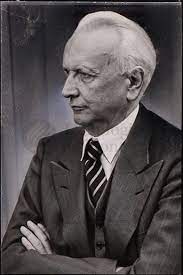
The twentieth century brought man not triumph but disillusionment with himself. After centuries enchanted by reason and by faith in progress, the cultured European suddenly saw himself as a "skeleton in the wind," flung into an alien and absurd world. Out of this horror was born existentialism — a worldview in which man is no longer the builder of the universe but the project of himself: a being that is only what it has resolved to be. The movement had two most powerful German voices. One, Martin Heidegger, turned the repellent ideology of his time into lofty poetry and remained a liar. The other managed to be honest to the end. That is Karl Jaspers.
He came to philosophy from far off: the son of a bank director, he exchanged law for medicine and psychiatry, where his teacher was Max Weber. His doctoral work in psychopathology imperceptibly grew into philosophy, and from 1919 Jaspers was a professor at Heidelberg. And then disaster came. In 1937 he was stripped of the right to teach: Jaspers's wife was Jewish, and every day for eight years he waited for them to come for him and to lead her off to the gas chamber. They did not part, they did not go into hiding — they stayed together. And when the Reich collapsed, he, unable to bear what he had lived through, surrendered his German passport and left to teach in Switzerland.
His thought begins at the boundary of science: knowledge only orients us in the world, while true philosophy devours science from within with uncomfortable questions. Being itself is an abyss, the source of every thing, which he calls the Encompassing (das Umgreifende). It can be grasped not by the understanding, which splinters things into concepts, but by reason — the voice of the abyss itself within us. Hence the central point: existence cannot be objectified. "I exist insofar as I do not allow myself to become an object," he writes. I am identical with my situation: with this people, these parents, this beloved person. I am free to abandon it all — but in doing so I would only betray myself, for I am the very reality out of which one cannot step.
Where, then, does the transcendent open to man? Not in rest and satiety, but at the edge. Struggle, suffering, unatonable guilt, death as reckoning form what Jaspers calls boundary situations — and he himself knew them all too well in the years of persecution. It is precisely here, when the project of "self-building" suffers shipwreck, that man sees the other and sees himself in the light of the other. The Encompassing is not a personal God whom one could depict; but it reveals itself through personality, and that countenance may be beautiful or terrible. The language in which the transcendent is encoded Jaspers calls ciphers, and human depth itself — existence illumined by reason.
But one cannot break through to the truth alone. Truth, for Jaspers, is bound up with personal existence and is therefore unique: "I am my truth." And yet only through communication, through the intercourse of unlike minds, does man find himself. The single Truth is reflected in people as in a multitude of mirrors — differently, sometimes cloudily, and some mirrors swallow the light altogether; but the small rays of honest mirrors, joining together, shine even in a terrible world: "the path of humanity is a dialogue of the unlike." And since totality is unattainable in either knowledge or action, every attempt to establish it by force turns into violence. The philosopher's duty is therefore not to hide in an ivory tower but with freedom of thought to stand against false "totalities."
In this consists his philosophical faith: "in the philosopher we seek the illumination of being" — not dogma and not proof, but a man's resolve to become free, truthful and reasonable, to make the choice between good and evil. In old age Jaspers put together a book on the great philosophers, setting side by side, across cultures and epochs, Confucius, the Buddha, Christ, Immanuel Kant, Plato, Augustine. In this bringing together of distant names sounds his surmise of the Axial Age — that common dawn when, in different corners of the earth, humanity turned all at once toward the meaning of being.
The significance of Jaspers lies in his having held philosophy at the height of honesty where his brilliant contemporary broke down: beside the poetic but fallen thought of Heidegger, his word sounds drier and more courageous. The source of this path reaches back to the eccentric Dane Søren Kierkegaard, whom all the existentialists regarded as their forerunner. And behind Jaspers stands Kant too, with his faith and the limits of reason: for philosophical faith is that same daring to think at the very edge of the knowable, where science ends and man begins.