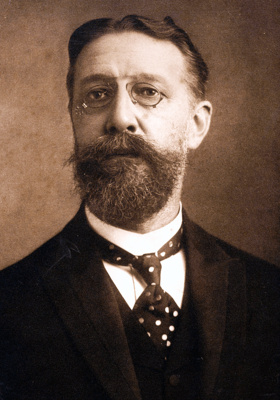
He was born in 1864 in Erfurt, and under his parents' roof he first met what would become the axis of all his thought — the clash of values. His father, a liberal politician, loved life with all its comforts and knew no inner discipline; his mother, from a Calvinist family, kept the stern faith of her forebears and a strict self-restraint in everything touching the flesh. The boy took his mother's side — and this quiet fault line would later grow into a great theme: how the religious spirit imperceptibly shapes the economy and the very cast of life.
His craft he called interpretive sociology: the scholar's task is not to invent a "spirit of the people" but to understand the aims that a living human being sets before himself. For only individuals are real; nations and classes are but the sum of the acts of particular persons. He distinguished four types of social action: instrumentally rational (an engineer builds a bridge), value-rational (a captain is the last to leave a sinking ship), affective, and traditional (I pray because my grandmother prayed). And so that the chaos of causes should not lead off into a bad infinity, he introduced ideal types — mental models that do not exist in pure form but against which the living is measured. Hence the commandment: science is free of value judgments. The scholar can say what a design will cost and whether it will come to pass, but he has no right from his lectern to decide who is guilty and how one should live.
Society, by his observation, moves from traditional domination, where the established order is revered as given from time immemorial, through charismatic domination — the power of the prophet, the leader, the miracle-worker — to legal-rational domination, resting on law and profession. Here is his nerve: the son of a Prussian official, he saw in an incorruptible bureaucracy, where men are promoted by examination and not by kinship, the engine of development. But he also recognized its reverse side — the "iron cage", in which man becomes a function. An apparatus without a bridle serves itself and stifles society; only democracy and the free market save it, and it is between these that the cage alone works for the good.
His famous insight — "The Protestant Ethic and the Spirit of Capitalism" — would in fairness be better called a Calvinist ethic. In the doctrine of predestination, man can earn salvation neither by deeds nor by thoughts: God Himself has chosen some for life, others for perdition, and His purpose is impenetrable. Between man and heaven lies an abyss; the sacraments are abolished. Where, then, is one to put one's hands? Calvin answered: labor for the glory of God, build the Kingdom on earth — and success in labor becomes an indirect sign of election. Thus is born an unheard-of kind of man: he earns honestly, but dares not turn his wealth upon himself — he saves, plows the profit back into the enterprise, lives modestly. Asceticism gave rise to accumulation. It is no accident that Europe's economic center shifted from the Catholic cities to the Calvinist ones; the Eastern Christian ideal of the deification of man, by contrast, only hindered capitalism.
Behind this stands something still broader — rationalization and the "disenchantment of the world." Modern man ceases to expect help from higher powers: events are wrought not by the will of the gods but by men themselves. Capitalism he defined as the striving for the greatest profit under rational discipline: not a venture but a calculation. And here he went against the grain of the current Marxism: it is not the economic base that gives rise to culture, but the highest form of the spirit — religion — that lies at the foundation of economic and political forms. To explain everything by the "driving forces of the economy" he called the naïveté of dilettantes.
His significance is hard to overstate: he completed the path begun by Auguste Comte, making sociology a rigorous science, yet refusing to reduce society to natural-scientific "laws of progress." In method he considered himself an heir of Immanuel Kant: it is not the facts themselves but the researcher's relating of them to values that selects what is worthy of study. And yet his late voice is bitter. It has fallen to us, he said, to live in an age bereft of a prophet, where the highest values have withdrawn from common life into the narrowness of mysticism and the fraternal circle. This godless world he felt more keenly than Friedrich Nietzsche and more anxiously than the singer of the decline, Oswald Spengler. And the last word he left not to science: which of the values is for you from God and which from the devil — the choice is man's own.