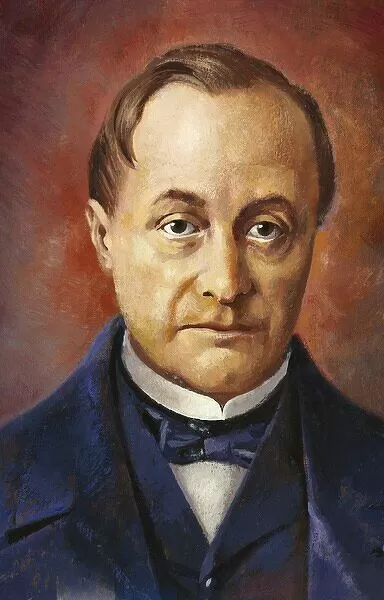
There are countries that think calmly, and there are countries that think in fire. While the island — Britain — after its almost bloodless revolution slowly grew rich and argued about economics, the continent was shaken by wars, revolts, and great ideas. Across it rolled Romanticism with its cult of the people as a single whole, and France burned along with everyone else. It was on this scorched soil, amid the wreckage of the old orders, that there arose a teaching which gave its name to a whole epoch of the mind — positivism. The word is dry, almost businesslike, and therein lies its whole essence: what counts is only positive knowledge — tested by experience, demonstrable, scientific. Everything else is conjecture, tradition, a metaphysical fog that must be dispelled.
The nerve of this teaching is utterly simple and utterly daring: science as the sole value. Not faith, not imagination, not the habit of the fathers, but only what can be established, measured, and generalized into a law. This line reaches back far — to English empiricism, according to which all reliable knowledge grows out of experience; so reasoned David Hume already. But positivism takes a step on which no one had dared before: it turns the strict method of the natural sciences upon man himself. Man ceases to be a mystery and becomes a social object — material for study. Society and the individual are to be calculated as coldly and precisely as the motion of the planets.
The whole century dreamed of this. It seemed that a little more, and it would prove possible to know the personality to its very depths, and hence to predict its behavior with the same precision as natural processes. An alluring dream: a world in which nothing remains ununderstood, where the human soul is broken down into causes and effects and therefore fully governable. It was precisely this heedless faith in an exhaustive science that was the real promise of positivism — and its hidden danger.
This danger was discerned by a man who knew the founder of positivism not from books. John Stuart Mill was personally acquainted with him, met him, and, by some accounts, attended his lectures — and his criticism carried all the more weight for it. In a work of 1865 devoted to positivism, Mill objected: science cannot be the sole value, and the study of man as a social object does not exhaust man. And the conclusion proved formidable: the attempt to exhaust man by scientific fact turns him into a machine that must be governed — and from there the road leads straight to despotism.
Mill's objection is elegant to the point of simplicity. If man is a machine, then the one who governs him is just such a machine too; and one machine cannot become a despot over its equal. A living society rests on something else — on the collision of free beings, never fully knowable and therefore never fully governable. It is precisely this incomplete transparency of man, this freedom remaining within him, that makes the life of society mobile rather than dead. Here, too, sounds the cherished thought of English thought in that period: what is real is not the mass, not an abstract "humanity," but each separate, unrepeatable human being.
Herein lies the significance of the figure who opened the door to a science of society: positivism was the first to demand in earnest that human life together be studied rigorously, as one studies nature, and along this path the great sociology would later travel — all the way to Max Weber. But alongside the proud precision of the method there remained forever the warning of its critics. One can describe man with laws and numbers — and yet something in him will slip away, will not fit into a formula. And so long as it slips away, he is free. It is on this fine gap between positive knowledge and the inexhaustible mystery of the person that stands the whole dispute which positivism bequeathed to the century that came.